
A pro-Brexit banner is seen outside the Houses of Parliament in London on Oct. 30. 2019.
Time is running out for the European Union and the United Kingdom to reach a free trade agreement before Britain's scheduled exit from the EU single market on Jan. 1, 2021. The second round of negotiations, which ended on April 24, failed to produce significant progress, leaving only two more rounds of scheduled talks before London has to decide whether to extend its participation in the single market in late June. Because of their very close trade ties, the European Union and the United Kingdom want to reach a deal — the only questions are when, and under what terms. As both sides reckon with the economic fallout from the COVID-19 crisis, a limited trade agreement that preserves the status quo of U.K.-EU trade relations as much as possible, or an extension of London's membership in the single market, will become increasingly likely in order to avoid a disruptive "no-deal" exit that neither Brussels nor Britain can afford.
Avoiding an Abrupt Exit
The European Union is open to pushing back the deadline for the United Kingdom to exit its single market, but U.K. Prime Minister Boris Johnson has insisted his government will not ask for such an extension. In 2019, a majority of the members in the House of Commons were against such a hard British exit from the European Union. Johnson's Conservative Party has since secured a comfortable majority, granting him much more leeway to direct the United Kingdom in whatever direction he wants, including leaving the single market without a trade deal. But while Johnson now has the political leverage to pursue a no-deal exit, Britain's increasingly grim economic situation amid the COVID-19 crisis will still deter him from doing so.
According to the International Monetary Fund, the British economy is now expected to contract by around 6.5 percent this year due to the fallout from COVID-19, while unemployment may reach 8 percent of the active population from roughly 4 percent at the start of 2020. The full economic impact of the pandemic, however, still remains to be seen. The more serious the economic downturn, the more likely London will be to reach a deal with Brussels, even if it means backtracking on previous promises on issues such as fishing rights or single-market alignment. A similar logic will influence EU decisions, as the bloc's main governments are not interested in the collapse of the negotiations at a time when the entire continent is in a recession. Brussels would thus swiftly authorize Britain to remain in the single market beyond Dec. 31, should London ask for an extension.
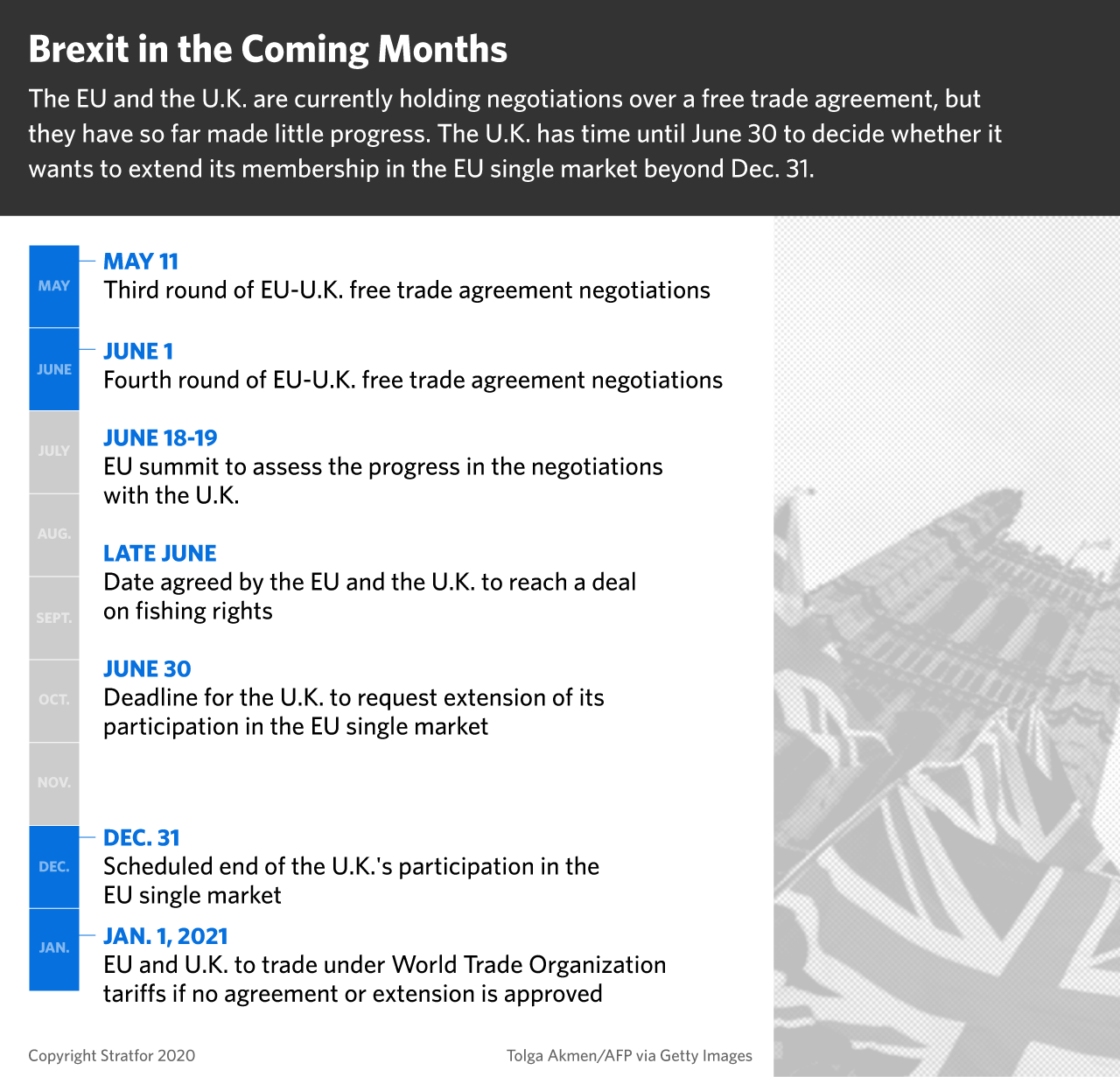
Amid the COVID-19 pandemic, London and Brussels will probably seek to avoid a hard exit from the single market, which would only create additional problems at a time when their economies are both in deep recessions. But even in this extreme scenario, trade under WTO tariffs in 2021 would probably be only a temporary situation, as the sharp economic toll would force both sides to return to the negotiating table at some point later in the year. In the meantime, EU-U.K. trade would be severely affected.
Obstacles to a Comprehensive Deal
An outcome in which the two sides reach a comprehensive free trade agreement in 2020, however — which is European Union's preferred option for the current phase of negotiations — also remains unlikely. due to the following obstacles:
- Timing: London and Brussels held the first round of talks in early March, but the second round was delayed by six weeks due to the COVID-19 outbreak in Europe. The negotiators now have only two months to make progress before the June 30 deadline for the European Union and the United Kingdom to decide whether to extend Britain's membership in the single market beyond Dec. 31.
- Logistics: Because of the quarantine measures in Europe, British and EU negotiators now hold their meetings via videoconference, a mechanism that is not nearly as effective as face-to-face talks. Both sides have complained that virtual meetings are highly inefficient and have created additional complications for a deal.
- Conflicting interests: Brussels' proposed comprehensive deal would keep Britain aligned with EU rules on areas such as taxes, state aid, workers' rights and environmental norms. Brussels also wants the agreement to preserve member states' current access to U.K. fishing waters, and to grant London's competitive financial services sector access to the European Union market only if it fully meets European standards. The United Kingdom, however, wants a deal that not only removes tariffs for most goods, but allows London to also move away from EU single market rules and to be able to freely sign free trade agreements with other countries around the world. There are precedents for compromises on these tricky areas: the European Union has an agreement with Norway that establishes fishing quotas for EU members, and also grants other non-EU countries such as Switzerland access to parts of its financial sector. The problem is that these agreements are negotiated on an annual basis, which conflicts with London's goal of a long-term deal on financial services, as well as Brussels' vision of a permanent deal on fishing rights.
The more comprehensive the trade agreement, the longer the negotiations will take. Given the short timeline, combined with the logistical limitations, it will be all but impossible for the European Union and the United Kingdom to find a consensus on their many outlying issues before the end of the year. And even if the United Kingdom asks for an extension, the complexity of the deal would result in the talks continuing well into 2021.
The Most Likely Scenarios
With the European Union and the United Kingdom both interested in avoiding a no-deal U.K. exit from the single market in 2021 in light of the COVID-19 pandemic, and their conflicting goals impeding the possibility of quickly reaching a comprehensive deal before the Dec. 31 deadline, the following two outcomes are now the most probable:
- A limited trade deal: As time runs out, Brussels could abandon its plans for a comprehensive trade deal and accept a more limited deal that is complemented with smaller sectoral agreements. Such a "bare-bones" deal, which is the United Kingdom's preferred option, would cover most goods and a limited number of services, plus a series of sectoral deals on other areas. Temporary deals that are meant to buy time and reduce disruptions will become more likely as the Dec. 31 deadline approaches, especially if the United Kingdom honors its pledge and does not ask for an extension of its membership in the EU single market. This scenario would still create problems for those sectors not included in the main deal or the sectoral agreements (this is a great risk to the United Kingdom's financial services sector, in particular).
- No trade deal and a single market extension: The severity of the pandemic-induced global recession could force the British government to abandon its official position and stay in the single market beyond 2020. This would be controversial within Britain's governing Conservative Party, as it would force the country to continue making financial contributions to the EU budget. But the extraordinary circumstances created by the COVID-19 pandemic would allow Johnson to change his position without paying a high political price in order to preserve the United Kingdom's crucial trade ties with Europe at a time of increasingly deep economic uncertainty. This outcome would preserve the current status quo into 2021 (which means that there would be no major economic disruptions). But it would also continue the long-term uncertainty about the final shape of EU-U.K. relations.
