
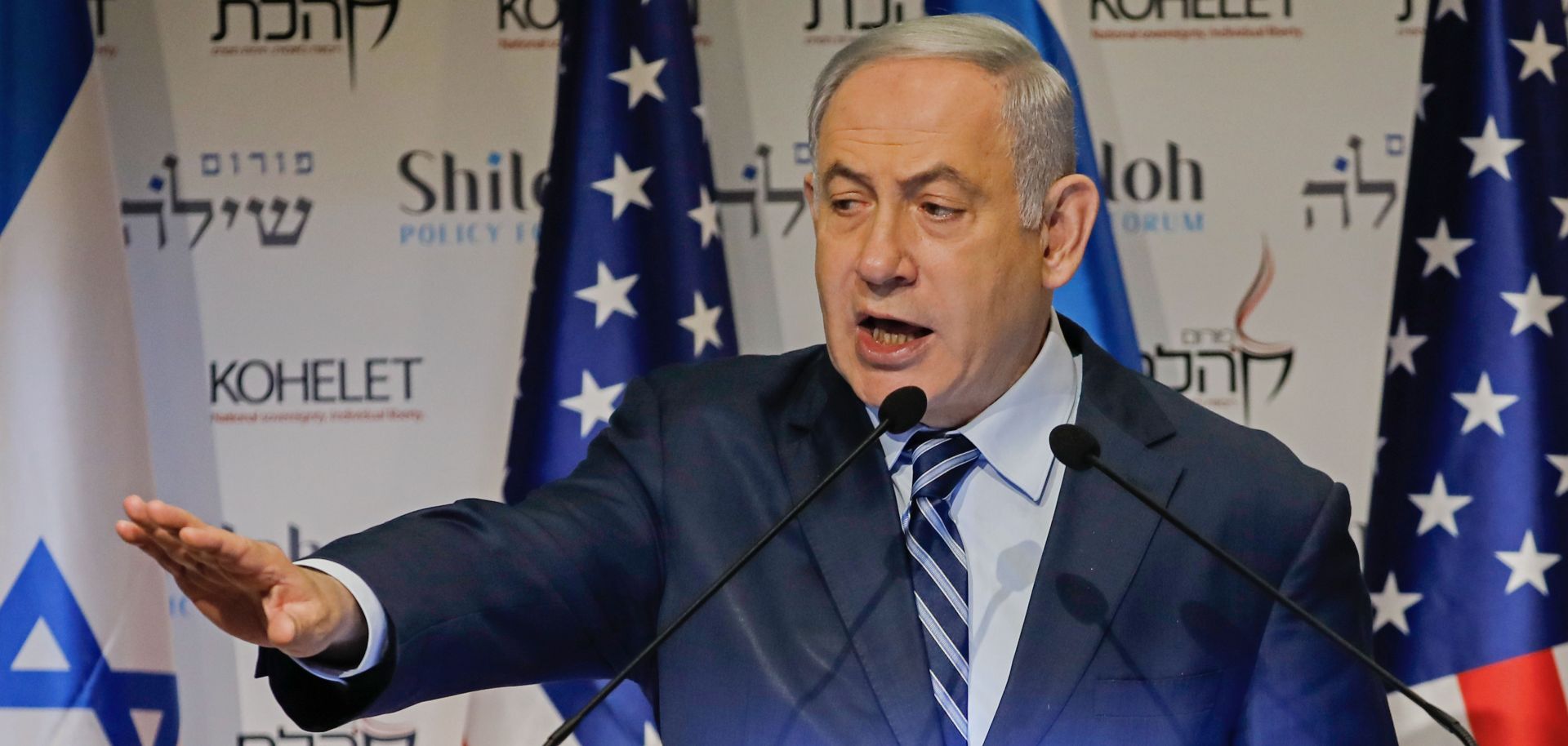
Israeli Prime Minister Benjamin Netanyahu speaks at a Jan. 8 policy conference in Jerusalem. Netanyahu said Israel would retaliate with a "resounding blow" if attacked by Iran over the U.S. killing of Qassem Soleimani.
A more aggressive U.S. strategy is letting Israel dial back its own threats against Iran. Typically willing to tie U.S. and Israeli regional efforts together, Prime Minister Benjamin Netanyahu has attempted to distance his country from the recent U.S. assassination of the Iranian Quds Force commander Qassem Soleimani, reportedly saying that Israel was "not involved" in the event and "should not be dragged into it." And in response to Tehran's declaration that it would no longer adhere to the stipulations on uranium enrichment in the Joint Comprehensive Plan of Action (JCPOA) nuclear deal, Israel's energy minister said it was still "too early to say" if the move meant Iran was actually chasing a weapon, marking a notable break from Israel's often alarmist rhetoric on Tehran's nuclear program.
For Israel, this unusually subdued response represents a temporary tactical shift: For now, it will allow current U.S.-Iran tensions to play out while letting Washington take the brunt of the risk of regional conflict. But there's a limit to how long Israel will stand idly by. If a lack of U.S. action allows Iran to close in on building a nuclear weapon, or if it looks as if U.S. President Donald Trump may lose his reelection bid to a successor less willing to stridently back an anti-Iran strategy, Israel will quickly retake its place at the driver's seat with even more fervor to strike its regional archnemesis. As 2020 unfolds, the risk of Israel-induced regional conflict will thus largely depend on how U.S. politics shape up ahead of November's presidential election.
America's Pain, Israel's Gain?
Israel's attempt to distance itself from the recent events between the United States and Iran is partially a product of current domestic politics. Israel has an election on March 2, and Netanyahu does not want to stir up a conflict before then as he yet again faces a narrow path to victory. Fanning the flames of U.S.-Iranian tensions right now would also risk opening a northern front in Lebanon against Iran's capable proxy Hezbollah, which has threatened to attack Israel should Washington further escalate against Tehran.
But perhaps most important is the fact that the Trump administration's heightened focus on Tehran has created an opportunity for Israel to fulfill its anti-Iran strategy without exposing itself to as much risk as it would by doing it alone. One of Israel's primary objectives is deterring Iran's regional proxy forces and the Iranian leaders who support them. And by striking Iraqi Kataib Hezbollah and killing Solemani, one of Iran's most powerful proxy force organizers, the United States, has helped do just that. Washington's apparent willingness to take the lead against these proxy forces and leaders means that Israel can, for now, refrain from attacking Iran's proxies in Iraq as it did over the summer.
The United States' current, hard-line stance on Iran has also allowed Israel to temporarily ease off its attempts to prevent an Iranian atomic bomb. In this, Israel's primary strategy has been to get Washington, and by extension the international community, to bring back the crushing sanctions regime that would isolate Iran enough to abandon its nuclear program. And that strategy is increasingly being achieved thanks to the Trump administration, whose push to keep the U.S. sanctions regime intact has prompted Iran to continuously step away from the JCPOA, alarming Europe in the process. As a back-up plan, Israel has also long threatened to strike Iran's nuclear program itself. In addition to a direct military threat, this approach is also a diplomatic pressure strategy meant to signal that Israel is willing to trigger a regional conflict with Iran if the international community does not take strong enough action against Tehran. But with Washington now telegraphing its own intent to strike Iran, there's far less need for Israel to echo the same sentiment.
Bringing Israel Back to Escalation
The conditions allowing Israel to temporarily stand down from Iran, however, are all dependent on U.S. behavior, which will likely change ahead of the 2020 election. And for that reason, Israel will no doubt be watching closely for how the election season unfolds in the coming months, as it could not only make the United States more risk-averse but may result in a more permanent shift in U.S. policy on Iran. Given Netanyahu's close ties with the White House, Israel can expect U.S. pressure on Iran to remain strong for as long as Trump remains in office. But should Trump fail to secure a second term in November, a less hawkish successor may attempt to revert to prior U.S. policies on Iran and undermine the current isolation campaign.
However, Washington's commitment to the anti-Iran front will start to waver long before Americans head to the polls. The 2020 election is likely to be a close one, and a sudden war — especially one that involves casualties — will be a risky bet for the Trump administration. As the election season unfolds, the United States may, therefore, grow more conservative in the face of Iranian provocations, whether that's new harassment or further developments in its nuclear program. The Trump administration's preoccupation with campaign season, meanwhile, could give Iran breathing room to develop both its nuclear program and regional proxies. And to ensure such build-ups don't become permanent, Israel will be strongly incentivized to once again consider strikes in Iraq, Lebanon and elsewhere — even if it means sparking a wider regional conflict.
Finally, just how far Iran progresses its nuclear program will also dictate how Israel behaves, with a more advanced program more likely to incur a strike. In the past, Israel has strongly hinted that 20 percent uranium enrichment would trigger an attack. But Iran's recent announcement that it would no longer adhere to the JCPOA restriction on uranium enrichment may lower that threshold, especially if the United States seems unwilling to take action.
In gauging whether Iran is an atomic threat, it is not entirely certain whether Israel will also take other factors into account, such as dual-use technologies or the development of future missiles. But what is certain is Israel's shift back to a more aggressive anti-Iran strategy, should it detect U.S. hesitance or conclude that Iran is on its way to making a bomb. Thus, it's likely only a matter of time before Israel jumps back into the fore as the most likely actor to strike Iran's nuclear program and spur a regional conflict with the potential to rope in — however begrudgingly — the United States.
