
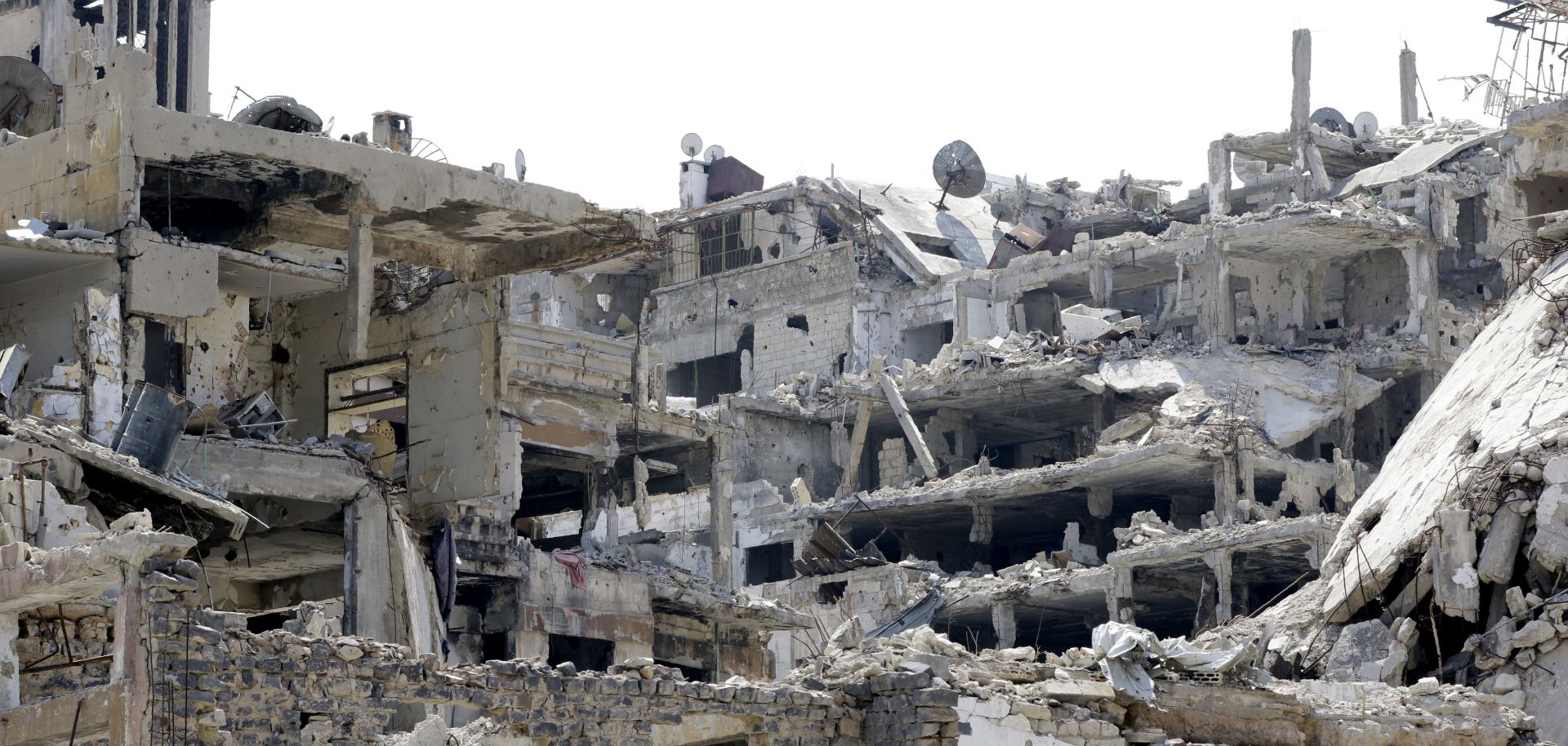
This Aug. 14, 2016, picture shows heavily damaged buildings in the al-Khalediah neighborhood of the central Syrian city of Homs. Tehran helped Damascus win the civil war, but it might not be able to help it normalize.
Nearly nine years on, the Syrian government is winning the country's civil war, thanks in large part to strong Iranian and Russian support. But as the war winds down, questions are rapidly emerging about how it might secure the peace — and what that means for the influence of the allies that helped get it there. In particular, there is great uncertainty about Iran's deep influence in Syria, as Damascus strategizes ways to emerge from its economic isolation, restore its sovereignty over its internal affairs and reduce its exposure to Israel's repeated attacks. These imperatives, however, clash with some of Iran's strategy for Syria, creating a situation in which Damascus might have no choice but to cut Tehran's influence down to pre-war levels if it's ever going to find a way to rebuild.
Iran's Diminishing Value
For decades, Tehran and Damascus have maintained close relations, in part because of their shared mistrust of Israel and their uniqueness as non-Sunni islands (at least in terms of Syria's rulers, if not most of its population) in the Middle East. Over the course of the civil war, however, Iran has managed to gain more influence in Syria because its intervention was exactly what Damascus required in its hour of need. Tehran supplied arms and militias that bolstered Syria's flagging national army, which had been torn apart by defections and paralyzed by distrust. Indeed, Iranian and Iranian-linked forces supplied much of the resources that allowed Damascus to retake Syria's major cities and push rebel factions toward the northern border with Turkey.
But as major cities like Damascus, Latakia, Aleppo and others have come firmly under Syrian control, residents of these areas, especially government loyalists, are yearning for a return to normalcy and economic recovery. U.N. estimates, however, put the price of reconstruction as high as $400 billion, meaning that the rebuilding effort will require the aid of many nations, including ones hostile to the current government. Given this, as Iran struggles under the weight of sanctions it has less to offer than it would like.
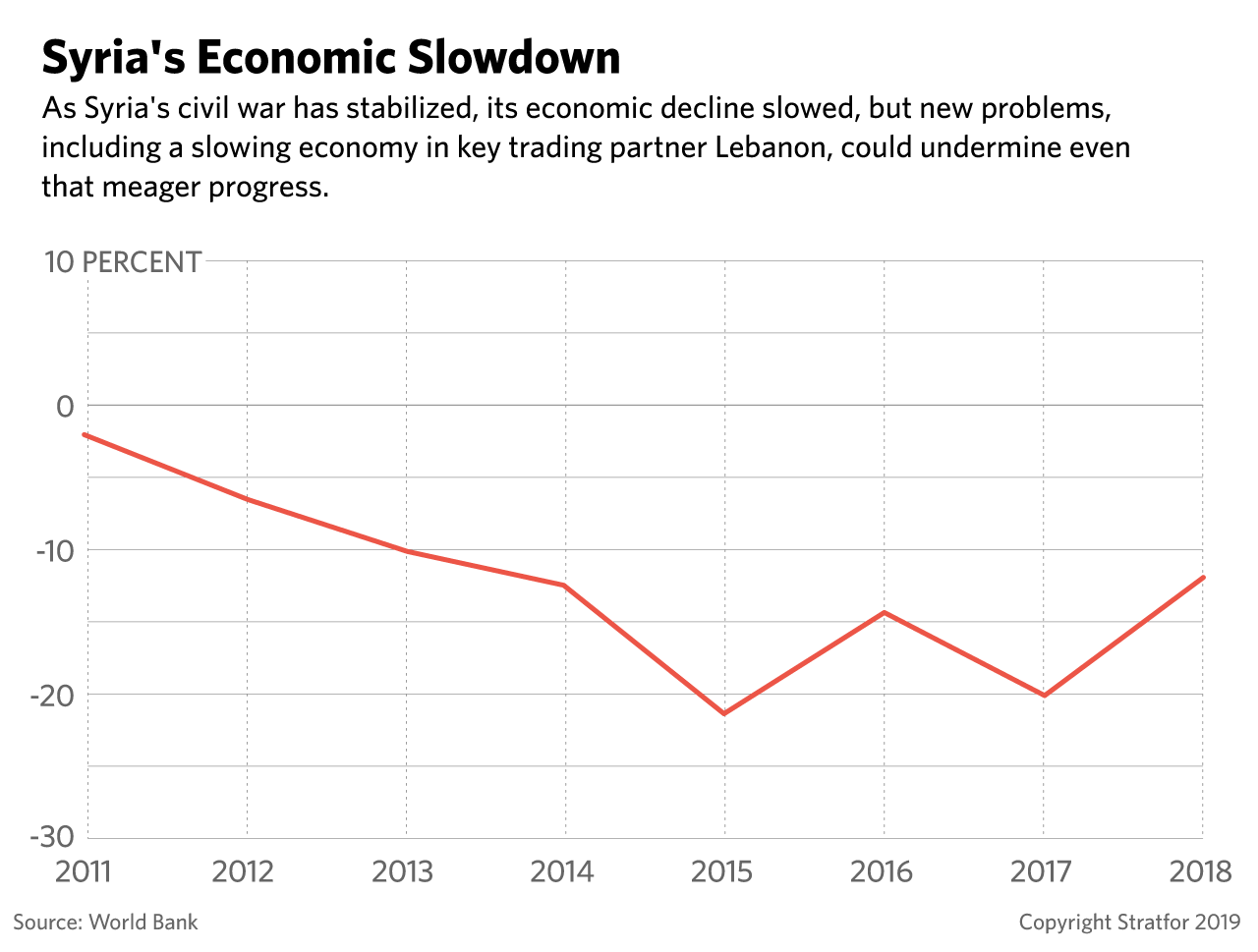
Today, the Syrian government controls most of the country's major cities, where up to 77 percent of its prewar population lived (displacement and poor record-keeping during the war mean there is no precise figure for the population today). Within the relative security of government-controlled areas, the population was, up until recently, experiencing an economic rebound: The Central Bank even reported a 1.9 percent growth in gross domestic product in 2017, the last year the institution published such data (the World Bank, however, still believes Syria's GDP regressed during the same time).
But now a series of problems are hampering economic progress, forcing the country to rethink its strategies to overcome economic isolation. U.S. sanctions against Syria's biggest economic ally, Iran, have hurt Tehran's ability to fund infrastructure projects and provide credit lines for essential goods. Before U.S. sanctions, Iran gave up to $8 billion a year to Syria, but it appears it is no longer able to fulfill prior obligations, as Tehran slashed wages for Iranian-aligned militias and delayed projects — or handed them to Russian companies.
And in terms of trade and energy flows, normal service hasn't resumed either. Syria's old trade routes remain largely disrupted, as the major Turkish frontier remains closed while routes through Iraq and Jordan have failed to supplant it. At the same time, Syria's small energy fields are still in the hands of the U.S.-backed Syrian Democratic Forces. Long-standing internal corruption, too, continues to drain resources. Compounding Syria's economic woes are the economic and political crises in Lebanon, Syria's last major local trade partner and one of its primary economic outlets to the world.
Time to Make New Friends
Though Damascus has defeated most of its most serious enemies, even loyalists are raising questions about Syria's future. Discontent emerged last summer in Damascus as ongoing energy shortages resulted in long lines to purchase fuel. And over the border in Lebanon, a shortage of dollars is now affecting business in Syria, fostering further resentment at the country's isolation.
Even Syria's government — which remained united in the face of the uprising — remains riven with its own internal factionalism, warlordism and politicking. The close family of President Bashar al Assad dominates the state, but sectarian clans, business leaders, militia commanders, military officers and parliamentarians are all jostling for a share of the spoils that loyalty to the state warrants. Finding a balance among these internal factions has been a longstanding priority for the al Assad family and will continue to be so in the year ahead.
Given its situation, Syria must find new economic resources to dole out to the factions. As Tehran is limited in what it can do, and Moscow and Beijing have so far been reluctant to open their checkbooks, Syria is looking farther afield — specifically, to some Gulf states, where it has made some diplomatic inroads with the United Arab Emirates and Bahrain. The former, in particular, is wealthy enough to invest in some of Syria's reconstruction; Abu Dhabi is also a useful diplomatic partner that could convince Riyadh to join in some capacity as well. For the time being, impending U.S. secondary sanctions on Syria will ensure that only companies with a high tolerance for risk will loosen their purse strings, however.
Naturally, too, these Gulf Arabs have a price of their own: a reduction in Iran's influence in Syria. But with security relatively normalized in regime territories, it's a price that Syria might be able to stomach, as it no longer needs the same level of Iranian involvement as it did in years past — in fact, Iranian forces might now be doing Damascus more harm than good in some areas. That is especially the case with Israel, as Israeli forces continue to hit Iranian forces inside Syria, further damaging vital Syrian infrastructure like the capital's airport. Working to decrease Iranian influence to pre-civil war levels would not only bring Syria closer to the Gulf Arabs, but it would also reduce Israel's incentive to continue its long campaign against Iranian forces inside Syria.
As it is, al Assad's government itself is loath to allow foreign influence to become permanent in Syria's internal politics. But as Syria seeks to restore some independence of action and cut back on Iran's clout in the country, Tehran will naturally move to preserve its influence — but in doing so, it may end up antagonizing Syria, the Russians, or both, especially if it does so too assertively or quickly for Syria.
As Syria attempts to reintegrate into the international community and find someone to bankroll some of its reconstruction, the era of Tehran's ascendence in Damascus might be drawing to a close. If so, Iran might find itself back in the position it held in 2011, when it was a major Syrian ally — but not a major patron able to use Syria at will.
