
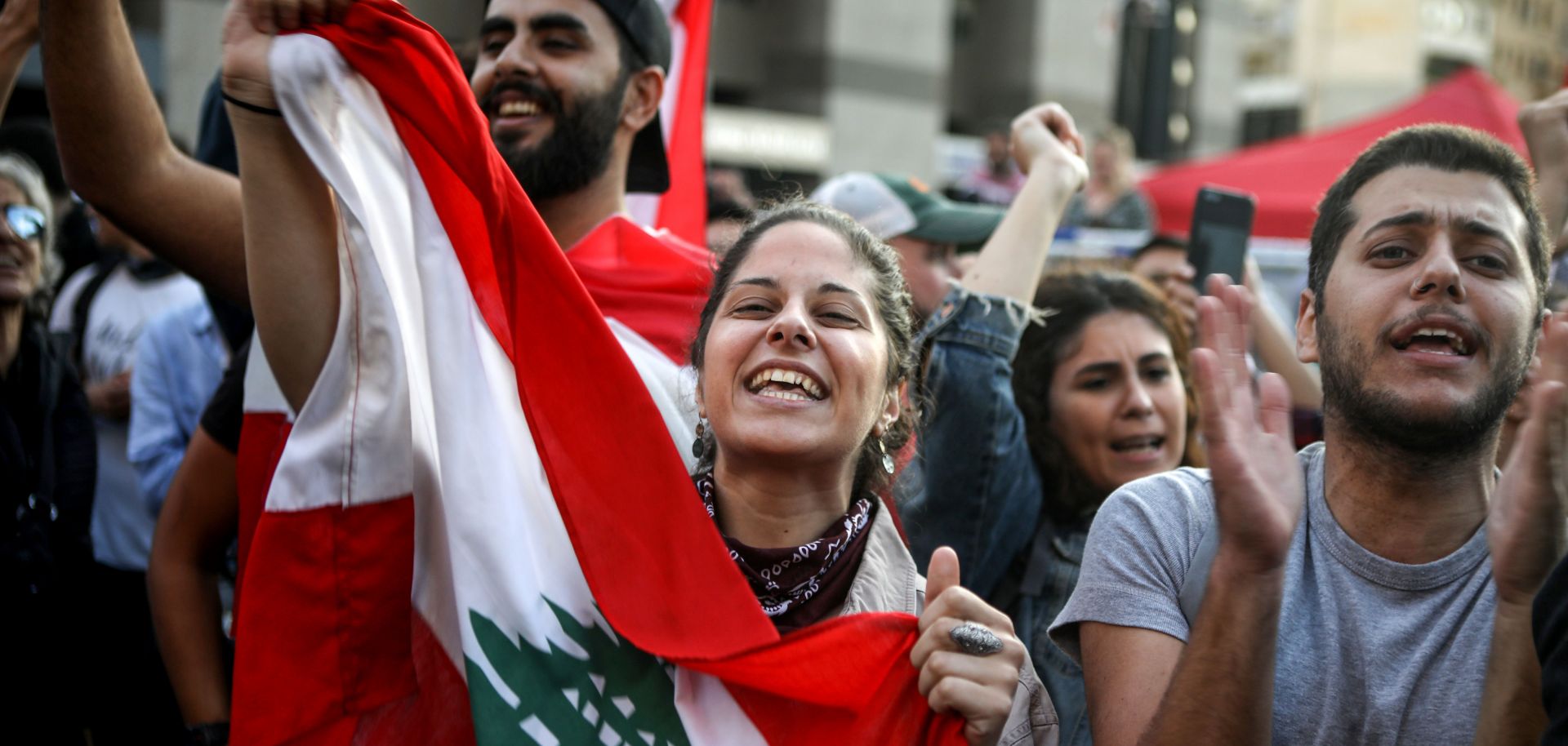
Anti-government protesters in Beirut celebrate Lebanese Prime Minister Saad al-Hariri's resignation on Oct. 29.
What Happened
Lebanese Prime Minister Saad al-Hariri announced his resignation Oct. 29, gladdening many participants in widespread protests that have paralyzed Lebanon's economy the past two weeks and put its political system in a critical state. In a nationwide speech before submitting his resignation to President Michel Aoun, al-Hariri said he had done all he could to resolve Lebanon's crisis. If Aoun accepts his resignation, the rest of al-Hariri's government would technically resign per the Lebanese Constitution and transition into a caretaker role until a new government is formed.
Why It Matters
Al-Hariri's announcement could mark the beginning of a potential widescale political change in Lebanon. The country is used to political paralysis and weak leadership — there was no president from 2014 to 2016, for example, and it took more than eight months to form a new government after elections in May 2018. But this period of political unrest is different from past episodes when Lebanon's sectarian factions squabbled among themselves and sought to capitalize on instability at the expense of other factions. This time, protesters want an end to the very political system that the factions rely on for their power and patronage. The protests represent a national, cross-sectarian movement that is weakening an already destabilized economy and pressing for the dismantling of the National Pact of 1943 that established Lebanon's current sectarian political system.
There are thus two fronts of importance: Lebanon's protest movement can press on the country's unstable economy, already under U.S. sanctions pressure and riddled with the debris of decades of economic mismanagement. That could push Lebanon into an economic crisis, one in which it cannot expect the international community to help bail it out.
What to Watch for Next
The reaction of the factions. Al-Hariri and his party, the Future Movement, are stepping away from the crisis and handing responsibility to Lebanon's other factions — for the moment. The reactions of these factions will give insight into how they will attempt to deflect the same popular pressure that helped bring down al-Hariri. As they do so, al-Hariri and the Future Movement will be down but not out and will be seeking their own paths to maintain or even expand their power.
Hezbollah, which has said it opposes al-Hariri's resignation, is the most notable faction, in large part because Hezbollah is attempting to hold its influence in place and keep control of the important Health Ministry, after expanding its electoral power in the May 2018 election. Sheikh Hassan Nasrallah, Hezbollah's leader, will give a speech on Nov. 1, which will give him an opportunity to stake out the group's stance. But other factions, like the Shiite Amal Movement, the Free Patriotic Movement and others that are allied with Hezbollah under the March 8 movement umbrella, are important to watch, too, as they attempt to find a way to navigate the protest movement that targets their power as well.
Signs of an early election. These reactions will give insight into how and if Lebanon will move toward an early election that few inside the Lebanese political system will welcome, in large part because it could inject change in a system that prizes stagnation. Early elections will be an opportunity for the protest movement, which includes broad sections of Lebanon's civil society, to build rival political parties to take on the entrenched elite. That will worry the insiders of Lebanon's sectarian system because at the moment they are vulnerable to accusations of corruption that could fuel new challenges to them at the polls.
The protest movement's next steps. Al-Hariri's resignation was a key demand of many protesters — some may go home with this victory. Meanwhile, if Lebanon's banks remain closed because of the protests, many Lebanese will not get paid at the end of the month. That, too, could send some protesters home and spur concessions from the movement as they see the country's political system go into flux.
But because the protest movement is cross-sectarian and grassroots, there is no simple solution to appeasing its myriad demands. Some within the movement may decide al-Hariri's resignation is not enough. Rather than appeasing them, his departure could embolden them to demand even bigger changes, like the formal end of the 1943 National Pact. With the economy performing as poorly as it is, a missed paycheck may also not bother them. If the protest movement does not return to work at scale, it will mean a prolonged period of political and economic crisis for Lebanon — and a further push toward uncharted water.
