
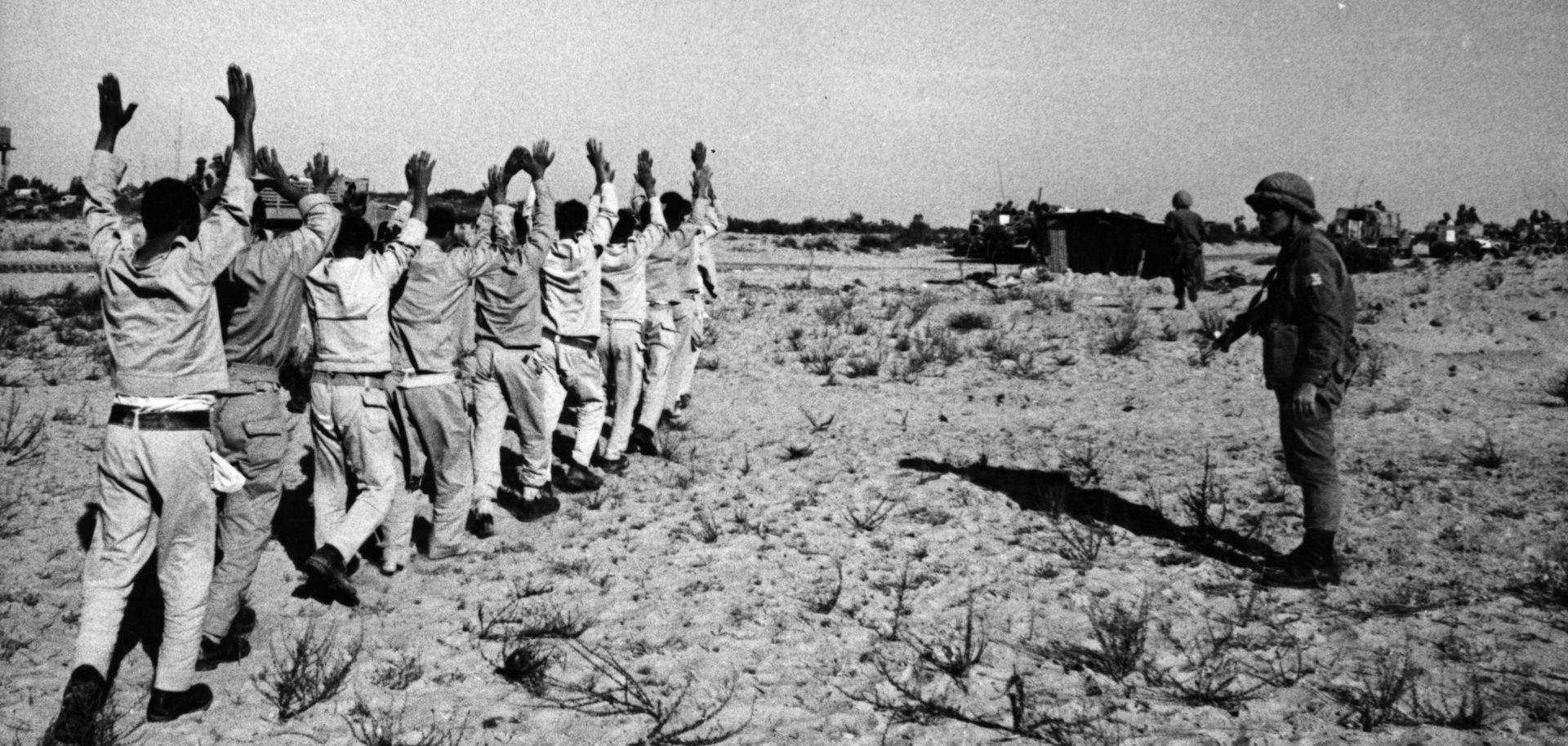
Egyptian prisoners of war hold their hands aloft after being rounded up by Israeli forces in the Sinai Desert following the Six-Day War in 1967. Israel is currently pursuing a transactional approach to diplomacy, but that will only work as long as it has something worth offering to other countries in the region.
New times call for new ideas: Where once Israel traded land for peace, it's now hoping to peddle regional cooperation for peace, all in a bid to finally gain (more) acceptance in the neighborhood. On Oct. 6, Intelligence Minister Israel Katz touted a potential nonaggression pact with the Gulf Arab states; not long before that, Prime Minister Benjamin Netanyahu promised to annex the Jordan River Valley in the West Bank to help win reelection in the country's Sept. 17 polls. On the surface, the announcements might seem contradictory, but both are linked: On one hand, Katz was signaling Israel's optimism that it might soon gain public acceptance from key Gulf Arab states, while on the other, Netanyahu was making it clear that Israel's survival strategy depends less and less on the country's old land-for-peace strategy.
Together, the developments represent a new, more transactional approach for Israeli diplomacy in which Israel believes it offers assets that other states will desire enough to give it the diplomatic recognition it craves. But while this strategy is likely to give Israel a modicum of greater acceptance, the country's transactional approach will encounter some formidable ideological barriers with big states like Turkey (in terms of normalization) and Iran (eventual recognition). Moreover, a transactional approach will only work as long as potential counterparts see value in working with Israel: After all, other technologically advanced countries with advanced intelligence capabilities — and none of the baggage associated with the Palestinian question — could also woo Middle Eastern nations, while some in the region could eventually come to view Iran as less of a threat. In such a case, Israel would find itself once again at the drawing board, looking for a new way to earn regional acceptance and secure its place on the map of the Middle East.
A Tried and Tested Strategy
Starting with the 1956 Suez War, Israel has repeatedly offered conquered territory to earn truces or treaties with its regional foes. By 1979, it had traded the Sinai to Egypt — twice — to gain a full peace treaty. In 1994, it traded parts of the West Bank to the Palestinian Authority to help ease the diplomatic process for a full treaty with Jordan. And, until this year at least, it held the Golan Heights as a potential bargaining chip to sign a treaty with Syria.
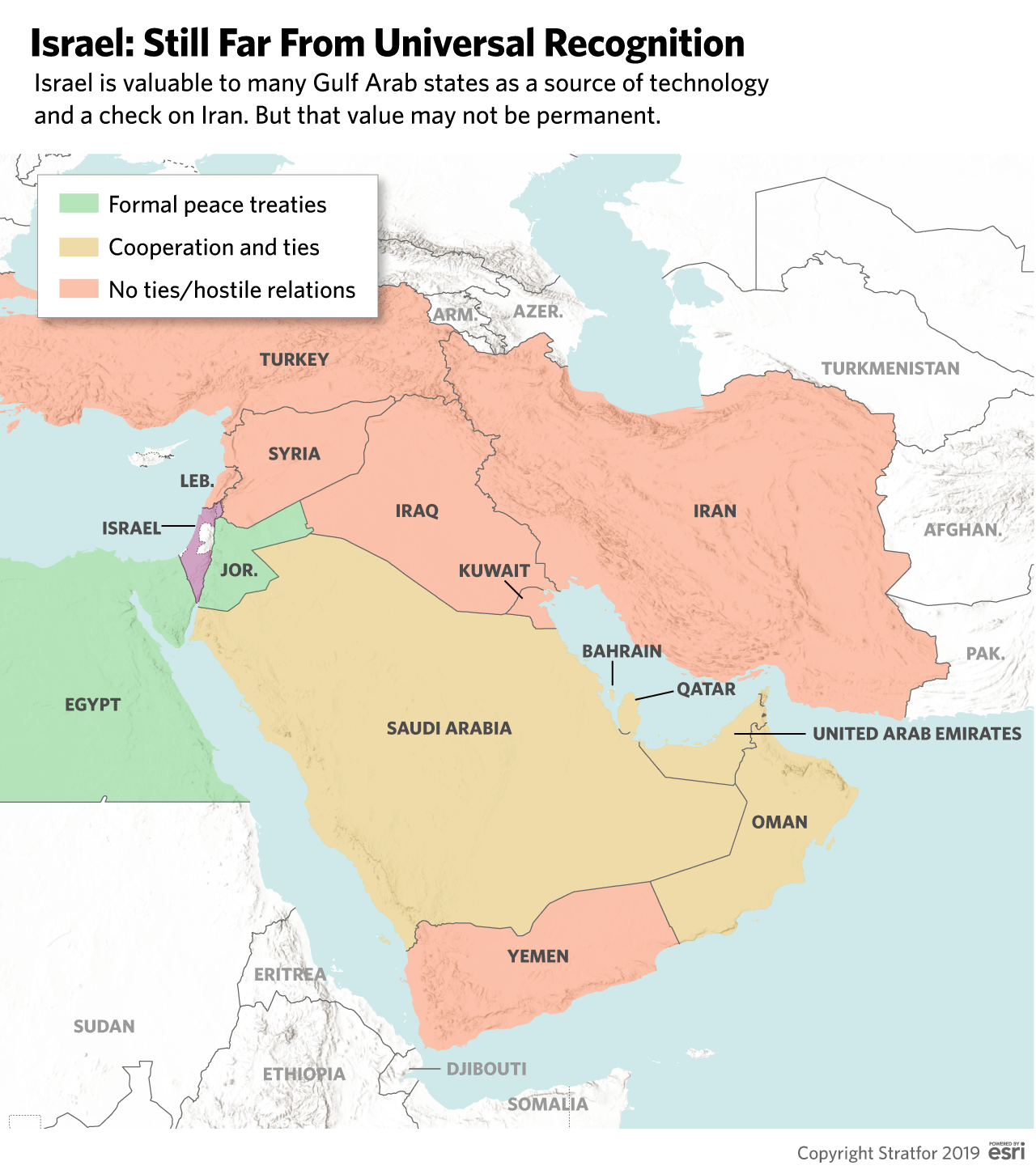
For Israel, however, there is only so much land it can trade away without endangering itself. What's more, in terms of Iran, Turkey, Syria and Lebanon, Israel either has no land to trade away (Iran and Turkey) or it faces rivals that are too politically committed to remaining in a confrontation with it to countenance a treaty (Syria and Lebanon).
But as the limits of the land-for-peace strategy have become clear, opportunities for cooperation have emerged in some parts of the Middle East — particularly in the Persian Gulf. A combination of fears of Iranian ascendance and changing views on the urgency of the Palestinian plight has led some Arab societies to more readily accept the idea of engaging with Israel. As these conditions have solidified, Gulf Arab leaders and Israel have begun to consider what they might have to trade with one another, from covert ties to technologies to intelligence.
Cooperation for Peace
For Israel, offering cooperation to whomever it can work with is now a key means of gaining regional acceptance. But while there are many who would like to acquire Israeli technology and benefit from Israel's overwhelming military superiority against mutual foes, there are limits to how close relations can become — leaving Israel's ultimate goal of full acceptance still off the table.
With their absolute monarchies, small populations and reliable security forces, Gulf states like Qatar, the United Arab Emirates, Bahrain and Oman can more readily pursue engagement. Each of them sees Israel as a potential trading and investment partner, while Abu Dhabi and Manama also align with Israel's stances on Iran's regional behavior and nuclear program. Their populations are also softening in their support for a Palestinian state as well, as a younger generation adopts different attitudes toward the Arab-Israeli conflict.
But if these states are Israel's best bet for friends in the region, it'll find it more difficult to make headway with the biggest country in the region, Saudi Arabia. Riyadh also desires access to Israeli trade and cooperation against Iran, but it has a much larger domestic audience to consider, as well as a more complicated, if still absolute, monarchy that must balance factions that still want the Palestinians to acquire a state.
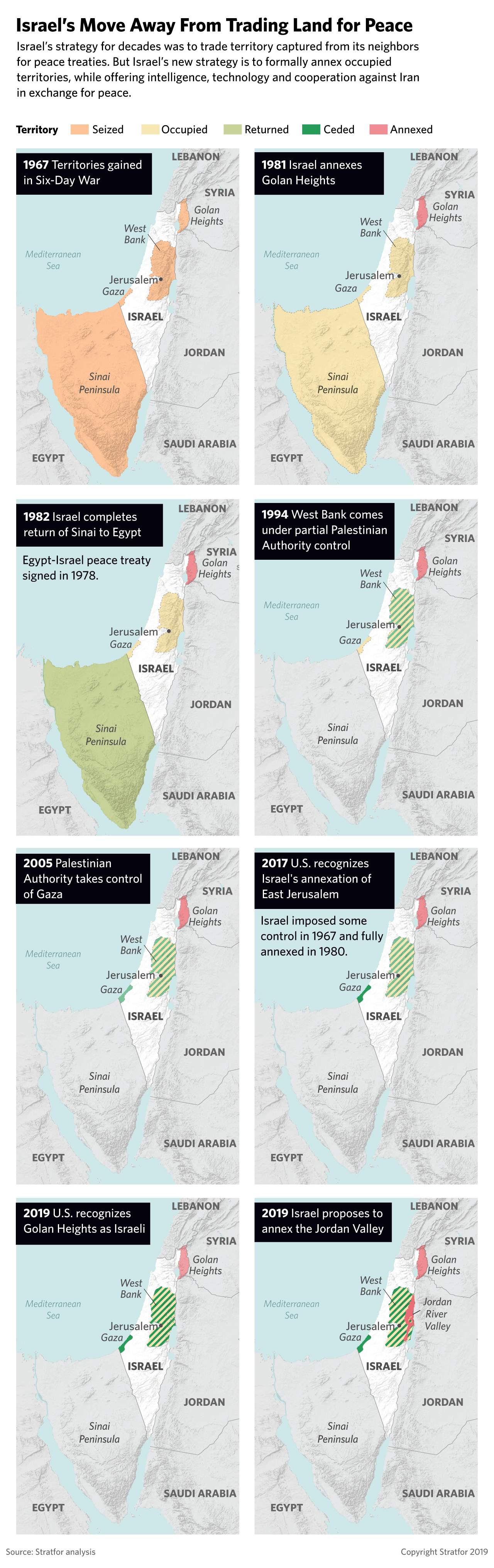
Kuwait, meanwhile, is unable to consider deeper relations with Israel at the moment. Not only does its parliament provide a robust check on the emir's foreign policy, but its comparatively free media still focuses heavily on the Palestinian question, keeping the public engaged. Kuwait has a notable Palestinian population that affects the country's sentiment as well.
These inroads into the Gulf — their various degrees of depth notwithstanding — all illustrate Israel's increasing diplomatic profile in the Muslim world. They represent, however, just five of the 31 states worldwide that do not recognize Israel, and the quintet is not even the biggest threat to Israel's security. That means that Israel will have plenty of diplomatic work to do to bring around the other 26 states — and there is no guarantee that its gains with the five will take hold permanently.
Straining the Gains
Israel is also embarking on its cooperation strategy because its situation at home makes it increasingly hard for an Israeli government to maintain power and pursue a two-state solution. Nationalism is on the rise in Israel, while demographic changes are bolstering right-wingers who wish to annex the West Bank. For Israeli prime ministers, thus, pushing against this tide could upend unstable political coalitions.
Acceptance through cooperation allows Israel to sidestep the issue for now. But as these nationalist forces entrench themselves, they will encourage Israeli governments to annex parts or all of the West Bank. When that happens, the ties that Israel has built up with Muslim states in the Gulf and elsewhere will come under much greater strain.
As Israel steadily takes power away from the Palestinian Authority, expands its settlements and ultimately annexes territory, it will have to decide whether to extend citizenship to the Palestinians living in such areas. But given the rising nationalist sentiment in Israel, few Israeli governments could allow such a step — meaning the Palestinians of the West Bank could be left without any documentation at all. That, naturally, will be hard for Arab governments and citizens to accept; even as they might be less forceful in demanding a Palestinian state, they do not want to see fellow Arabs become a permanent underclass. In such a situation, Gulf Arab states would likely have little choice but to turn their back on Israel regardless of the economic and security benefits that engagement would bring.
There are other drawbacks to this transactional approach to diplomacy as well. Downturns in global or regional economic conditions that weaken trade relationships may also reduce Arab states' willingness to remain close to Israel. Arab Gulf states may also find other partners, like China, India or Europe, that can provide similar relationships and technology without the Palestinian issue causing the ties to fray. This is especially the case with countries like China and India, where vibrant tech sectors may one day compete with those in Israel.
Additionally, a key aspect of covert Arab-Israeli ties — opposing Iran — could change if U.S. and regional hostility against Tehran dissipates. Another nuclear deal, a fundamental change in the U.S. or Iranian governments (through elections in either, or the appointment of a new supreme leader in Iran), or a Gulf Arab-Iranian detente could render Israel's transactional diplomacy moot.
Israel has many things to offer the Gulf Arab states — for now. But there is no guarantee that the value of Israeli cooperation will remain the same in the future. If circumstances change so that regional countries no longer need — or want — what Israel is offering, the latter will again find itself wondering just how to go about finding friends in the region.
