
An Indian man works at a construction site at the Asian Highway (AH2) project, which connects Nepal, India and Bangladesh, in Siliguri, India, on Feb. 1, 2018.
India's quest to create a sphere of influence in South Asia keeps running into snags. This time the complication is in Nepal. Khadga Prasad Oli returned as prime minister at the head of a communist alliance after the country's election in December 2017. Oli had positioned himself as a nationalist channeling anti-Indian sentiment and vowing to explore a closer relationship with Nepal's giant northern neighbor, China. Once in office, however, he tempered his stance. He honored tradition by choosing India as the destination for his first international visit on April 6 — a sign of his government's pragmatic desire to maintain cordial relations with Nepal's giant southern neighbor. Nonetheless, Oli's election represents a setback for India's strategy in Nepal, and it will force New Delhi to change its approach, since China and its Belt and Road Initiative offer tempting alternatives.
Nepalese Geography: The Terrain of a Buffer State
Nepal's geopolitical significance lies in the country's role as a buffer state between larger powers. The Himalayas ripple across the country's boundary with the Tibetan Plateau and China, making it vital to India's strategic defense along its northern frontier. The mountain range — which includes Mount Everest — effectively seals off the Indian subcontinent from China. The rugged northern border with China stands in sharp contrast to Nepal's southern border with India, which encompasses the Terai, a flat, grassy lowland that's part of the Indo-Gangetic Plain.
Geography has led landlocked Nepal to develop a strong dependence on its southern neighbor for trade and fuel supplies. China's annexation of Tibet in 1950 only heightened Nepal's strategic significance by suddenly bringing China right up to India's border. For China, the presence of a Tibetan exile community in Nepal — today numbering at least 20,000 — means the country could be a potential base for subversive activities. And for Nepal, its position means using its Chinese connections as leverage in negotiations with India.
Southern Ties, Coercive Tactics
After a decade-long civil war that ended in 2006, Nepal made a haphazard transition from a Hindu monarchy to a secular democracy. The government drafted a new constitution in September 2015, but the charter triggered protests in the Terai lowlands among the Madhesi, who share cultural affinities with India and live along the southern border. During the protests, the United Democratic Madhesi Front, a political coalition, demanded more constitutional rights and new provincial boundaries to give them a majority along the length of the Terai.
The Madhesi set up a five-month blockade along the border-crossing at Raxaul-Birgunj, through which nearly 70 percent of India's goods pass into Nepal. Kathmandu thought India was tacitly supporting the blockade. (In a similar move in 1989, India had closed 15 of 17 transit points to pressure Nepal to back down from purchasing weapons from China.) At the time, Nepal was already reeling from two earthquakes in 2015 that had killed 9,000 people. Oli, the formerly pro-India prime minister who had campaigned on a platform critical of India to win his first stint in office in October 2015, turned to China and signed agreements to cover trade and the fuel shipments that India had previously monopolized.
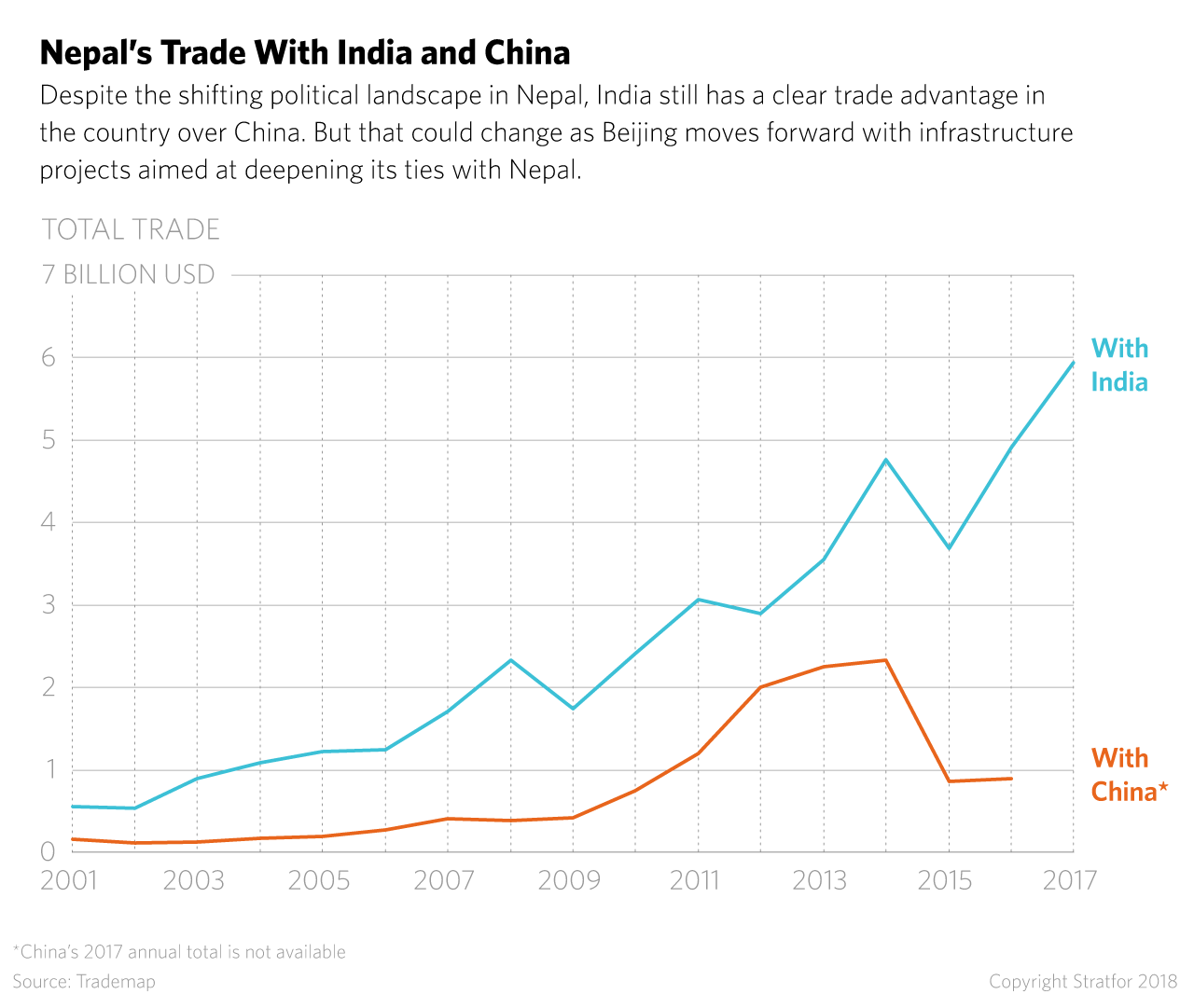
Prime Minister Khadga Prasad Oli was later forced to step down ahead of a no-confidence motion supported by the Communist Party of Nepal-Maoist Centre (CPN-MC) and the pro-India Nepali Congress party. His 2017 campaign for reelection once more included an anti-Indian bent and saw him run as part of an alliance between the Communist Party of Nepal-Unified Marxist Leninist (CPN-UML) and the CPN-MC. The latter had abruptly withdrawn from the governing coalition with the Nepali Congress party, led by then-Prime Minister Sher Bahadur Deuba. That move raised suspicions about China operating behind the scenes to forge the new partnership.
Nepal's Path Along the Chinese Road
The returning prime minister has vowed to strike an independent course for Nepal and to balance relations between its two giant neighbors. While India is concerned about Nepal's signing on to the Belt and Road Initiative in May 2017, the government in Kathmandu has its own goals in mind. To boost its gross domestic product of $765 per capita — and grow its $21 billion economy to graduate to middle-income status — Nepal needs to invest at least 2.3 percent of its annual GDP in infrastructure. China's Belt and Road Initiative can help in that respect.
However, India fears that Chinese projects — an international airport in Pokhara, nine roads and railways, two special economic zones and three hydropower facilities — could ensnare Nepal in a debt trap like the one that entangled Sri Lanka. That country was unable to repay Chinese loans and found itself having to sign over a majority stake in the Hambantota port on a 99-year lease to a Chinese state-owned firm, for a cost of over $1.1 billion. India is also concerned that Chinese economic developments such as Hambantota could be used for military purposes — a prospect that is especially troubling given the growing military tensions between China and India. As for Beijing and Kathmandu, they conducted their first-ever joint military exercises in 2017.
What Is India to Do?
For India, the logical response is to alter its behavior, and Prime Minister Narendra Modi will have to moderate his government's approach. New Delhi has little choice but to ease off demands for Nepalese constitutional reform in favor of the Madhesi and ease off using coercive tactics. Oli's return demonstrates how the costs of arm-twisting outweigh the benefits.
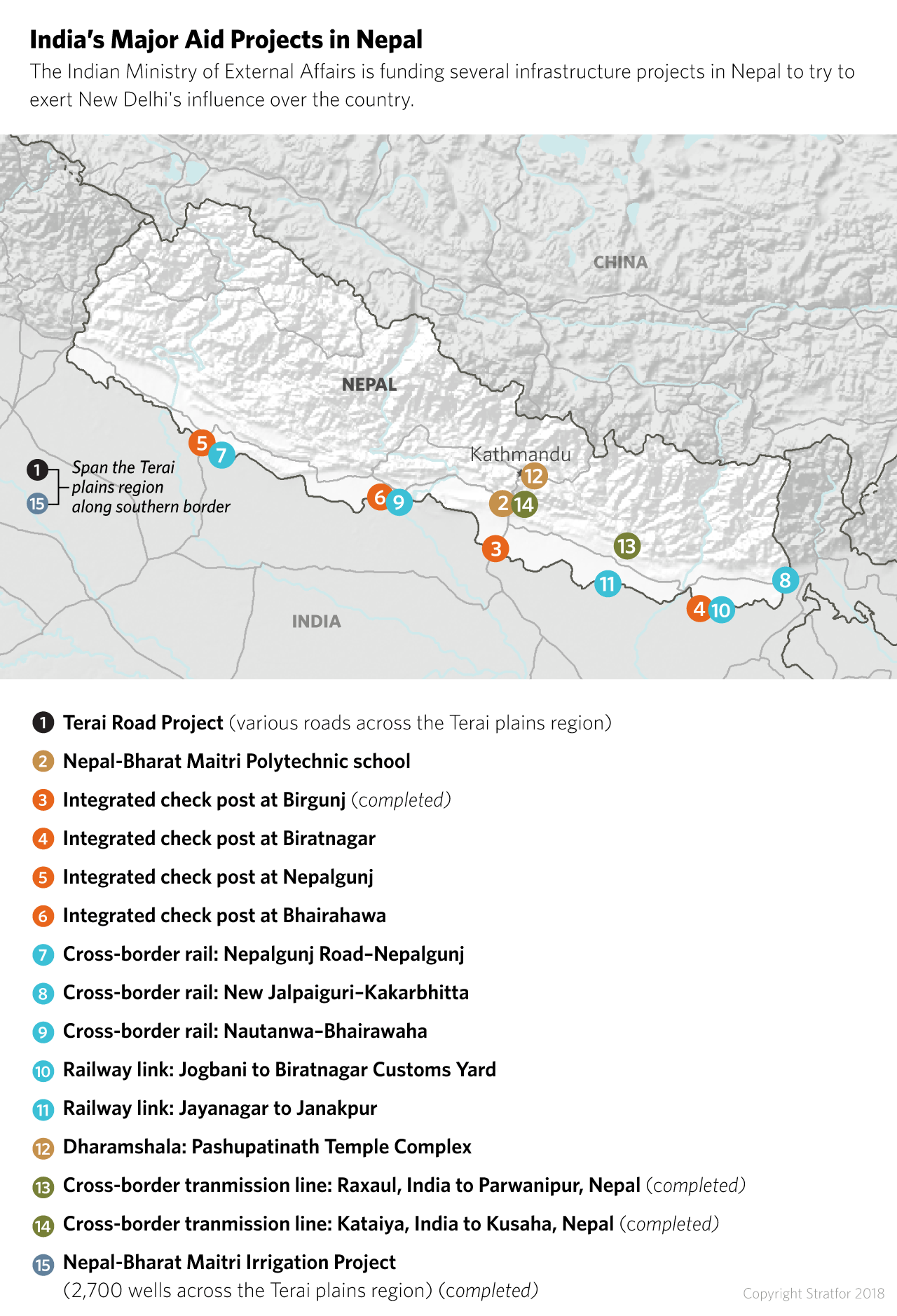
In addition, India will have to prioritize its funding for government-sponsored projects in Nepal and do some image-management in Kathmandu. New Delhi has already budgeted a 73 percent increase in foreign aid allocation for Nepal for the fiscal year starting April 1. Among the projects New Delhi is focusing on are integrated checkpoints, cross-border railways, power transmission lines and inland waterways. A new government in Kathmandu provides India with another opportunity to cultivate stronger relations.
To be sure, India's relationship with Nepal includes elements that China simply lacks. Specifically, the two countries are signatories of the 1950 India-Nepal Treaty of Peace and Friendship, which along with foreign policy collaboration, governs the free movement of Indians and Nepalese across the open border. Furthermore, seven Nepalese Gurkha regiments serve in the Indian Army. Even as the turbulence of Indo-Nepalese relations temporarily subsides, it reflects broader strategic concerns. India is too weak to match China, but too strong to sit idly by. India's diminishing ability to shape Nepalese politics in the face of growing Chinese influence means that New Delhi will have to find alternative modes of involvement. Otherwise, India risks becoming a power unable to control its own sphere of influence.
