
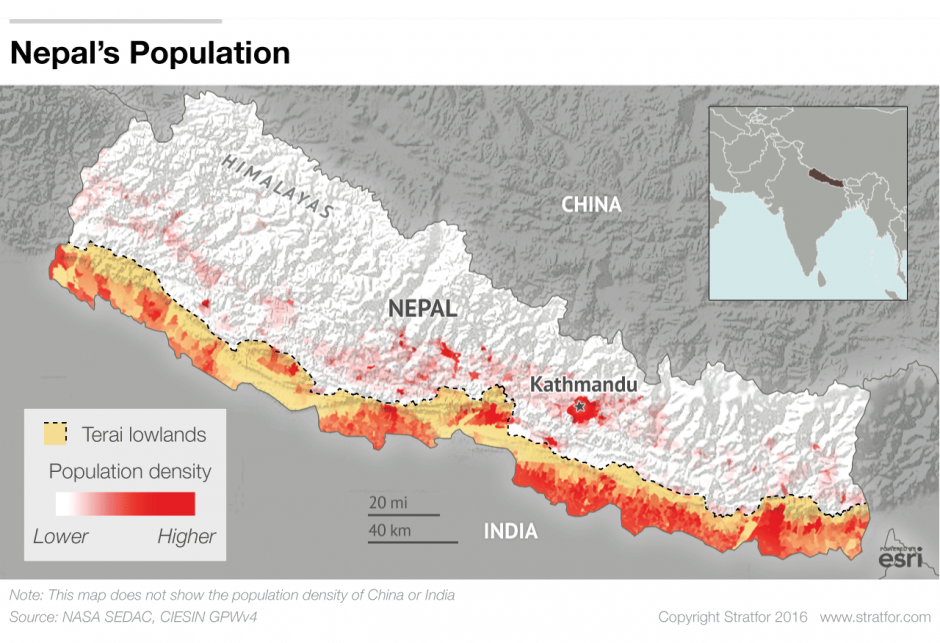
Nepal is a tiny country on India's northeastern border with a narrow strip of territory that is divided lengthwise into three types of terrain. Along the northern border with Tibet are the towering Himalayan peaks, effectively walling off Nepal from China. They have made it nearly impossible for Nepal to build any land-based infrastructure, such as roads and bridges, connecting it with China. Moving southward, the mountains of the north slope off into the swath of hill country stretching across the country's middle. The Nepalese capital sits in this region, deep in the fertile Kathmandu Valley. From this strip, the hills flatten into the Terai lowlands, spanning Nepal's southernmost edge before crossing into India, where they eventually join the Ganges River Basin. In this way, geography has both squeezed Nepal between India and China and made New Delhi the more prominent foreign partner of Kathmandu.
A History of Ethnic Rivalry
For much of Nepal's history, the Thakuris and Brahmins — groups belonging to the hill societies based in Kathmandu — have monopolized power among the country's patchwork ethnic factions. But in an effort to keep it, they have used their position to minimize the influence of the Madhesi, a powerful voting bloc that they view with suspicion because of its close ties to India. (The lack of geographic barriers between the Terai lowlands and India has facilitated a cross-border relationship between the Madhesi and their Indian neighbors.)
To that end, the hill country factions proposed a new constitution in September 2015 that, if enacted, would mean the Madhesi no longer have proportional legislative representation. The prime minister has long opposed the identity-based federalism that the Madhesi advocate, an idea that argues Nepalese states should be built along ethnic lines. Because the Madhesi are numerous — seven of every 10 residents in the Terai lowlands, which house roughly half the country's population, are Madhesi — their proposed states in Terai would grant them greater representation at the hill-based elites' expense. Incensed at the ruling groups' far less appealing plan for demarcation, the Madhesi responded to their perceived marginalization at the hands of the hill people by staging a four-month blockade at the Nepal-India border, a move that many Kathmandu elites interpreted as confirmation of New Dehli's influence over the Madhesi.
Balancing the Power of Nepal's Neighbors
The blockade caused a flare-up in anti-India sentiment in the capital, a recurring theme in Nepalese politics. This offered Oli an opportunity to pursue one of his biggest political goals: strengthening Nepal's ties with China. India has consistently played an important role in Nepal, and though Oli did not necessarily aim to change that, he sought a counterweight to New Delhi's outsize influence in the country. As relations between Nepal and India deteriorated during the Madhesi blockade, ties between Kathmandu and Beijing flourished. The two signed a memorandum of understanding on fuel imports and trade; at the same time, Nepal recalled its ambassador to India and canceled a visit between the Indian and Nepalese heads of state set for May.
And initially, it seemed as though Oli might be able to make permanent headway with China while riding out the Madhesi demands. But the Maoist members of the prime minister's coalition, knowing that Oli depended on their political support, seized the chance to exact concessions from him by threatening to pull out of the ruling alliance. The first time they used this tactic, in May, Oli agreed to sign a nine-point agreement that stipulated, among other things, that the territorial concerns of the Madhesi would be addressed. But when it became clear that Oli did not plan to meet their demands, the Maoists renewed their threats to quit the government. This time they followed through, withdrawing their support from the prime minister on July 12. Oli's party lost its majority in parliament, giving Nepal's two opposition parties room to call for a vote of no confidence. Rather than enduring the humiliation of being voted out, Oli resigned.
And so, the sizable obstacles that Nepal's identity politics and fragmented political scene present proved too difficult for Oli to overcome. According to the country's power-sharing agreement, Pushpa Kamal Dahal will take Oli's place for nine months before handing power to a figure within the Nepali Congress party. Yet if either of these leaders fail to address the concerns of the Madhesi — as they are likely to do, given the issue's intractable nature — Nepal will continue to be mired in the political crises that have long stood in the way of its stability, prosperity and growth.
