
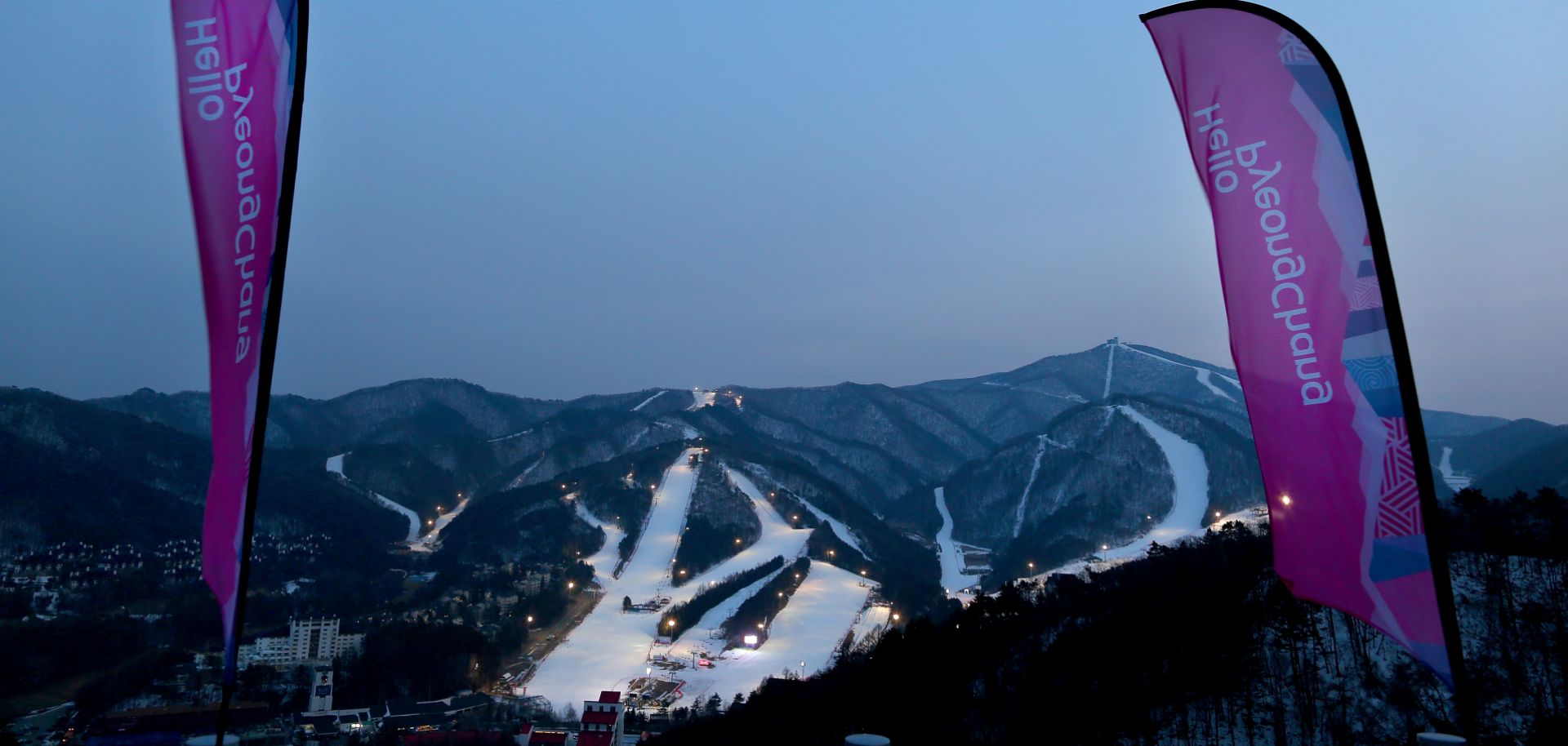
The Pyeongchang Mountain Cluster that is the site of the 2018 Winter Olympics in South Korea.
Perhaps it's the symbolic purity of fluffy snow and perfectly manicured ice, or maybe the physical grace of many of the winter sports, but — superficially, at least — there is something decidedly less combative about the Winter Olympics. This is a decidedly unscientific observation, but when thinking of intersections between the Olympics and politics, I sense that most of us default to the summer variety: the student protests and African-American activism of Mexico City in 1968 and the hostage crisis in Munich in 1972. But that would downplay the significant moments in the deceptively long history of the Winter Olympics. With the competition in South Korea in full swing, it's an opportune time to consider the Winter Games' somewhat controversial origins and highlight their biggest geopolitical moments.
The modern Olympics began in 1896, but it took another generation for the winter version of the Olympics to officially debut in Chamonix, France. Technically, the 1924 Chamonix games were presented as an "International Winter Sports Week," only to retroactively be dubbed the first Winter Olympics in 1925. However, the modern Winter Olympics were in many ways the heir of the Nordic Games, first held in Stockholm, Sweden, in 1901. Like their summer counterparts, the fin de siecle Olympic ideals of nationalism and aristocratic amateurism also lived at the heart of this competition; Viktor Balck, the founder and driving force of the Nordic Games, was a charter member of the International Olympic Committee (IOC) and close confidante of modern Olympics founder Baron Pierre de Coubertin.
The Nordic Games, featuring an almost exclusively Scandinavian field of athletes, ran regularly through the early 1920s. Despite the ideological overlap with the Olympic movement, there was an isolationist tinge to the winter sports festival. Fearing the sacrifice of their cultural heritage, Nordic countries were hesitant to embrace the rapid growth of the Olympic movement in general, and they especially opposed increasing calls for the IOC to sanction a winter games. On the one hand, these concerns were valid. With the successful reception for the Chamonix festival and the even greater coming out party at St. Moritz in 1928, the Winter Olympics killed off the Nordic Games. On the other hand, the sustained success (to this day) of Scandinavian athletes in the Winter Games seems to have only bolstered the relationship between cold weather sport and national identities.
Inevitably Geopolitical
Given the relationship between the two Koreas, the current edition of the games is inevitably wrapped in geopolitics. And with due consideration, it becomes clear that the subject of geopolitics doesn't necessarily favor the warmer months. We tend to consider the 1936 Berlin Games as a turning point when the games became explicitly political, but the German Reich's use of world sport for political ends actually began earlier that year during the Winter Olympics in Garmisch-Partenkirchen. (This was the last time that both events were held in the same country, ending the short-lived tradition that the summer host received the right of first refusal for the winter offering.) As historian Jean-Loup Chappelet notes, "The grandiose backdrop of the Bavarian Alps served as the setting for the 1936 winter games, awarded to Garmisch-Partenkirchen. Nazi Germany spared no effort to make the event — a prelude to the Berlin games — a success. Arenas that were immense for the time were built, notably a stadium with a capacity of 60,000 for the ski jump and an artificial, outdoor skating rink for 10,000 spectators."
Of course, for Americans of a certain age, the Winter Games provided arguably THE highlight of the sporting Cold War, the "Miracle on Ice" during the 1980 Lake Placid Games. In a much-mythologized victory for U.S. hockey — and a triumph for the American psyche — a ragtag team of collegiate players triumphed over a legendary Red Army ensemble. Of course, that the Soviets dedicated themselves to become a hockey superpower was itself a geopolitically informed decision. It's hard to conceive of a time when Russians weren't hockey greats, but the sport wasn't even introduced to the USSR until after World War II, when Anatoly Tarasov was tasked with developing a competitive program. Building on the Soviet enthusiasm for the similar sport of bandy, hockey offered a team game fit for selfless, communist ideals, as well as the opportunity to compete on the world stage.
The U.S.-Soviet sporting rivalry, which was interrupted by the boycott of the 1980 Moscow Summer Olympics, was rejoined at the 1984 Winter Games in Sarajevo. The competition that year was generally well received, following the Yugoslavian government's hard-fought effort to secure and deliver the first Winter Olympics hosted by a socialist state (China will host in 2022). Ten years later, during the Lillehammer Games, athletes and fans alike adopted the motto "Remember Sarajevo" in a solemn testimony to the city's devastation in the war that followed Yugoslavia's demise. The IOC and Norwegian hosts joined forces to form the Olympic Aid Program for Sarajevo, which was the first of an ongoing series of collaborative humanitarian efforts between the IOC and the United Nations.
Embracing the Positive
When considering the geopolitics of sports, we often head down cynical paths, like state-sponsored doping regimes or the unfortunate economic and infrastructural legacies of hosting mega events. Sometimes, it helps to be reminded that it's not all doom and gloom and that sports can still be fun.
For those of us from warmer climates, it's easy to chuckle a bit over some of the more esoteric events that the Winter Games bring, like curling or biathlon or skeleton. But, stripped of our cumbersome loyalties to soccer teams or baseball clubs, these athletic competitions offer a wonderfully aesthetic, pure spectator experience. Even if you can't stand up on pair of skis, you can appreciate the ski jump: an absurdly human combination of unbridled potential and unnecessary risk. Add a little ice hockey into the mix, plus the visceral and noisy thrill of the bobsleigh, and you've got a nice slate of winter entertainments to enjoy, without ever leaving the warmth of your living room.
