
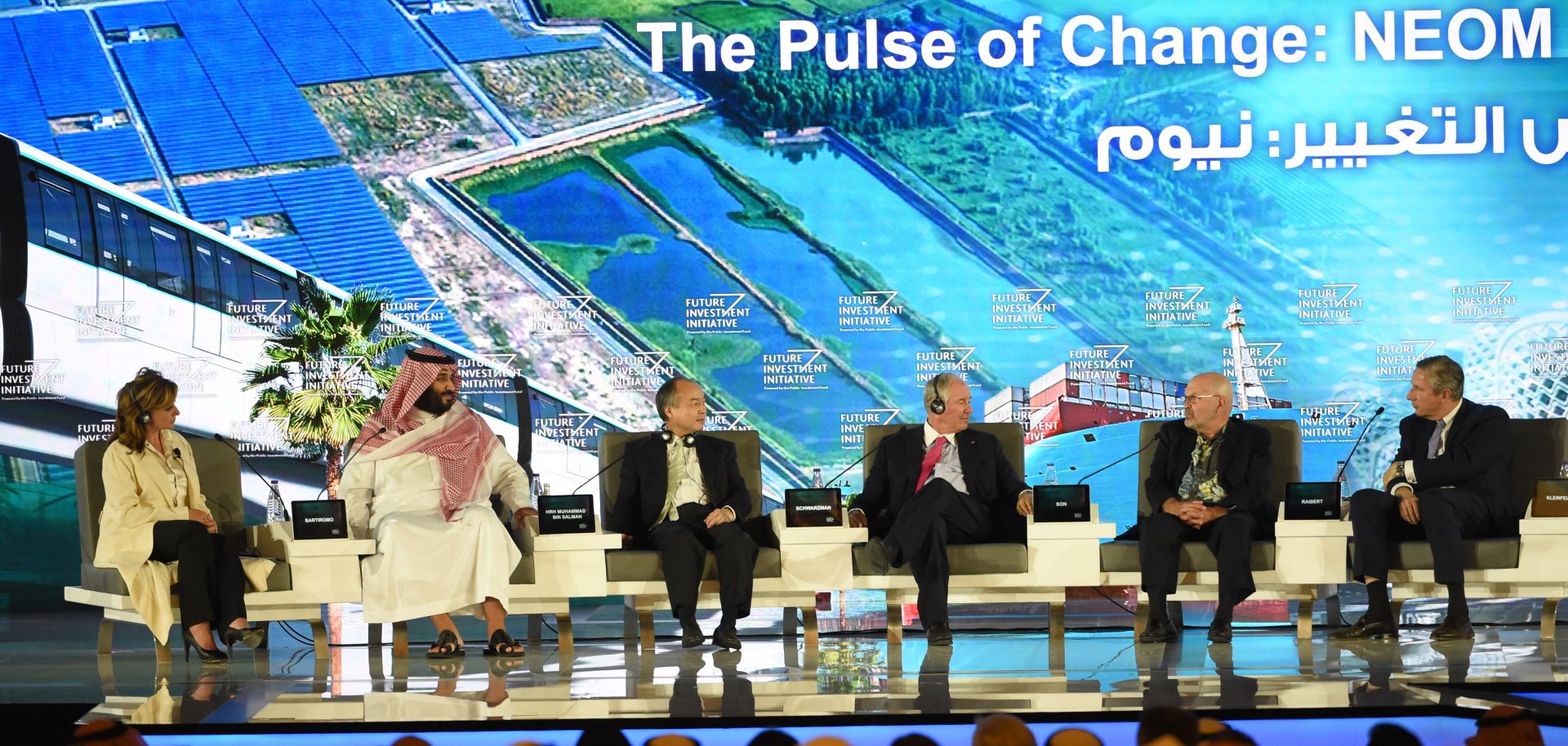
Saudi Crown Prince Mohammed bin Salman (second from left) and other participants attend the Future Investment Initiative conference in Riyadh on Oct. 24, 2017. The crown prince pledged a "moderate, open" Saudi Arabia, breaking with conservative religious leaders in favor of an image catering to foreign investors and Saudi youth. He also announced plans to construct the NEOM project, a modern city on the coast of northwestern Saudi Arabia.
Saudi Arabia is again paving the way for a more diversified economy. The country kicked off the Future Investment Initiative on Oct. 24, in hopes of furthering its efforts to attract foreign investment. The crown jewel of the event was the unveiling of the $500 billion NEOM project by Crown Prince Mohammed bin Salman. The project — which takes "neo" from the Latin word for new and "m" from the Arabic word for future (mostaqbal) — aims to develop a 26,500-square-kilometer megacity in northwestern Saudi Arabia within an independent economic zone that stretches into Egypt and Jordan.
It's an ambitious plan, one that could put Saudi Arabia on the map as a leader in developing the cities of the future using new technologies that other cities cannot. But there are just as many risks: There is no guarantee that the city will succeed, or even be completed as previous Saudi attempts to build cities prove. Still, the government in Riyadh has to do something to revitalize its economic model, and futuristic cities are the way it plans to go.
A Vision Materializes
Using investments from Saudi Arabia, the country's Public Investment Fund and private investment, the NEOM project would serve as the entry point for the planned King Salman Causeway that will span the Red Sea over the Tiran and Sanafir islands into Egypt. And as a distinct economic zone spanning three countries, NEOM will have its own laws, taxes and regulations.
It will also focus on nine investment sectors: energy and water, mobility, biotech, food, technological and digital services, advanced manufacturing, media, entertainment, and living conditions. But what sets the NEOM project apart from other megacities is its focus on using disruptive technologies. All of the services and processes plan to be fully automated, while robots, which apparently may exceed the population of NEOM upon completion, will handle repetitive and arduous tasks. The city will even be fully powered by electricity derived from renewable sources, primarily solar and wind. The fact that Klaus Kleinfeld, former CEO at manufacturing companies such as Alcoa, Arconic and Siemens AG, has been tapped to run the NEOM project speaks volumes about the direction Saudi Arabia plans to take the city.
Saudi Arabia is hoping to emulate what has made global hubs in Singapore and Dubai successful by applying a similar model to something near the Suez Canal. Not only is it a major chokepoint for global trade, but it's also at the center of aviation routes connecting Europe, Asia and Africa; it is a crossroads just eight hours away from 70 percent of the world's population by air travel. With so much traffic and so many emerging technologies to attract foreign investment, aspects of the city and plan could have immense potential.
Still, it will struggle to materialize in the way that the government hopes. After all, NEOM is not the first modern megacity Saudi Arabia has tried to build over the past decade. The Saudi government began construction of King Abdullah Economic City outside Jeddah on the coast of the Red Sea in 2005 with initial costs of $100 billion. Today, it's still under construction and needs billions of dollars more to finish, having undergone several changes to its original plan since development started. In addition, the Public Investment Fund finally kick-started its previously announced Qiddiya project, which will eventually become an entertainment city outside Riyadh. Attracting the manpower, capital and investment to develop NEOM, Qiddiya and the slew of other initiatives that make up the Saudi Vision 2030 plan will be difficult.
Preparing for the New Future
While it will be difficult, Saudi Arabia has no choice but to try something new. If the recent fluctuations in oil prices have taught the Saudi government anything, it's that it has to change its economic model from one defined by oil revenue to something more sustainable over the next few decades. Saudi Arabia needs to use what capital it has while it still has it to take advantage of its strengths. And as a desert country with only oil, wind and sunlight in abundance, capitalizing on its location by creating modern manufacturing hubs such as the NEOM project could be the answer. Few existing cities can take full advantage of the new technologies that are revolutionizing urban development, mainly because the antiquated designs and layouts of most cities hinder those efforts. Gaining valuable expertise in building a futuristic city from scratch could become Saudi Arabia's competitive advantage. What's not clear is whether NEOM will succeed at its planned location. It's a risk, but one Saudi Arabia has to take.
Saudi Arabia is also trying to improve its image and present itself to the world as a safe investment destination by limiting the potential for domestic unrest and violence during its crucial economic changes. To protect against these risks, Saudi Arabia is aiming to reduce its ties to extremist groups and curb extremism more broadly. The same day the crown prince announced the NEOM project, he also said that Saudi Arabia would "restore ... moderate Islam, open to the world and peoples." This is an important statement for Saudi Arabia and its immediate neighbors given the kingdom's history.
Since before its founding in 1932, Saudi Arabia has upheld a more conservative interpretation of Islam thanks to the cooperation between powerful Wahhabi clerics and the ruling House of Saud. These conservative interpretations of Islam define the Saudi education system, and many have criticized it for being susceptible to extremist schools of thought. Saudi Arabia's ulema, or body of Muslim scholars, play an important role in regional Islamic discourse, too. Their religious rulings, or fatwas; their stewardship of Mecca and Medina; and their interpretations of hadith, or religious texts, are influential throughout the Muslim world. The crown prince's statement also follows a recent royal decree establishing the King Salman complex in Medina for reviewing religious texts to prevent extremist interpretations from spreading globally. Such moves are Saudi attempts to place the country at the head of global counterterrorism efforts and reassert its role as the leader of the Islamic world.
The government in Riyadh has embarked on an ambitious plan for the future. Whether the NEOM project, as envisioned, is tenable or is unrealistic remains to be seen. It doesn’t matter. Saudi Arabia will attempt to build the city nonetheless.
