
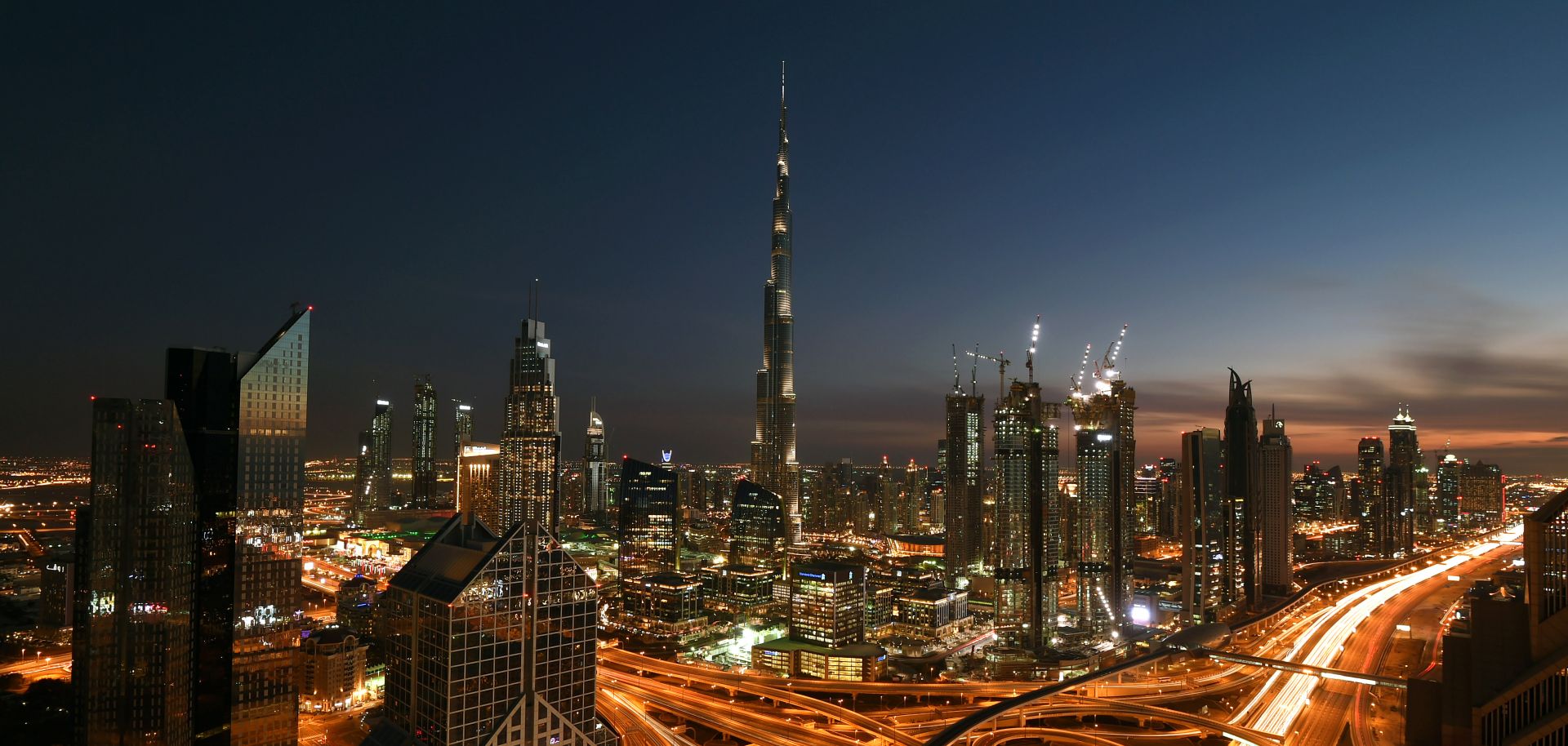
The Burj Khalifa towers above the Dubai skyline on Feb. 6, 2017. Thanks in part to the bulding's grandeur, the world began to think of Dubai and its impressive skyline as the international hub of the Middle East.
Mohamed Alabbar, the chairman of Dubai real estate developer Emaar Properties, approached Emirati Sheikh Mohammed bin Rashid al-Maktoum in the early 2000s with an ambitious plan. He dreamed of building a massive tower that, at 90 stories, would have been one of the tallest in the region. But the sheikh believed the proposal didn't aim high enough, so the company revised it, adding an extra 73 stories to the soaring structure.
Thus the iconic Burj Khalifa came to be the tallest building in the world. Thanks in part to the grandeur of the tower and others like it, the global community began to think of Dubai and its impressive skyline as the international hub of the Middle East. Yet despite its renown, the tower — along with many of the buildings nearby — stands mostly empty. Whether skyscrapers like the Burj Khalifa are truly a success, then, seems to be a matter of perspective.
Reaching for the Sky
The world's earliest skyscrapers arose in major U.S. trade cities around the turn of the 20th century. At the time, available land was scarce in many of these locations, which often rested on islands or peninsulas, and traveling over great distances was difficult before the use of automobiles became prevalent. So, as urban economies and populations grew, expanding outward wasn't a viable option. Instead the cities resolved to fit more people and businesses into the same plots of land by building up.
By the mid-20th century, many considered New York City to be the most vibrant metropolis in the world, and at the forefront of its image was the city's famous skyline. Over time, the link between striking vertical masterpieces and economic and cultural dynamism became commonplace. Though modern transit technology has made urban density less of an absolute imperative today, the quest for prestige and distinction continues to drive the construction of gleaming towers ever forward.
Now, cities around the globe are reaching new heights, literally. The past decade has witnessed the biggest skyscraper boom in history. Nowhere is this more evident than in Dubai and Shanghai, home to the world's two tallest buildings. But with a closer inspection into these cities' designs, it is clear that they weren't constructed with purely economic goals in mind. Not only were Shanghai and Dubai built on reasonably flat and unimpeded terrain, they reached maturity during the age of the automobile — both factors that suggest it would have been cheaper and more efficient to expand horizontally rather than vertically. For the most part, these cities have done just that. However, each has also made an exception by designating zones specifically intended to look like Manhattan. Dubai's Downtown and Shanghai's Pudong districts loom above the rest, but the financial sense of their scale is questionable as high vacancy rates indicate a massive oversupply of floor space.
Why, then, would real estate developers pursue such lofty projects? Often the answer lies in the state: Many projects in these areas are built by firms owned at least in part by the government, ensuring that the firms' financial calculations are shaped by political considerations as well. Even among private companies in these countries, official incentive structures, hopes of currying favor with government officials and the desire for prestige influence corporate behavior. On top of it all, these types of building projects — no matter how outrageous they may seem at first — can spur the growth of the city as a whole, carrying the promise of profits to be made down the road.
Putting the Cart Before the Horse
Up-and-coming cities have more to gain from a collection of skyscrapers than just rental revenue. Such beacons of glass and steel signal to the wider world that the cities which house them have become modern, cosmopolitan hubs of the global economy — regardless of whether they actually are. By mirroring New York City, these places begin to be treated a bit more like New York City, creating a self-fulfilling prophecy of urban growth.
The cycle generally unfolds in five stages. First, a city builds a collection of gravity-defying towers to trumpet the arrival of a Central Business District on the international scene. Then, visitors and media outlets around the world, equipped with pre-existing notions of what important global hubs look like, take notice of the emerging city and tourism begins to rise. Subject to the same perception, business owners start to move into the city, opening regional offices in the area. Now possessing a large stock of commercial and residential floor space, the city is readily able to meet the rapidly growing demand. The final result: A metropolis that does indeed function as a major global city, fulfilling the potential its newly built skyscrapers promised.
Few cities more clearly embody this model than Dubai. Located on the Persian Gulf and surrounded by an endless stretch of desert, Dubai was little more than a small fishing village several decades ago. Today, it stands as one of the world's most important air and sea transport entrepots and the global business gateway to the Middle East. It also boasts one of the world's most spectacular skylines — including the aforementioned Burj Khalifa — and it is known for the grandiose malls and resorts it has built on manmade islands.
Dubai still grapples with high office vacancy rates, suggesting that its market is overbuilt. But from a higher vantage point the picture looks quite different: Tourists routinely snap photos around the Burj Khalifa's fountains and the city's lavish malls and resorts, delivering a different kind of return to the government that funded their creation. Visitors carry the impression of an advanced, modern and safe Dubai back home with them — one that other cities in the region cannot make the same claim to — encouraging businesses to locate regional offices and logistics hubs to the city. It's no surprise that Dubai's economy has grown accordingly around global business, transport logistics and tourism.
Across the Asian continent, Shanghai's riverfront Pudong district has followed a similar path. It's not uncommon to hear those speaking of China's rise in the international system extol Pudong's transformation from mere farmland in the early 1990s to its contemporary heights. Much of this praise is well deserved, since Shanghai's economy and need for office space have dramatically increased since then as well. But the unshakable desire to build bigger is all too likely to surpass demand. In fact, Shanghai Tower — the crown jewel of Pudong, second only to the Burj Khalifa in height — has already become a symbol of this excess. Built by the city's municipal government, the tower was completed in 2014. But according to a recent report by the offices' leasing agents, tenants occupied only 20 percent of the building's floor space as of June 2017.
Still, skyscrapers like the Shanghai Tower bring important value to the city and country. In addition to serving as a status symbol of modern China, the buildings are a point of civic pride and identity for Shanghai's residents, who often gather in the hundreds of thousands to experience the stunning waterfront. Moreover, the towers bolster Shanghai's image as a gateway for international business into mainland China, better enabling the city to catch up with its rival Hong Kong over the past few decades. When Hong Kong was returned to the mainland in 1997, its economy was over four times the size of Shanghai's; today, Shanghai's economy is 50 percent larger than Hong Kong's.
Winner Takes All
"Fake it 'til you make it" has proved to be a successful development strategy for cities such as Dubai and Shanghai. But it may not work as well for other cities in the future. Dubai and Shanghai achieved their modern forms during unique periods in their respective regions' histories, when the forces of globalization were opening the Middle East and mainland China to international commerce on an unprecedented scale. Global businesses needed to carve out a presence somewhere in these regions and had no well-established commercial hubs to choose from. The two cities were the first peacocks to flash their feathers, capturing the attention of international corporations looking toward their corners of the world.
In so doing, however, Dubai and Shanghai partially closed the same window of opportunity for their neighbors. Today, cities across the Middle East and China seem to be locked in a competition for the tallest, grandest skyline. Many municipalities are angling to outdo the reigning champions by building their own soaring towers, but their efforts may be too little, too late. Because at the end of the day, these new contenders are unlikely to persuade international businesses to fly to new perches, now that they've settled comfortably into the urban forests designed specifically to impress them.
