
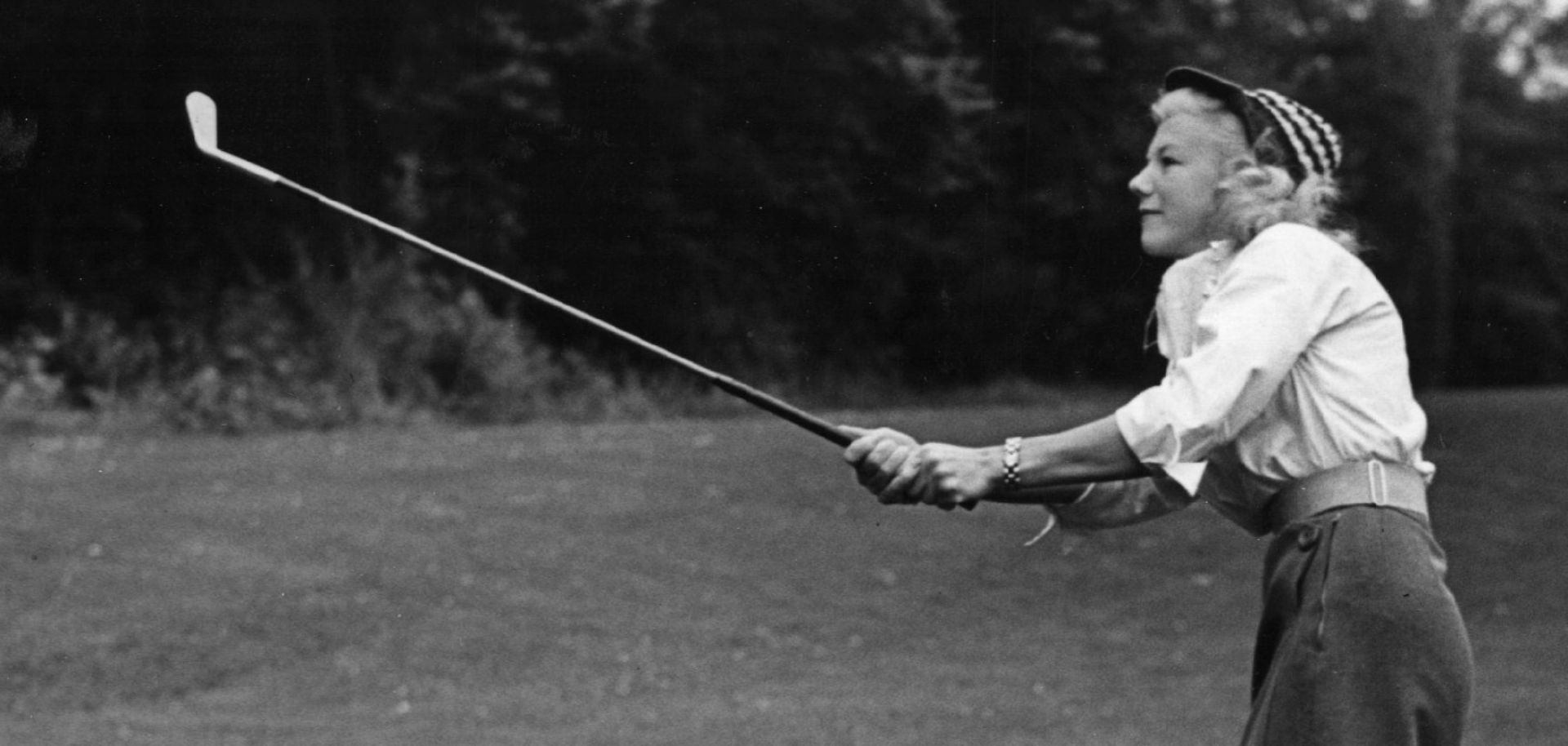
Sheila Hamilton with her Alsatian caddy during a golf match at Primer Hill during the 1950s.
I've had a passing interest in golf for as long as I can remember. The seemingly endless stream of tournaments that my father watched on TV first exposed me to the sport. Moreover, my hometown of Austin, Texas, enjoys a rich golfing tradition. It was the home of the "Socrates of the golf world," as Sports Illustrated dubbed legendary teacher Harvey Penick. Besides mentoring professional golf superstars Tom Kite and Ben Crenshaw, plus hundreds of other players, Penick wrote the top-selling sports book in history, Harvey Penick's Little Red Book: Lessons and Teachings from a Lifetime in Golf.
I was also blessed to grow up next door to the historically significant Lions Municipal Golf Course. Its 16th hole was known as "The Hogan Hole" in honor of its famous characterization by another legendary player, Ben Hogan, as "the only hole I've ever seen without a fairway." Perhaps more important, "Old Muni" was the first course south of the Mason-Dixon Line to open its doors to racial minorities. It was always a treat when my dad took me there for some swings on the practice range.
After a recent decision to take golf lessons, I made the trip to the old course for the first time in a few years. Despite it being a beautiful weekend, the course was stunningly underpopulated. Perhaps I shouldn't have been surprised. Golf in the United States, according to almost every metric, is struggling. The total number of U.S. courses is down by more than 1,000 since 2005, and over that time period, millions of players have quit the game.
In the U.S., a Subpar Showing
There are several reasons for the sport's decline. For one, the game seems poorly equipped to weather the country's changing social norms. In comparison to historical standards, men (who make up over 77 percent of U.S. golfers) today are typically much more involved in child-rearing and household management. Most married households feature two breadwinners. In addition, an increasing number of men are stay-at-home dads. And despite the continuing wage gap between the genders, women are outperforming their male counterparts in many other ways. More women than men receive college educations, and an even greater proportion go on to advanced graduate work. My own wife's professional life reflects these developments: She holds a master's degree in accounting and is the vice president of her company.
That means I need to hold up my end of the bargain at home. I take the kids to school on a majority of weekdays, and I'm in charge of a number of household chores. I also help coach their Little League team and I am sometimes on my own with them when my wife has a work or social event. I'm happy to do all this, of course; it's what I signed up for as a father. But it doesn't leave much time for taking up a sport like golf. Consider that an average round takes four hours to play. And at most courses, you must arrive at least 30 minutes before your scheduled tee time. When you figure in driving to and from the course, we're talking about at least a five-hour commitment.
The game not only demands time, but it also requires money. Even at the moderate end of the scale, equipment costs can easily exceed the budgets of many lower-income people. Greens fees, even at municipal courses, can add considerably to the tab. And the cost to join a private club ranges from the expensive to the outright ridiculous. The fact that course designers over the past several decades have tended to favor longer, more difficult layouts in response to advances in club technology that allow even duffers to hit like the pros of old has also made the sport more challenging for new players to access. Given all these factors, it's no wonder that golf is struggling in the United States.
Out of the Rough
For all its problems in the United States, golf is becoming more popular in other areas of the world — possibly as a product of greater affluence in historically poorer countries. It was no accident that, after a 112-year absence, the sport returned to the Olympics last year in Rio de Janeiro. Not surprisingly, the potential for industry expansion elsewhere has caught the attention of course designers and investors. A recent study by The R&A, the organization that governs the sport outside the United States, found that 556 courses are currently in the planning or construction phases around the world. Even though golf has fallen out of political favor in China, Asia alone accounts for about 30 percent of that total.
Interest in golf has likewise mounted in the former Soviet satellites of Central and Eastern Europe. Indeed, since the collapse of the Soviet Union in 1991, the market for the game in the region has grown at an average annual rate of 13 percent. South America is emerging as an important site for golf growth as well. In fact, over the past seven years, the continent has featured the highest growth rate in course additions in the world. Even Africa has 51 new facilities under development.
Golf's Future Course
While the globalization of golf gives reason for optimism for fans of the sport, those interested in preserving the game for future Americans will have to consider making some dramatic changes. Greater opportunities may be needed in terms of nine- or even six-hole games. Course designers, of course, will also need to think about how to moderate the challenges that new players face. And the sport will need to find ways to reduce player costs and attract individuals from new demographics.
But perhaps there is room for optimism. Officials in the U.S. golf industry are well aware of the problems that the game faces. The USGA started a "Play 9" initiative several years ago that promotes shorter rounds for golfers and shorter courses alike. So far, the outcome of the effort has been encouraging: Since 2014, the number of nine-hole games played has grown by more than 10 percent annually. Furthermore, attendance at practice ranges and other nontraditional golf sites seems to be on the rise.
Dallas-based Topgolf may provide the model for preserving the sport in the United States. The company runs 33 entertainment complexes worldwide (with 19 more currently being planned) that combine innovative golf-based competitions with food, music and beverages. It bills its offerings as scalable to any age or skill level, including children. The result has been wildly successful: The company boasts an annual visitor total that exceeds 8 million. In May 2016, the men's and women's pro golf tours entered into a strategic alliance with the firm. "This is a game-changer," said Mike Whan, commissioner of the women's tour. I hope he's right.
