
(FREDERIC J. BROWN/AFP/Getty Images)
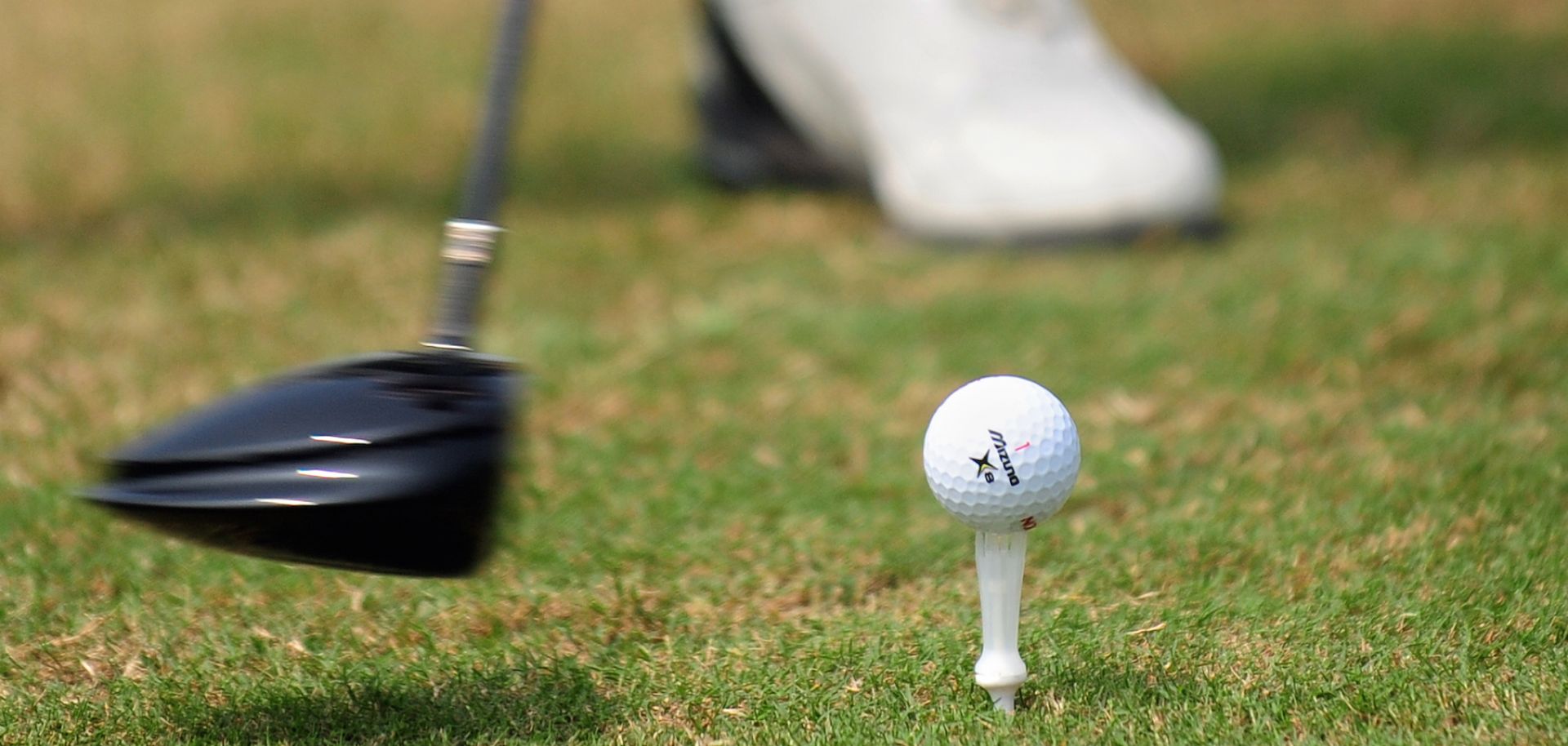
A golfer tees off at a course in Sanya in China's southernmost tropical island province of Hainan. Last year, as part of his well-publicized crackdown on corruption, Xi emphatically banned Communist Party members from playing golf.
Of the most abused (and, at times, inaccurate) sports cliches, the one extolling the unifying power of competition has to be near the top of the list. Never mind parental brawls at Little League games or the 1969 "Football War" between El Salvador and Honduras, do sports not bring us together? Cynicism aside, the bouncing ball does occasionally lead to pivotal geopolitical moments. One of the shining examples of sports bridging a gap between countries came in the early 1970s, when international table tennis tours facilitated a thaw in relations between China and the United States.
The era's Ping-Pong diplomacy deserves a column in its own right, but in short: the tabletop game provided an opportunity for both Chinese leader Mao Zedong and U.S. President Richard Nixon to save face as the countries sought to end more than two decades of hostility. In 1971, China hosted the American team for exhibition matches; a reciprocal trip brought the Chinese team stateside in 1972. By focusing on cultural and sporting exchanges and highlighting how the sportsmen of two nations could come together, diplomatic doors quietly opened, and the process of normalizing relations began.
During Chinese President Xi Jinping's visit to the United States in early April, another sport played with a little white ball moved to the fore. At the meeting with U.S. President Donald Trump at his Mar-a-Lago resort in Florida, it was hard to ignore the legacy of sporting diplomacy between the two countries. Yet, beyond the similar dimensions of golf and ping-pong balls, this encounter had little in common with its famous predecessor.
The meeting itself appears to have been amicable enough, although not particularly eventful — its most notable aftermath being Trump walking back some of the more hyperbolic critiques of China that were proffered during his presidential campaign. Symbolically, the location of the meeting, mere miles from Trump's frequent weekend destination, his eponymous 27-hole golf resort, was perhaps the most interesting element. Especially given Xi's vocal criticism of golf in China and his apparent lack of interest in playing the game himself. Of course, taking into account Trump's already regular trips to Mar-a-Lago and his penchant for routines, we must be careful not to over-interpret the site selection as a power play on Trump's part. However, the encounter provides an opportunity to reflect on the history of golf in the People's Republic and how the current status of the sport reflects China's tenuous development into a modern, global power.
In 1949, Western sports were an early focus of Mao's post-revolutionary tenure. Basketball, with its focus on harmonious teamwork and the collective spirit, could stay. Unsurprisingly, the individualistic, bourgeois game of golf was a nonstarter; a course in Shanghai was converted into the city zoo. Restrictions on the game were loosened in the 1980s as the social and economic reforms led by Deng Xiaoping allowed for a cautious engagement with Western notions of leisure. A nascent golf industry emerged in the 1990s, with a small surge in course construction, like the Jack Nicklaus-designed layout at the Mission Hills resort in Shenzhen. Today, every Chinese province boasts at least one course.
Shifting economic tides and the emergence of a Western-influenced consumer class made golf something of boom industry in 21st century China. As tastes have shifted to European luxury brands and Starbucks franchises continue to pop up on every corner, the embrace of the once-taboo sport should come as little surprise. From 2004 to 2009, the number of golf courses in the country increased from 170 to nearly 600. In 2005, the country's first professional tour, the Omega China Tour debuted, running until 2009. A women's professional tour, part of the LPGA, was established in 2008. A men's professional tour, the PGA Tour China, was introduced in 2014.
Despite the emergence of the sport and China's general fondness for athletic competition, the Chinese population at large has not embraced golf. The cost of playing remains out of reach for most Chinese; wealthy businessmen and foreign tourists still account for most tee times. However, the game did seem to be steadily gaining traction. A golf industry report notes that some 400,000 Chinese golfers played in 2011, projecting that if the annual 10 percent growth rate of participation in the sport held, that number could hit nearly 20 million by 2020. At the elite level, Chinese golfers like Li Haotong and Lian Wenchong, are beginning to make a splash, even if they have yet to crack the upper echelon of the sport. On the women's side, Feng Shanshan is the current star, owing to her bronze medal performance at the Rio 2016 Olympics, the country's first medal in the sport.
Despite this progress, golf has not been exempt from the Chinese cultural identity crisis in recent years. The PGA Tour China? After three mostly successful years, the start of the 2017 iteration was delayed, and its status is in jeopardy. That aforementioned boom in golf course construction between 2004 and 2009? Well, it came after a 2004 ban on new courses, which the government deemed to be an environmental and economic extravagance. If you'll afford me the pun, this seems par for the course in modern China, where local officials and quasi-capitalist development engage in a complicated dance with official Party dictates; most of the new courses were developed as "sport parks" or "leisure centers" that happened to have 18 holes, sand traps and water hazards.
For his part, Xi appears intent on making an example of golf. Earlier this year, his government shut down over 180 courses, citing environmental concerns and the misappropriation of farmland and natural areas. Last year, as part of his well-publicized crackdown on corruption, Xi emphatically banned Communist Party members from playing golf. In the wake of these developments, Xi's time at Mar-a-Lago was inevitably fraught with symbolism. On one hand, Xi is steering the country through an economic cool-off and challenges to Party ideology. On the other, as his comments at January's World Economic Forum at Davos indicated, he is intent on seeing China take a stronger leadership position in world affairs. While he may never tee off himself, Xi will inevitably have to tolerate the maddening game, both at home and abroad.
