
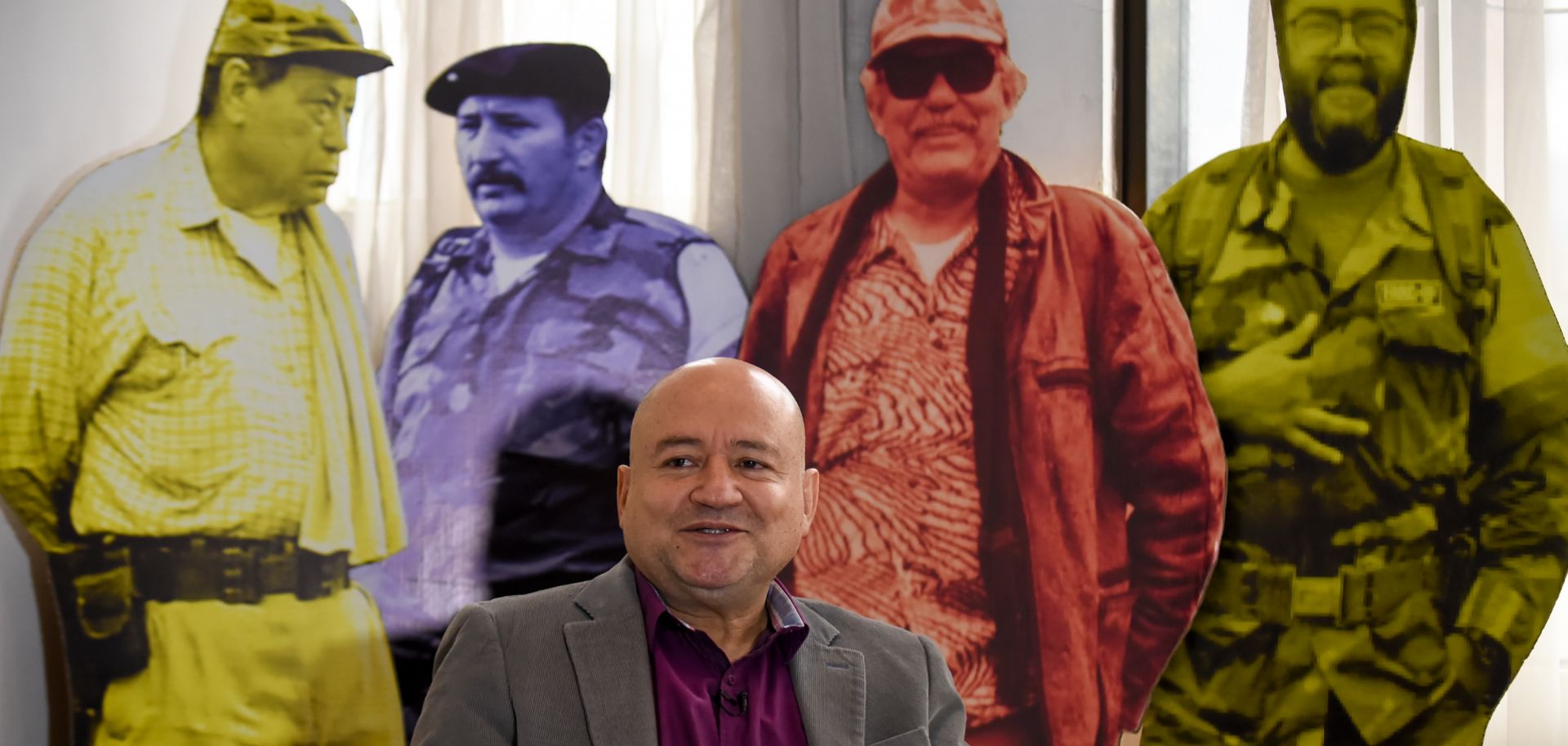
FARC commander Carlos Lozada speaks in front of the images of late FARC leaders Manuel Marulanda Velez, Jorge Briceno Suarez, Jacobo Arenas and Alfonso Cano.
An Uphill Battle
Within the next few months, FARC will receive at least five seats in each house of the legislature, and its allies will have the opportunity to compete for seats in 16 electoral districts. The group will also change its name to the Alternative Revolutionary Force of Colombia. (Conveniently, its acronym will remain the same.) Regardless of any formal and legal rebranding, however, the new FARC party will enter the country's political scene at a disadvantage.
As in other Latin American countries, Colombian politics have been largely defined by a two-party system for many years, starting in the mid-19th century. Indeed, the country's Conservative and Liberal parties remained dominant well into the 20th century, and the two had regular confrontations that at times turned violent. A particularly influential period of conflict lasted from 1948 to 1953, after the assassination of populist Liberal politician Jorge Eliecer Gaitan led to mass rioting. It was out of this clear, two-sided confrontation that FARC emerged in 1964. Initially a radical wing of the Liberal Party, the group quickly established itself as a communist insurgency. It intended to challenge the state not by winning elections, but by using force, and it followed through with that intention with several decades' worth of guerrilla warfare.
However, the two-party system that defined the Colombian government for more than a century began to diversify in the 1990s and early 2000s as the country's political environment grew more tolerant and the differences within the dominant parties grew more distinct. Major figures, both liberal and conservative, splintered off to form their own parties. Now the Colombian legislature is mostly divided among five political parties, presenting a competitive electoral landscape for the newly formed FARC party. Rather than being the only alternative to the Liberals and Conservatives, FARC is one option among many, and a controversial one at that. Even more leftist parties, such as the Alternative Democratic Pole, have little in common with FARC on an ideological level. And convincing the voting public that FARC is no longer associated with the violence of its past will not be as easy as a name change or a stamp of approval from the government.
Positioned so far outside the political mainstream, FARC will struggle to expand its legislative presence in upcoming electoral cycles. The 16 seats the party has the chance to vie for are tied to underrepresented districts in which it happens to have local support, but outside of these regions, FARC is not widely trusted. In its infancy, moreover, the party doesn't have the political patronage networks needed to run strong electoral campaigns and earn new votes. As a result, it may face legal risks as it tries to expand in coming elections: Though the group promised a clean break from insurgency-related crimes, some of its leaders — particularly at the local level — may continue to obtain funds illegally. In general, illicit campaign funding is not unusual in Colombia. But FARC will likely be under extra scrutiny from its political opponents, and if the evidence is clear enough, some of the party's candidates may face disqualification or criminal charges.
A Little Leverage
The rebels' new party will most certainly be fighting an uphill battle as it tries to expand its influence at the national level. But even if it can't make a big splash right away, the new FARC can still create small ripples that will indirectly impact the government. FARC's main strength as a political entity will be its capacity to leverage votes in exchange for political favors from other parties. And if FARC allies secure seats in the 16 districts up for grabs, it may have enough of a presence to play a crucial role in close legislative votes, using its position to obtain benefits such as social spending or public works in regions where it has an established presence.
FARC may also collaborate with the political wing of Colombia's second-largest leftist insurgency, the National Liberation Army (ELN). FARC's existing political branch, known as Marcha Patriotica, has allegedly already begun discussing an alliance with its ELN counterpart, the Congress of the People. Once FARC is an official party, this alliance could help its candidates gain local offices, perhaps as municipality mayors. Of course, such minor offices won't greatly benefit FARC on the national level, but the party has no choice but to start small. These local successes could happen in tandem with FARC's leveraging of votes in Congress to serve its electoral districts. And this strategy, if executed successfully, may slowly help the new party cement its place in Colombian politics.
