
After more than 50 years fighting off a left-wing insurgency within its borders, Colombia may be on the verge of achieving a peace agreement with the largest of the country's militant revolutionary groups, the Revolutionary Armed Forces of Colombia (FARC). The historic deal would effectively diminish violence in the country to whatever the other major left-wing Colombian militia, the National Liberation Army (ELN), can sustain on its own. The drop in politically motivated attacks would open the door for economic growth; companies that have previously stayed out of Colombia's violent regions would start investing there again, particularly in extractive industries such as mining and energy production.
But a peace agreement would not resolve everything. Even if FARC militants by and large lay down their arms, many will stay active in criminal activities such as drug trafficking and illegal extraction of resources. Much of rural Colombia, along with several cities, would still be plagued by violence, this time perpetrated by criminal organizations in the name of profit rather than militias in the name of Marxist-Leninist ideology.
From Militancy to Organized Crime
Large groups of former militants in Colombia have turned to major crime before. The main criminal organizations in the country today formed a little more than a decade ago around a core of former militant leaders from the Self-Defense Forces of Colombia — a paramilitary organization opposed to the FARC. When the group officially disbanded in the early 2000s, former members joined together to form crime groups. These organizations trafficked drugs, illegally extracted oil, and extorted money from local businesses and residents. Over time, competition and law enforcement efforts broke up these groups, fragmenting organized crime in Colombia, similar to the drug cartels in Mexico.
The largest group is the Clan Usuga, also referred to as the Urabenos, which operates as a loose confederation of criminal organizations that exercises influence nationwide. More regionally focused groups include the remnants of the Rastrojos, a criminal group that broke apart in 2012 after its main leaders were arrested, and small criminal groups operating in Medellin.
Major criminal organizations are involved in activities including illegal mining, extortion, and smuggling of food and fuel from Venezuela. All these are profitable; in fact the FARC's fellow revolutionary guerrilla group, the ELN, supports itself partially by engaging in all three even as it keeps politically motivated violence at the center of its agenda. But one of the major sources of revenue for these groups is cocaine.
Colombia's Illicit Drug Trade
Colombia has been a major coca-growing nation and cocaine producer since the 1970s, and today it is still the primary exporter of cocaine to the United States and Europe. Along with Peru and Bolivia, Colombia is the first link in the cocaine supply chain to the rest of the world. Organized criminal groups there are primarily focused on producing cocaine and selling it to Mexican criminal organizations or to other groups that traffic it to the United States, Europe, East Asia and other parts of the globe. With so many eager markets, the cocaine trade will continue to drive most organized criminal activity in Colombia.
Given the opportunities in the drug trade, many former FARC militants would likely move into major crime after leaders came to a peace agreement with the Colombian government. Lower-ranking members in particular, who would not receive the same kinds of amnesty offers their superiors get, would have to find ways to evade authorities and fend for themselves. Just as other paramilitary groups did in the early 2000s, they may form their own groups and rebrand these organizations under new names, remaining involved in the same criminal activities as when they were acting under the FARC. Thus FARC may evolve into simply another group in Colombia's criminal landscape.
Areas of Concern
The array of active criminal organizations will keep levels of violence relatively high in Colombia for the foreseeable future. Overall, the country is actually becoming safer, and has been for decades. Today violence related to the drug trade is much lower and more geographically isolated than it was during the 1980s and 1990s. But even as the country becomes safer overall — and even newly free of a FARC insurgency — it will still be risky for companies to operate in several areas, mainly the Pacific coast, the Venezuelan border and the southern interior.
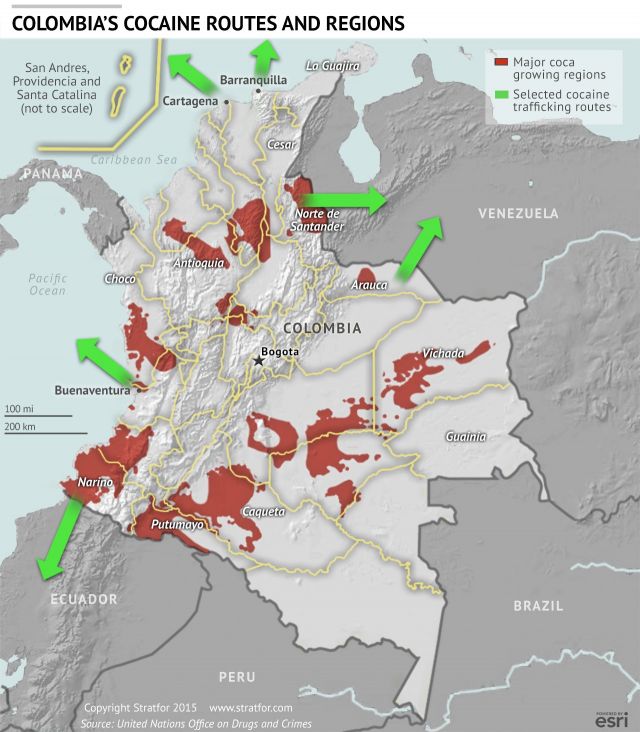
Colombia's northwestern region, particularly the department of Choco, has become a battlefield for rival crime groups. The Clan Usuga (known locally as Gaitanista Self-Defense Forces of Colombia) as well as the FARC and ELN compete in operating illegal gold mines and extorting small-scale mining operations in the department. During 2014 and 2015, a turf war broke out between the ELN and the Clan Usuga in Choco that continues to this day. Thanks to the fierce rivalry, Choco now has a homicide rate of 30.5 per 100,000 inhabitants, compared with the national average of 26.5 for every 100,000 inhabitants.
Elsewhere in the northwest, FARC and the Clan Usuga operate illegal mines, extort gold mining companies and produce cocaine in the Antioquia department, clashing frequently and catching residents and companies in the crossfire. In October 2015, a Colombian firm associated with the Canadian gold mining firm Gran Colombia Gold had to cease operations after an attack by Clan Usuga gunmen killed two Colombian employees, likely as punishment for refusing to pay extortion fees.
Northern Colombia may be a major source for gold, but the southwestern departments are home to another lucrative industry: cocaine. The department of Narino holds around 25 percent of the country's planted coca, much of which is processed into cocaine and smuggled out through local and Ecuadorian seaports. The FARC has a lot of power in the area, so the peace agreement could ostensibly stabilize it to some extent. At the same time, if FARC members stay involved in organized crime — which they likely will — companies in Narino and Putumayo departments run the risk of having to pay steep extortion fees to former militants looking to turn a profit. In addition, since 2011, Clan Usuga factions have moved into the area, especially Buenaventura and other cities. And where there are competing criminal organizations, local residents and the local economy will suffer.
Along with the north and southwest, Colombia's lengthy border with Venezuela will also remain a major area of activity for Colombian criminal groups, largely because it is vital transit route. All major Colombian criminal organizations involved in trafficking cocaine abroad smuggle it through roads and rivers to Venezuela, through sections of the Colombian departments of La Guajira, Vichada, Guainia, Arauca, Norte de Santander, and Cesar. And their cargo is not confined to drugs: The Clan Usuga, the FARC, the ELN and other smaller groups smuggle subsidized fuel and food in from Venezuela as well.
Some areas along the border such as such as Vichada and La Guajira are too remote for most foreign firms, though some firms are located there. But in other parts of the border region — as in the gold and coca-producing parts of the country — firms seeking oil and mineral resources there risk being harassed by the various crime groups. FARC or ELN remnants will likely continue to threaten companies operating in Colombia's energy industry in Norte de Santander, Boyaca and Arauca departments with extortion.
Enduring Risks
Colombia has more challenges to economic growth and political stability than just a revolutionary insurgency. Today the government is closer than ever before to reaching a deal that could stop the FARC, its most powerful rival, from attacking pipelines, downing electricity transmission lines and waging war against government forces on Colombian soil. A peace agreement would be a huge step forward, opening the door to foreign investment and creating a more stable environment for businesses.
But in the end, the deal would not completely resolve the problem, because it would not eliminate the groups responsible. Following the lead of paramilitary groups that disbanded in the early 2000s, a post-deal FARC would probably continue the same kinds of criminal activity. Certainly, the hierarchical, unified military organization it is now would disappear, instead fragmenting into smaller groups under new names. But that decentralization will only stoke violence as multiple groups compete with one another.
At the same time, there is room for optimism. The same fragmentation that may increase competition between crime groups will also make those groups smaller, weaker and easier to shut down. If the FARC and the Colombian government do sign an agreement, the government will be able to turn its attention to organized crime. This shift is already occurring, as a targeted aerial strike of a Clan Usuga camp in Choco on Nov. 2 resulted in 12 deaths among the criminal group's members. And after several decades battling insurgents, Colombia may be better equipped than ever to crack down on the drug trade.
