
It is not the first time that such groups have come to the negotiating table. A faction of the Urabenos collective led by the group's founder, Daniel Rendon Herrera, took tentative steps in 2014 to surrender to Colombian authorities. Reports emerged in April of that year that the group wanted to capitulate, and in September, Rendon released a video calling on his group to demobilize. In November, the Colombian attorney general's office announced that it would present a draft law to allow unspecified criminal groups to demobilize, but the law never materialized. In May 2015, the Colombian government appointed a representative from the attorney general's office to conduct exploratory talks with Rendon's faction. The willingness to cooperate was not limited to just Urabenos, however, as unconfirmed reports indicate that a faction of the Rastrojos criminal group was also attempting to negotiate its surrender to the government earlier this year.
The Urabenos in Context
The Urabenos, sometimes called Clan Usuga, are smaller and less centrally controlled than the United Self-Defense Forces of Colombia, the more politically motivated group they emerged from. The parent organization fragmented in a series of demobilizations from 2003 to 2006, culminating in Rendon's departure in 2006. Within a year, a coterie of former United Self-Defense Forces of Colombia members formed around Rendon and resumed criminal activities. The group strengthened after the Rastrojos — another remnant of the United Self-Defense Forces, and the Urabenos' closest rival — split after its top leaders were arrested in 2011 and 2012.
Until a division between Rendon and another leader, Dario Usuga, emerged in December 2014, the Urabenos were Colombia's most cohesive drug trafficking organization — other than the Revolutionary Armed Forces of Colombia. They also were involved in coca growing, extortion and illegal gold mining across the country. Unlike the major militant groups, however, the Urabenos conduct few targeted attacks against security forces and none against energy infrastructure. Currently, the Urabenos are not a single entity. They are a loose confederation of criminal groups across the country, often acting in unison, though a number of the criminal groups calling themselves Urabenos likely answer to either Rendon or Usuga.
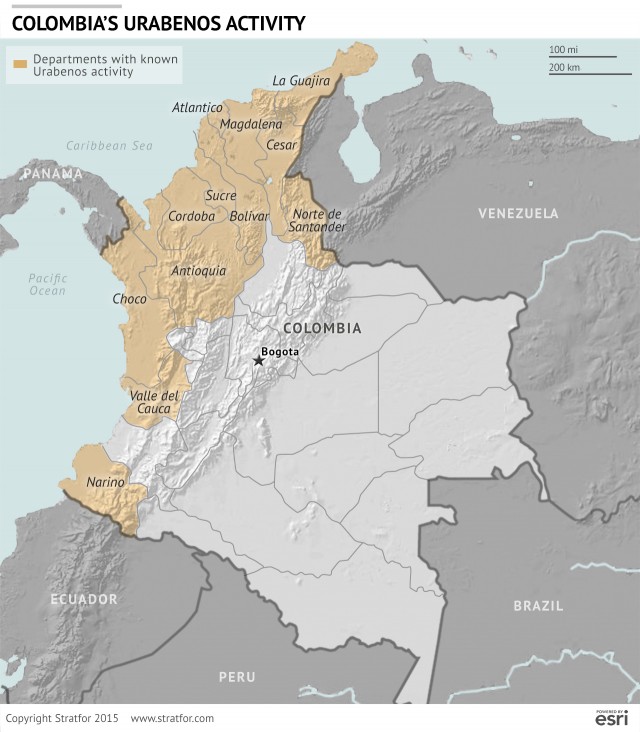
Despite their nationwide presence, the group poses a smaller threat to public security than Colombia's left-wing insurgency. The Urabenos and other criminal groups are notably weaker and more divided than the FARC, which is the largest criminal structure capable of inflicting damage on Colombian government and private business interests countrywide. The Urabenos' main connection to the FARC is through alliances in strategic cocaine trafficking areas, including the departments of Narino, Cordoba and Antioquia. The group's limitations are on account of its role in the cocaine supply chain. Since the shift in cocaine trafficking routes to Mexico in the 1980s, Mexican criminal groups control the bulk of profits from the trade. As coca growers, cocaine producers and the first link in the trafficking chain, Colombian drug trafficking organizations keep significantly less of the profits from the cocaine trade than their counterparts in the 1970s and 1980s did. Consequently, they are far weaker than the criminal groups of decades past.
Limited Gains Expected
The government's decision to engage part of the Urabenos in peace negotiations is likely an attempt to secure a victory similar to those achieved against criminal organizations over the past 15 years. The surrender of at least some of Colombia's unlawful elements could lead to reorganization and infighting among the country's remaining criminal groups. Moreover, the government could further disrupt criminal operations if demobilized personnel are willing to provide intelligence. The structural factors that make Colombia a major cocaine production hub will keep drug shipments flowing in the long term, but dividing the Urabenos would reduce the number of public security threats the Colombian government contends with.
In the coming months, the attorney general's office will continue talks with the Urabenos faction to encourage demobilization. If the talks lead to a deal, the agreement would more closely resemble the surrender of a criminal organization than an eventual FARC peace deal, which involves negotiations over the militants' eventual political role. Apart from its regional alliances with specific FARC fronts — which are based on mutual criminal interests, such as extortion, illegal mining and cocaine trafficking — the group has no political motivations that would require a lengthy negotiation to address. Compared to the lengthy FARC talks, the surrender of Urabenos leaders and members could be a short process.
If a section of the Urabenos demobilizes, the subsequent loss of leadership at a national level could lead to infighting among the group's local franchises. Depending on which leaders and members surrender, violence could increase in areas such as Medellin and parts of Colombia's Caribbean and Pacific coasts as the groups split, or other criminal organizations rush to fill the vacuum left by the weakening Urabenos.
