
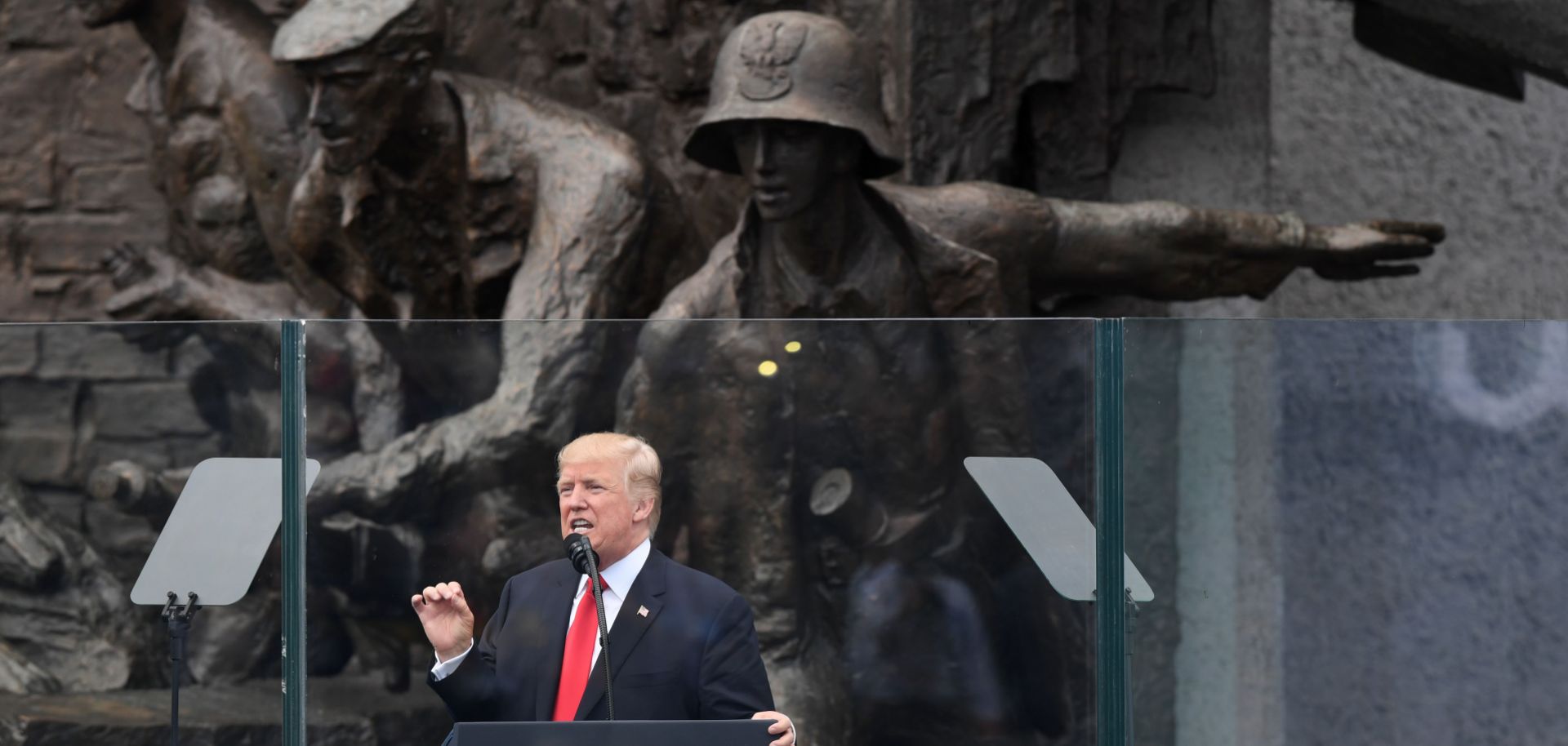
U.S. President Donald Trump speaks July 6 in front of the Warsaw Uprising Monument in Warsaw, Poland. Polish President Andrzej Duda said Trump's visit shows Poland is "a country that matters." U.S. President Donald Trump's visit to Poland on July 6 brought no major surprises, but it was enough for the government in Warsaw to feel relieved. Trump said the United States is "committed to maintaining peace and security in Central Europe" and that his administration is working with Warsaw "in response to Russia's actions and destabilizing behavior." Trump also said the White House supports Poland's strategy to diversify its energy sources. And while Trump's visit to Poland had a deep symbolic meaning, some concrete decisions were also taken, as the United States agreed to sell Patriot missile defense systems to Poland. These events happened only hours before Trump is scheduled to have his first meeting with Russian President Vladimir Putin on July 7 on the sidelines of the Group of 20 summit in Hamburg, Germany, an encounter that Poland (and the rest of the world) will be watching closely.
U.S. President Donald Trump's visit to Poland on July 6 brought no major surprises, but it was enough for the government in Warsaw to feel relieved. Trump said the United States is "committed to maintaining peace and security in Central Europe" and that his administration is working with Warsaw "in response to Russia's actions and destabilizing behavior." Trump also said the White House supports Poland's strategy to diversify its energy sources, and that he hopes U.S. shipments of liquefied natural gas to Poland will increase in the future. And while Trump's visit was deeply symbolic, some concrete decisions were made, as the United States agreed to sell Patriot missile defense systems to Poland. These events happened only hours before Trump is scheduled to have his first meeting with Russian President Vladimir Putin on July 7 on the sidelines of the Group of 20 summit in Hamburg, Germany, an encounter that Poland (and the rest of the world) will be watching closely.
Polish officials had been looking to meet with Trump for months. Warsaw has relatively cold relations with Brussels, as it refuses to accept an EU plan to distribute migrants across the bloc, and the EU Commission is investigating whether reforms in the Polish judiciary have weakened the rule of law in the country. More important, Poland sees the United States as its ultimate protector against potential Russian aggression. This viewpoint explains why Warsaw wants to make sure its relations with the United States remain as strong as possible. According to Polish President Andrzej Duda, Trump's visit "shows we are a country that matters and it strengthens our position in the European Union."
From the White House's perspective, the fact that Poland is one of the few NATO members that meets the alliance's spending target of at least 2 percent of gross domestic product on defense allows the United States to present Poland as an "exemplary" NATO member at a time when the White House is asking other members to increase their military spending. The two countries already have strong defense ties, as U.S. troops are in Poland on a rotational basis, including many who were deployed in January to boost NATO's presence in Eastern Europe. Poland participates in NATO missions in places like Afghanistan as well. Poland is also a customer for American energy, investment, weapons and technology, and both sides are interested in deepening these ties. Moreover, Poland's governing Law and Justice party's views on issues such as climate change and immigration are similar to Trump's.
Trump's visit was an important event for the rest of the region as well, because it coincided with a summit of the Three Seas Initiative, a gathering of a dozen EU members along the Baltic, Black and Adriatic seas. These countries are interested in improving their energy infrastructure connections to diversify their energy sources, and in developing closer political and economic ties. Some members of the initiative, especially those on the Baltic and Black seas, are also interested in enhancing their military cooperation and they share Poland's concerns about Russia. For them, economic and political ties with the European Union are important for their prosperity, but close defense ties with the United States are fundamental for their security.
At a time when the White House openly disagrees with Germany and France on issues such as trade and the environment, Trump seems interested in showing that his administration has good ties with Poland. In Warsaw, Trump criticized "the steady creep of government bureaucracy" and praised the sovereignty of nations. While he did not explicitly mention the European Union, these statements were seen by some as a veiled criticism of it. But the bloc is sending signals of its own. While Trump was speaking in Warsaw, Japanese and EU officials in Brussels announced they had agreed to a free trade deal. The timing of the announcement is not a coincidence, as Japan and the European Union wanted to send a message of their support for free trade before the G-20 meeting.
The Trump administration is forcing Europe's largest political and economic players to perform a delicate balancing act. On the one hand, Germany and France have to criticize Trump's positions on issues such as immigration, protectionism and climate change, for domestic reasons, as the U.S. president is unpopular in both countries. They also are interested in siding with economic giants such Japan and China on the defense of free trade. On the other hand, Germany and France cannot afford to worsen their ties with the world's largest economic and military power. In fact, Trump will return to Europe on July 14 to participate in France's Bastille Day celebrations. On issues ranging from global trade to the fight against terrorism, the European Union cannot afford (nor has the means) to isolate the United States.
Trump's visit to Poland served as a preamble to his meeting with Putin on July 7, too. During the 2016 presidential campaign, Trump promised to improve relations with Russia, but he has toned down that rhetoric in recent months. Still, on July 5, U.S. Secretary of State Rex Tillerson stated that the White House is willing to consider stability operations with Moscow in Syria. A rapprochement between the United States and Russia, even if it's a limited one, would certainly make Poland anxious. At the same time, relations between the European Union and Russia remain ambiguous, as the bloc recently extended sanctions against Moscow for six months because of the situation in Ukraine, but the German government defends infrastructure projects like the Nord Stream II pipeline, which would carry Russian natural gas to Germany. An improvement in U.S.-Russian relations would force not only Warsaw but also Berlin and Paris to recalibrate their foreign relations and rethink their strategies.
