
British Prime Minister Theresa May's best-laid plans seem to be going awry. When she called snap elections back in April, her center-right Conservative Party held a solid 20-point lead in the polls. May had hoped to capitalize on the ruling party's performance and secure a parliamentary majority to ease the difficult Brexit negotiations that await. But as voters in the United Kingdom prepare to vote June 8 in their second general elections in three years, the Tories' lead has slimmed considerably. Following a shaky campaign and an unprecedented surge in popularity from the leftist Labour Party, May now faces the possibility that the upcoming elections will leave her in the same position she started, or worse. And depending on the vote's outcome, both sides of the Brexit negotiations may have to reconsider their approach.
A Mean Loss
The opinion polls this campaign season have been unusually inconsistent. After nearly every polling company failed to foresee the parliamentary majority the Conservatives pulled off in 2015, many firms tweaked their methodologies in different ways, causing a wider spread in their projections this time around. But though the numbers vary from poll to poll, they all tell the same story: The ruling party is losing its edge. The Conservatives led the Labour Party by 18 to 24 percentage points when May called the elections April 18. Today, that lead has waned to between 1 and 12 points, with most polls showing an advantage of 4 to 6 points.
These numbers bode ill for the current administration. May's government has a working majority of just 17 seats, small enough that a handful of dissenting Tory parliamentarians could hamstring it. To maintain a majority, the Tories need to win at least 326 seats in the June 8 election (and a solid majority would require an additional 40 to 50 spots). A recent poll from YouGov, however, predicted that with a 4 percent lead, the Conservatives would win only 305 seats, a far cry from the 150-seat majority that seemed feasible in April.
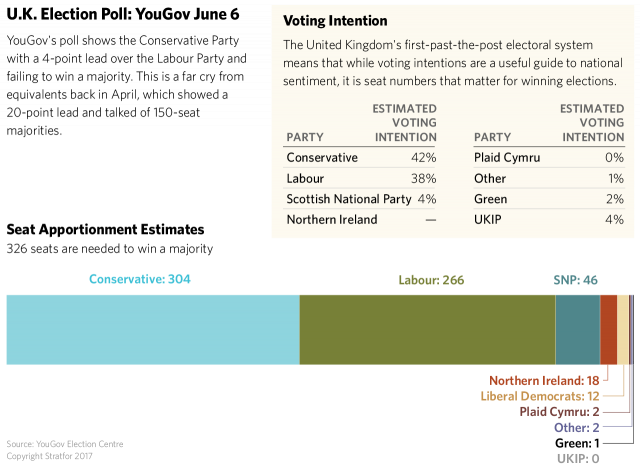
Predicting Britain's Next Government
Even so, a Conservative victory is the most likely scenario for the upcoming vote. If the Tories perform better than the polls suggest, and May clinches the large majority she was hoping for, the government will enter Brexit negotiations with a clear mandate and the leeway to pursue its priorities regardless of internal dissent. Should the Tories come away with a narrow majority, on the other hand, the prime minister could be in trouble. May has been widely criticized for her party's poll performance, particularly since it was not necessary for her to call an early election. The Conservative Party, famously ruthless in such situations, may opt to replace its leader, and it would be vulnerable to dissident factions. Alternatively, the Labour Party could eke out a majority in Parliament. Though the result is highly improbable at this stage, considering the rapid changes in the polls and their wide margin of error, it can't be ruled out altogether.
If both parties fall short of a majority, the United Kingdom will wind up with a hung Parliament on its hands. This is the scenario most pollsters expected in the 2015 election, and today, it would most likely lead to a Tory-led coalition or a Labour minority government. Either way, a hung parliament could make for some tricky coalition computations.
The Conservatives' natural coalition partner, Northern Ireland's Democratic Unionist Party, provides only around eight seats in Parliament. The centrist Liberal Democrats would be another option for the Tories; polls suggest the group would offer about the same number of seats as the Democratic Unionist Party, though it may well exceed expectations. To win it over, however, the Tories would have to compete with the Scottish National Party, which shares many of the Liberal Democrats' progressive ideals. Allying with the group is a politically risky move for parties south of the Scottish border, as that likely would require concessions toward Scotland's independence. For that reason, the Labour Party has explicitly ruled out the Scottish National Party as a coalition partner. Labour is also highly unlikely to form a coalition with the Tories, given their long-standing rivalry. Should the parties fail to reach a workable compromise, new elections could occur.
What's Next for the Brexit
Negotiations over the Brexit are in their early stages, and most parties in the United Kingdom are still hammering out their positions on the matter. Nonetheless, clear differences already have emerged among them. The Conservative Party has crafted a negotiating strategy centered around leaving the EU single market and customs union. According to the current Tory government, doing so will free the United Kingdom from the European Court of Justice's influence and enable it to forge new trade relationships with countries beyond the bloc. At the same time, however, the Tories have made clear that they aim to negotiate continued tariff-free access to the European market. The Labour Party also supports leaving the single market, but its position on the customs union is more ambiguous. Party leaders have not clarified whether they would try to leave it and have suggested that the European Court of Justice may still play a role in settling legal disputes in the United Kingdom. The Liberal Democrats, meanwhile, want to stay in the single market and organize a second referendum on the terms to be negotiated in the Brexit. And the Scottish National Party is primarily focused on Scotland's fate, though it has tried to push the government to take a more moderate position on the Brexit.
A narrow Conservative majority would preserve the status quo: The party's Euroskeptic elements could force the government to take a harder line in Brexit talks, perhaps to the United Kingdom's detriment. Under a solid Tory majority, by contrast, the British government would be empowered to ignore the most vocal Euroskeptics and take a softer approach to Brexit negotiations. A substantial Conservative victory is also the only scenario in which the British government could negotiate freely, safe in the knowledge that it wouldn't lose power. After all, polls indicate that the Tories are the only party capable of securing a strong majority.
A hung Parliament would also likely encourage the United Kingdom to soften its stance on the Brexit. If the Liberal Democrats formed a coalition government with the Tories, for instance, they would probably advocate to preserve the rights of EU nationals living or working in the United Kingdom. But they would be hard-pressed to persuade the Tories to hold a second referendum on issues such as the customs union or single market, unless they were to win more seats than expected in the June 8 vote. Should the Labour Party establish a minority government, likewise, the United Kingdom would still leave the single market, though perhaps not the customs union. The prospect of a second referendum over the Brexit negotiations would be no less remote, while the chances of a second referendum on Scottish independence would improve.
And in the unlikely event that the Labour Party wins an outright majority, the Brexit negotiations would probably continue more or less unfazed, despite the major leftward shift in British politics that the victory would portend. The party's position is not drastically different from that of the current administration, beyond its interest in staying in the customs union.
From the European Union's perspective, an altered British government could compel member states to rethink their negotiating strategy. The bloc devised its current position as a response to May's decision to leave the single market and try for a free trade agreement with the bloc instead. But regardless of the vote's outcome and the European Union's reaction, some of the most contentious issues at stake in the Brexit — such as the United Kingdom's financial contributions to the bloc — will remain.
