
The United Arab Emirates takes its National Day celebrations seriously. Though each of the six countries in the Gulf Cooperation Council rings in its own national holiday in similar fashion, Emiratis observe their nation's founding with unrivaled flair. When the country commemorates its 45th anniversary on Dec. 2, parades will wend their way through city streets decked out in the national colors, red, white and green. Flags and lights will adorn buses and strip malls across the young nation, and the world's tallest building, Dubai's Burj Khalifa, will be fully illuminated in honor of the holiday. Doubtless, the country's most recently completed megaproject — a manmade canal that has turned downtown Dubai into an island — will also be festooned for the occasion.
These displays of national pride are as much intended to dazzle outside observers as they are UAE citizens. Since its founding in 1971 — and especially under its current leadership — the United Arab Emirates has striven to impress, cultivating an opulent and progressive image to court the foreign labor it relies on. This approach has paid off; companies from around the world have opened branches in the United Arab Emirates, and its two largest city states, Abu Dhabi and Dubai, are widely considered the most hospitable locales for skilled expatriates in the Gulf region. But the country's success has been hard-won.
From Fish to Riches
For all the glitz and glamor of the United Arab Emirates' national day festivities, the country's wealth and prestige are only a few years older than the nation itself. When the United Kingdom established the Trucial States in 1820 to increase its control over maritime tribes in the area, the sheikhdoms that today make up the United Arab Emirates were little more than backwater trade posts. Fishing and pearl trading were still the main sources of revenue for these desert communities on the Persian Gulf. What the region lacked in economic prospects, however, it made up for in location. The Trucial States afforded the United Kingdom an ideal vantage point from which to monitor its trade and activities in Iran, India and Africa. In exchange, the Trucial States got security guarantees from the British armed forces while continuing the trade with Iraq, Iran, India and countries in sub-Saharan Africa that had sustained the territory for centuries prior.
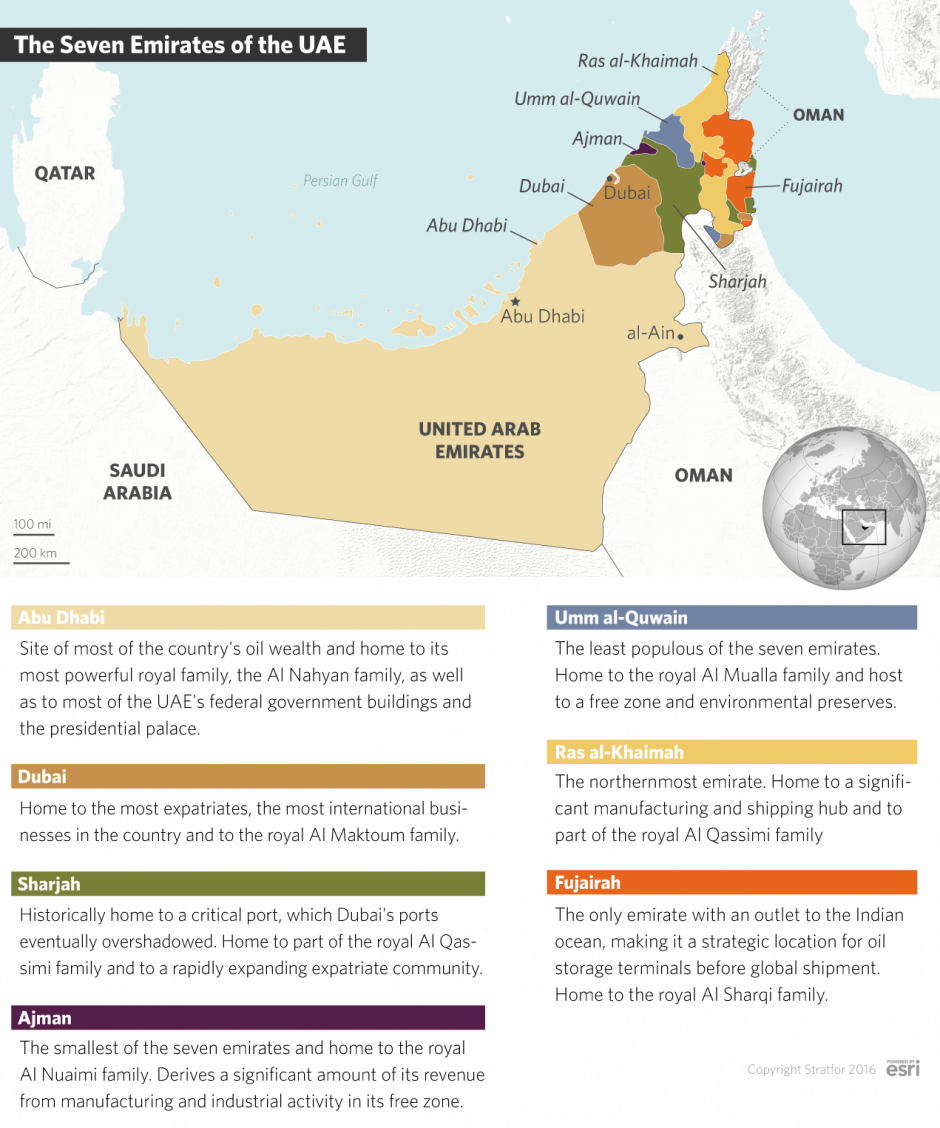
Then the discovery of oil in Saudi Arabia in 1938 set off an oil rush throughout the Persian Gulf region as local leaders wondered whether their territories, too, contained undiscovered deposits. Toward the end of the next decade, British forces withdrew from the Trucial States after nearly 150 years there, prompting the rulers of its constituent sheikhdoms to band together in the absence of the United Kingdom's aegis. The resulting alliance, founded in 1971 by Sheikh Zayed Bin Sultan al-Nahyan of Abu Dhabi, was a loose federation of powerful tribes and ruling families that became known as the United Arab Emirates. (Bahrain and Qatar declined to join the federation, but after Iran's revolution eight years later shocked the Persian Gulf region, they came together with the Emirates, Kuwait, Oman and Saudi Arabia to form the Gulf Cooperation Council.)
In the short time since, the United Arab Emirates has undergone a dizzying transformation, unmatched even by its fellow GCC members. Though Bahrain, Qatar and Kuwait have established renowned financial sectors — something Saudi Arabia is trying to cultivate — they pale in comparison with that of the United Arab Emirates. The trend extends to other areas of the country's economy as well, and looks sure to continue in the years to come. UAE officials anticipate that the 2022 World Cup in Qatar will bring a windfall of tourists to their country, which has more lodging and sightseeing opportunities to offer than Doha does. Two years later, Dubai will host Expo 2020, giving the country another chance to showcase the stunning progress it has made since its founding.
The Side Effects of Success
But the United Arab Emirates' quick rise has also caused problems for its government. Given the country's small population, finding the labor necessary to support its thriving economy has proved a perennial challenge. To keep up with the rapid growth that its burgeoning oil industry fueled in the 1950s and 1960s, the United Arab Emirates had to bring in much of its workforce, including educators, from outside the country. Most of the imported workers hailed from other Arab states — from the Palestinian territories, Jordan and especially Egypt — and some brought with them ideas about Arab nationalism and Islamic fundamentalism. At the same time, some young Emiratis sent to study abroad returned home with new notions of social justice and organization imparted by a group called the Muslim Brotherhood.
Although the UAE government initially tolerated the Muslim Brotherhood, it came to see the group's growing influence as a threat to its control over the country — worse yet, one that it had invited in. Abu Dhabi began cracking down on the organization during the 1990s and 2000s, trying to stamp out what it considered a parallel state. Its staunch opposition to the group continued even after elections in 2012 brought the Muslim Brotherhood to power in Egypt. After all, the country had come to depend on its progressive culture to attract foreign labor and could little afford to let fundamentalist groups threaten its reputation for stability. The Muslim Brotherhood's stint in power, moreover, lasted only a year before a 2013 coup ousted President Mohammed Morsi, and the group has not regained its political influence since. Nevertheless, political Islam is a force in the Middle East — and one the Emirati government will no doubt encounter again, so long as it relies on foreign workers to power its economic rise.
As the country's clout has increased, it has also taken on a more assertive role in regional foreign policy. The Emirati government supplies rebel groups in Syria with aid and equipment and supports various factions in Libya as well. But its activities abroad have sometimes come at a cost to Abu Dhabi. The country, for instance, has drawn criticism for its involvement, alongside Saudi Arabia, in Yemen's civil war. In addition, the United Arab Emirates observed its first ever Commemoration Day in 2015 to honor the death of 40 Emirati servicemen in a single attack in Yemen — the deadliest incident in the country's brief history.
Through the decades, Emirati leaders have demonstrated that they will not suffer roadblocks on the path to their country's success. Sensing the slightest obstacle — for example, the rise of a potential opposition group — the government pre-emptively acts to mitigate or remove it.
