
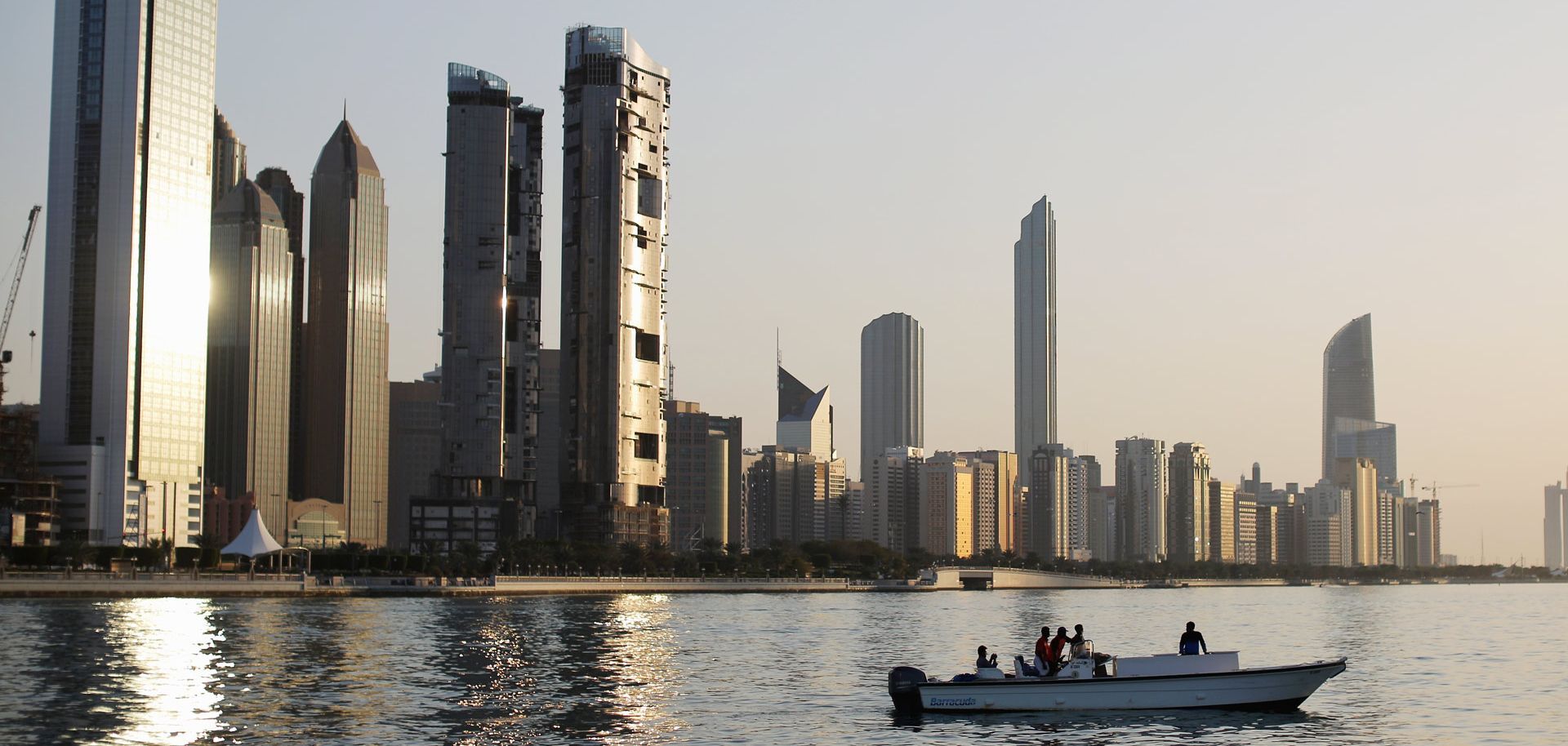
Like its neighbors in the Gulf Cooperation Council (GCC), Abu Dhabi, the capital of the United Arab Emirates, has spent the past two years contending with low oil prices. To endure the oil slump, the emirate has taken a similar approach to that of other GCC countries, proposing a rash of reforms to restructure its energy and financial sectors and to attract foreign investment and development. Though Abu Dhabi's plan is rife with adjustments and policies that will draw expatriate talent, economically it is losing more and more ground to rival emirate Dubai. Moving forward, Abu Dhabi's political primacy will remain unmatched, buttressed by the far-reaching influence of the al-Nuhayyan royal family, which founded the United Arab Emirates and has ruled it for 300 years. But unless Abu Dhabi can achieve close to the same economic diversification that Dubai has, its power in the country may wane. Moreover, as Abu Dhabi competes for economic power within the United Arab Emirates, it will also be fighting for the same within the GCC. In that arena, Saudi Arabia will be its biggest competitor.
As an oil producer, Abu Dhabi, the largest emirate, leads its country by a sizable margin. Compared with Abu Dhabi's roughly 3.08 million barrels per day, the rest of the country produces just 30,000-50,000 barrels per day, almost exclusively from Dubai. Before oil prices crashed in 2014, oil production constituted over 50 percent of Abu Dhabi's gross domestic product — a higher share even than in Saudi Arabia. Years of healthy oil prices gave Abu Dhabi a cushion of financial reserves far larger than those of its fellow emirates and made it the biggest emirate economically. Even so, the capital realizes that it will need to diversify its economy to stay afloat in the long term.
Beginning With Banking
Meanwhile, the emirate's focus on oil production has left its other sectors relatively neglected compared with those in Dubai. But that may soon change. Abu Dhabi's two largest banks, National Bank of Abu Dhabi and First Gulf Bank, announced June 19 that they were exploring a merger that would create the Gulf's largest bank. Two weeks later, Abu Dhabi reported that two of its sovereign wealth funds, the Mubadala Development Co. and the International Petroleum Investment Co. (IPIC), would merge.
One of Abu Dhabi's most respected investment corporations, Mubadala has long been led by Western-educated technocrats whose merits dictate their promotions more than their personal connections do. Many of them have since moved on to more important positions in the Abu Dhabi leadership. For example, the company's former CEO for energy was appointed head of Abu Dhabi National Oil Co. in February. Another former Mubadala official now sits on Abu Dhabi's Executive Council, in charge of its finance department. By contrast, IPIC has been suffering from mismanagement, roiled over the past few years by changes in leadership. Moreover, the returns on its investments in several overseas energy assets, such as refineries, have been lackluster.
In rolling IPIC into Mubadala, Abu Dhabi likely hopes to save the floundering fund's reputation before it gets any worse. At the same time, the merger will help the more successful company expand its energy portfolio beyond Mubadala Petroleum. Furthermore, Mubadala is heavily involved with the other key initiatives that Abu Dhabi is undertaking, including the establishment of an international investment center, known as the Abu Dhabi Global Market (ADGM). The center officially started operations in October 2015 with a simple directive: Do what Dubai did a decade ago.
Dubai's Rise
Over the past decade, Dubai's financial sector has blossomed. Since 2007, when it was first ranked on the Global Financial Centres Index, Dubai has risen 12 spots, achieving 13th place in March. The emirate owes its success in part to its financial openness, as well as to the growth of the Dubai International Financial Centre (DIFC). Established in 2004, the DIFC was set up as a way to diversify away from Dubai's oil dependency after oil production peaked in the 1990s. And it worked: Today, oil and natural gas accounts for a negligible percent of Dubai's GDP. To attract interest, the DIFC was designed with a number of incentives for the financial community, including having no direct corporate income tax, no limit on the repatriation of earnings, flexible labor laws and a powerful independent common-law court system.
Thanks to the DIFC and other relatively autonomous investment zones, which host several of the world's leading technology and media companies, Dubai has helped build the United Arab Emirate's reputation as a prime site for expatriate employment. Abu Dhabi's contribution, on the other hand, has been less notable. The difference is in the emirates' policies. Dubai has run the DIFC according to market-led dynamics, rather than with the tight control that Abu Dhabi exerts over the public-sector companies that abound there. In 2009 and 2010, the DIFC responded to the global financial crisis by cutting a huge percentage of jobs to balance its books — something unthinkable in Abu Dhabi's public-sector companies, which employ Emiratis. Other laws have enabled Dubai to become a major aviation hub, making the emirate's economy as diversified as any in the Middle East and, of course, keeping it wealthy.
Abu Dhabi has taken notice. Like the DIFC, the ADGM has an independent court system based on common — rather than civil — law, an independent financial regulatory agency and zero percent corporate and personal income tax rates. It also allows the repatriation of profits and capital. To distinguish itself from Dubai, Abu Dhabi is putting financial technology at the center of ADGM. Mubadala is making great strides in this endeavor, for example, through the joint creation of Nibras Al Ain Aerospace Park, which aims to attract investment and leaders from the regional aerospace industry. Mubadala Healthcare also recently brought a gleaming Cleveland Clinic to Abu Dhabi, right next to the new ADGM building. Though its success will be felt gradually, in the long term it will help Abu Dhabi stake its place in the health care industry, an area of growing competition among GCC countries.
Despite adopting many of the DIFC's policies, however, the ADGM faces an uphill battle to gain traction. After all, Dubai is already a well-established international financial hub, and it offers much better port infrastructure to enhance its financial attractiveness, thanks to its royal family's decision to dredge the port in the 1950s. More important, if Abu Dhabi wants to replicate Dubai's success, it will have to first change its citizens' attitudes toward market-oriented practices in the financial sector. Mubadala's investments and corporate attitude are well suited to do so.
The Broader Competition
But Dubai is not Abu Dhabi's only rival. Abu Dhabi's ultimate goal is to become the prime investment hub in the GCC, but Saudi Arabia in particular is also vying for that position. In fact, both are undergoing reform initiatives with a common name — Vision 2030 — and guided by the same three platforms: economic restructuring to increase transparency and efficiency, diversification of the industrial base away from upstream oil and natural gas, and the establishment of an open, liberalized financial hub to attract investment and development. While the first two platforms do not necessarily represent an area of competition for Gulf countries, the latter will become increasingly contentious as most of the GCC's oil producers compete to establish financial centers to lead the economic bloc.
Even though its plans are similar to Saudi Arabia's, Abu Dhabi is years ahead in its efforts. Abu Dhabi's reform initiative was announced a full eight years ahead of Saudi Arabia's, and it has benefited from being friendly with the West when it comes to attracting expatriate talent. In fact, as it stands Saudi Arabia's investment sector is perhaps the least developed in the GCC. But Saudi Arabia is home to the region's largest equities market, Tadawul, which it soon plans to open to financial investors. If it were to fully open to international investors, it would be a market of unprecedented size in the Middle East. Saudi Arabia is also modeling its new Saudi Public Investment Fund to be more aggressive in diversification efforts — in what Saudi Deputy Crown Prince Mohammed bin Salman hopes will mirror Mubadala and the more diversified UAE investment funds. All of this, if successful, would make Saudi Arabia a veritable investment center in the GCC — even when not accounting for the enormous potential inflows that the Saudi Arabian Oil Co. initial public offering could bring.
If Saudi Arabia is successful in its reform efforts, its financial center could surpass those of both Dubai and Abu Dhabi. Within the construct that is the GCC, the United Arab Emirates has been one of the most aggressive in enacting financial and economic reform. The country would like to maintain its position as the GCC's financial hub. Should Saudi Arabia's develop, however, there may be growing pressure on Abu Dhabi and Dubai to bring their financial sectors closer together, as a sort of national champion. For now, no such effort exists, and the two emirates continue to act as fierce competitors. Abu Dhabi realizes that oil revenues no longer offer it the financial security that they once did. Though the al-Nuhayyan family will maintain its rule, it may not be enough to sustain Abu Dhabi's primacy in the United Arab Emirates as Dubai's influence in the country grows. If it cannot match Dubai's diversification efforts, the capital will cede its place as the United Arab Emirates' economic driver sooner rather than later.
