
The standoff between the Venezuelan government and the political opposition shows no signs of ending in the next few months. The opposition coalition, known as the Democratic Unity Roundtable (MUD), will try to use its relative popularity with voters to pressure the government into allowing a recall referendum against President Nicolas Maduro or triggering an early presidential election. But besides organizing street protests to support these causes, the best the MUD can hope for is to present itself as a better alternative in future elections. The opposition will likely bide its time, waiting for Venezuela's economic crisis to further erode the government's approval ratings so that by the time regional elections take place in mid-2017, it may be in a position to benefit.
Talking in Circles
So far, the opposition has presented a united front in its efforts to pressure the government. Historically, however, the MUD has not acted as a unified whole with a coherent leadership structure, but as a fragmented collection of parties with diverse agendas and political interests. Parties in the coalition such as Vente Venezuela and Voluntad Popular fought to bring a referendum recalling Maduro to a vote this year, considering it a viable path to power in the country. In July and August, representatives from more centrist parties, such as Accion Democratica, Un Nuevo Tiempo and Primero Justicia, appeared more open to compromise, engaging in discussions with leaders of the ruling United Socialist Party of Venezuela (PSUV).
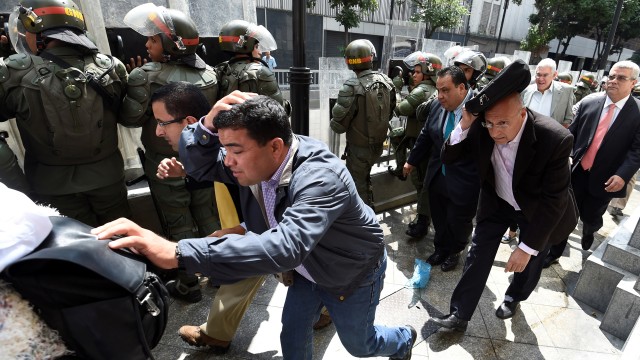
Opposition lawmakers duck for cover as they head toward the National Assembly during Oct. 27 protests there. The move to oust Maduro has unified the usually fragmented political opponents of the ruling United Socialist Party of Venezuela. (JUAN BARRETO/AFP/Getty Images)
The United States and the Vatican, along with other influential global leaders, encouraged these negotiations, which seemed aimed at facilitating a transition toward a more popular government or at least achieving some sort of cooperation between the ruling party and opposition. But given the level of political polarization between the two sides, the discussions made little progress, and the opposition remained adamant that Venezuela could only advance without Maduro in office. As the country's economic and political situation deteriorated, the MUD chose to press the electoral advantage it had gained after the December 2015 legislative vote to secure a recall referendum. The government, meanwhile, may have entered the talks hoping to reach an understanding with the opposition or perhaps as a means to forestall making any substantive concessions.
The Limits of Protest
Either way, Maduro and former National Assembly Speaker Diosdado Cabello now appear unified in their attempt to delay the referendum. The Oct. 20 decision by the politically influential Cabello and his allies to try to permanently suspend the referendum process through the judicial system has exposed the opposition's limitations. The MUD simply does not control enough institutions to pressure the government into rapidly accepting a recall referendum. Even its threats to protest have not been effective because the country's security forces have shown that they can crack down on demonstrations when necessary or short circuit them by preventing people from traveling to protest sites. In addition, the protests that do occur trigger the more intransigent parts of the government (like Cabello's faction) to push for even more crackdowns and arrests of opposition leaders. Still, the opposition has threatened to hold another protest — this time a march to the Miraflores presidential palace on Nov. 3 — which it may try to use to restart the referendum process.
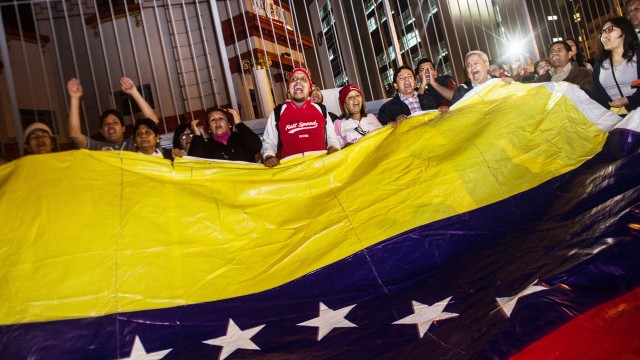
A demonstration outside the Venezuelan Embassy in Lima, Peru, showed support for the protest movement in Venezuela. (ERNESTO BENAVIDES/AFP/Getty Images)
For now, the opposition's attempts to pressure the government into accepting the referendum will likely rely on bringing as many people into the streets as possible. That strategy is a risky one, however, given the potential for violence or retribution against the MUD's leadership. The government's goal is to stave off the challenges from the opposition and maintain control until the next presidential election in 2019. And despite the challenges it faces in the deteriorating economy and the threat of a default by state oil company Petroleos de Venezuela (PDVSA), the government may well manage to pull this off. Barring a major disturbance — such as a loss of military support for the leadership, a wave of violent protests or a debt payment default — government pressure could be enough to break the MUD's tenuous unity.
Cracks in the Military
Whether Maduro's administration endures depends on whether he, Cabello, and Cabello's coalition of governors and security bureaucrats can hold off internal challenges from members of the armed forces dissatisfied with the country's political and economic direction. Though Defense Minister Vladimir Padrino Lopez backs Maduro, the same cannot be said of the military's middle ranks. And even Padrino Lopez took four days to make his support for Maduro public after the lower courts ruled against the referendum. His hesitance, combined with the opposition's appeals to the armed forces to switch sides and back the referendum, hints at divisions within the military.
Now that the referendum route has been ruled a dead end for the time being, Cabello and Maduro are interested in a negotiation to halt the opposition's advance, while the opposition is calling again for protests. So what could break the political stalemate?
Protests That Spiral Out of Control
It is likely that a call to protest from the opposition will lead to wider violence in Venezuela as security forces attempt to disperse protesters. A particularly rough response from security forces could spawn more demonstrations in Caracas and elsewhere, which could evolve into a widespread wave of protest, similar to one that occurred in 2014. But there are pressure points that could prevent such protests from gaining traction.
The government's control of food distribution systems and persistent food shortages have discouraged protests so far. Many people who might otherwise march against the government may be refraining for fear of ceding their places in line to get staple goods or losing access to food altogether. Nevertheless, a new wave of protests is possible given the population's growing desperation. A rash of violent protests resulting in mass casualties could invite heavier sanctions on Venezuela by the United States or degrade the armed forces' loyalty to the current government.
A PDVSA Default
As PDVSA approaches the due date for its next debt payment, a default cannot be ruled out. Even after a debt swap put an extra $2.8 billion in the state-owned oil company's coffers, PDVSA could have a hard time making the $2.1 billion payments due in April 2017. Since the company's oil production is forecast to keep falling through next year, a significant increase in PDVSA's income is unlikely.
A default would not necessarily bring about the end of the Maduro administration unless other parts of the government thought his removal necessary to quell public discontent. But a default would probably cause Caracas to change tack, seeking more lines of outside credit, albeit with little chance of success. The full consequences of a default would not show up for a few months, but as PDVSA's lines of credit — which allow the company to maintain production — dry up, oil output will drop further. Oil sales are the government's main source of export revenue, funding shipments of food and other essential items already in short supply. A sharp decline in imports under this scenario would create a prolonged period of economic contraction, spurring heavier migration abroad and fueling unrest.
Heavy U.S. Sanctions
Meaningful U.S. sanctions targeting Venezuelan entities could bring the opposing sides in Venezuela back to the negotiating table. It is possible that U.S. President Barack Obama will approve additional sanctions on some Venezuelan officials before he leaves office in January. However, for sanctions to influence the actions of ruling party officials, they would have to impair the function of a state entity like PDVSA and not just target individuals. The United States has so far been reluctant to heavily sanction Venezuela because of the damage that stringent measures could do to the country's fragile economy. For the same reason, Washington would probably exercise restraint in imposing further sanctions.
The coming weeks and months will be crucial in determining whether a political transition occurs in Venezuela sooner than later. In the meantime, the government will likely try to resist any protest pressure from the opposition. But the prospect of a PDVSA default and the specter of social unrest will influence how Venezuela's leaders (and, more important, its armed forces) view the recall referendum and discussions with the opposition.
