
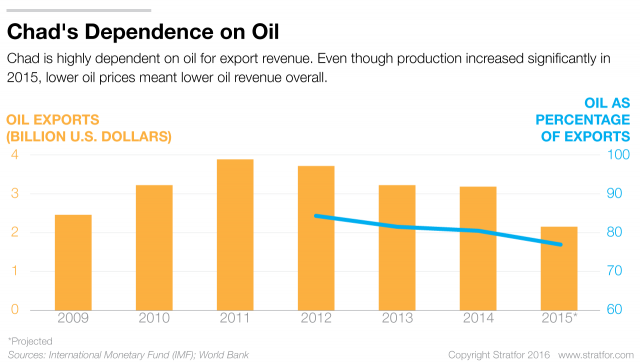
As a small producer that depends on oil for 60 percent of its government revenue, Chad has aggressively tried to increase its share of profits from the oil it produces. On Oct. 6, a high court in the country ruled that U.S. supermajor ExxonMobil must pay $819 million in unpaid royalties for oil previously produced by its consortium in Chad. On top of that, the court slapped the company with a fine of $74 billion — around five times Chad's annual gross domestic product. The proposed fine and royalties will only add to the strain between the Chadian government and international oil companies. But instead of trying to collect its payment, N'Djamena will likely use it as leverage over ExxonMobil in renegotiating its contracts with the company's consortium, a strategy it often uses to strengthen its control over oil revenues.
Chad's grab for more oil revenue is hardly shocking. The government, led by President Idriss Deby, depends on that revenue to fund the strong military and patronage networks that enable it to keep control over the starkly divided country. And because the country lacks the expertise and experience to produce oil on its own, it relies on foreign oil companies to do so. This puts it in the delicate position of having to push the oil companies it partners with to increase — or at least maintain — production without alienating them.
A Means to an End
Like many other oil producers, Chad has been hit hard by the drop in global oil prices, which was made all the more painful by the country's decreasing production. From 2010 to 2015, oil production in Chad fell 36 percent to 78,000 barrels per day. New projects have since bounced production back to between 120,000 bpd and 150,000 bpd, but these figures are still below the country's 2005 peak production of 173,000 bpd. Adding to its financial troubles, Chad had a falling out over the summer with the International Monetary Fund. In August 2014, the country agreed to a $122 million loan over three years from the IMF. Although it received the first two tranches of this payment, totaling $75 million, the IMF decided in August to withhold the third tranche until Chad makes more progress toward implementing the reforms it agreed to. Around the same time, Deby installed a new oil minister, Bechir Madet. Madet's first order of business in office will likely be to renegotiate some of Chad's contracts with international oil companies and foreign creditors.
ExxonMobil is a good place to start. Though two other international oil companies — Glencore and China National Petroleum Corp. (CNPC) — have begun production in Chad in the past couple of years, ExxonMobil's consortium still produces most of the country's oil today. This makes it the best target for the kind of legal and financial unpleasantness that Chad has visited upon the company. The government first filed its suit against the Doba consortium, which ExxonMobil leads, in March 2014, arguing that it should have paid 2 percent royalties on its oil instead of 0.2 percent. The consortium's members maintain that they were paying the amount agreed to, but Chad claims that the country's National Assembly and president never ratified the 0.2 percent rate. Regardless of which side is right, the exorbitant fine, which far exceeds the amount of the alleged underpayment, is clearly meant to goad ExxonMobil to the negotiating table.
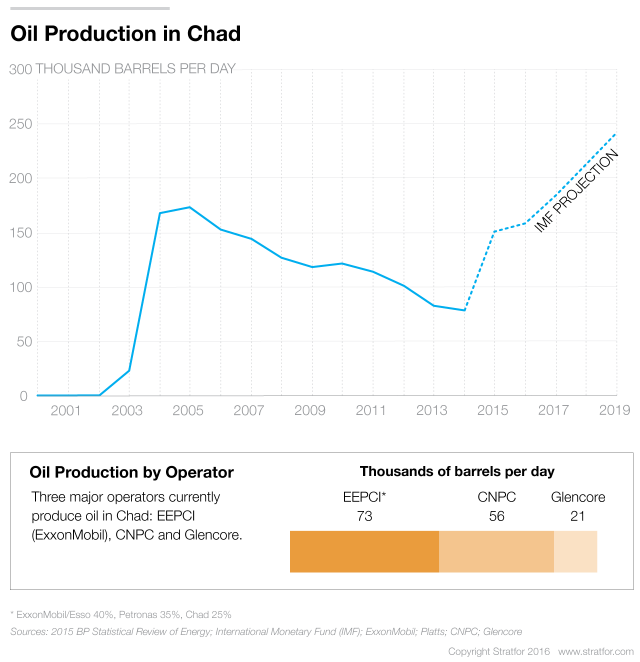
Moving forward, Chad hopes to increase production to 150,000 bpd to 200,000 bpd, a target that is not entirely unreasonable from a geological point of view. Glencore, CNPC and a few other smaller companies are all exploring an expansion in production, but low oil prices have soured investment prospects. In fact, Glencore has already announced that it will scale back its drilling program for this year, having reduced the estimate of its Chadian assets by $1 billion. Chad's aggressive tactics with regard to ExxonMobil will do little to entice other investors. Despite its attempts to improve relations with international oil companies, for example by striving to reduce corruption, Chad risks driving them away if it continues to exert so much pressure on them.
A Volatile Relationship
From the very start, Chad's dealings with ExxonMobil have been tumultuous. When ExxonMobil first said it would develop Chad's Doba fields, the country had to find a way to help finance a pipeline. The World Bank offered funding to assist Chad on its road to development, but the support came with a few conditions. To ensure that profits from the oil project went toward developing the country — and not to Deby and his close associates — the deal required all royalties to be deposited into an account in London. N'Djamena would receive only 13.5 percent of the funds for discretionary spending, and the rest would be earmarked for humanitarian and development efforts. Shortly after production in Doba began, an uprising involving Deby's ethnic group occurred in the northeast, prompting the Chadian president to try to integrate the rebel groups into the military and civil service. Under the World Bank's imposed spending limits, however, Deby did not have the money to do so, especially since he was already devoting much of the country's oil income to ensure his personal security. N'Djamena did not have the funds to cover these expenses while still meeting its other obligations, leading to strikes in the public workforce and defections from the military.
Deby tried to pull out of the deal with the World Bank, which subsequently froze the London account and the $125 billion in it. The president then demanded that the freeze be lifted and that ExxonMobil and its consortium partners begin paying Chad its royalties directly, or else Chad would halt production from the Doba fields and order the companies out. The companies eventually complied, as did the World Bank. Nonetheless, the incident provides a cogent reminder that Deby will try to maintain oil revenue by whatever means necessary, even if it costs his country's reputation.
Back to Tough Tactics
In the decade since, Chad has resorted to similar tactics to control its revenues and contracts with ExxonMobil and other international oil companies. For example, Chad got into a dispute with CNPC in 2013, accusing the company of violating its environmental laws and fining it $1.2 billion dollars. When CNPC failed to pay, N'Djamena canceled its production licenses in August 2014, though the two later compromised on a $400 million penalty, higher royalties and a 25 percent stake in the CNPC project for Chad. Considering the success the country has had with this strategy, Chad will probably continue relying on strong-arm negotiating tactics to alter deals retroactively. As oil prices languish and Deby's government remains under crushing financial duress, N'Djamena will keep using fees, renewals, alleged contractual breaches, fines and threats to cancel licenses to try to increase oil production and revenues. Already, Chad has proved that it is not afraid to take on supermajors such as ExxonMobil or companies backed by a powerful government such as CNPC.
At the same time, the country does not want to kick companies out or nationalize their assets for failing to comply. N'Djamena likely intends to negotiate the massive ExxonMobil fine down to a much smaller sum while overhauling the terms of their contract, much as it did with CNPC. The resulting contract could include even higher royalty rates or a larger stake in the Doba project for Chad's national oil company, Societe des Hydrocarbures du Tchad.
Whatever the outcome of its dispute with ExxonMobil, Chad will continue down its rocky road with international oil companies. Though increasing oil production in the long term is a priority for Deby's administration, maintaining stability in the short term — for instance, by not driving oil companies out of the country — is imperative. Still, Chad's government will be forceful at times in dealing with international oil companies.
