
As Beijing continues with its corruption probe and consolidation efforts within key industries, Chinese President Xi Jinping's vision for reforming the oil and natural gas sector has become clearer. During the last few months, various officials from the State Council and other key Chinese institutions have revealed some of Beijing's plans for the sector, and China is preparing to announce these plans later this year. One common rumor from other sources has been the merger of Chinese state-owned giants China National Petroleum Corp. (CNPC) and China Petrochemical Corp. (Sinopec). However, both corporations have categorically denied the rumor, and the leak of Beijing's plans paints a different picture.
Under this scenario, Beijing will continue to reduce the power of its major oil corporations, introduce more market-oriented reforms, and encourage competition between China's national oil companies and foreign private companies. In making the energy sector more market-oriented, China will continue to liberalize various pricing mechanisms, possibly removing government control entirely. Beijing will open up a number of areas to private companies throughout the sector. This will include stripping ownership of some of China's major national oil companies' assets. As with market-based reform and deregulation measures being introduced in other sectors, the broad end goal is to increase efficiency and lower costs and prices as the Chinese economy slows down.
Beijing clearly is using its anti-corruption campaign as a way to remove any resistance within the "Big Three" state-owned oil companies — CNPC, Sinopec and the China National Offshore Oil Corp. (CNOOC) — to Xi's reforms. Beijing recently issued a one-sentence statement April 27 that it had opened up a corruption probe into Sinopec President Wang Tianpu.
The Structure of the Energy Sector
Unlike most of China's industrial sector, a good deal of China's oil and natural gas operations have been consolidated, with only a handful of firms dominating most of the sector. Historically, only the three national state-owned oil companies plus the provincially owned Shaanxi Yanchang Petroleum had the right to explore and produce conventional oil and natural gas resources or import crude oil.
This structure is unique to the oil and natural gas sectors, largely because of the geography of the industry. In China, mining industries such as coal and steel are relatively geographically dispersed and, under Mao Zedong, Beijing pushed a strategy of self-sufficiency for heavy industries in most of the country by maintaining high production regionally, if possible. After Mao, many of these mines and operations were privatized or semi-privatized to influence local party leaders, which created very fragmented sectors that Beijing is now struggling to consolidate. In contrast, oil and natural gas resources remain concentrated in just a few areas. The sector never fragmented in the same way, except for the small-scale, independent "teapot" refineries in Shandong and Sichuan.
The current structure of the oil and natural gas sector is largely a relic of two reforms that occurred between the late 1980s and early 2000s. First, Beijing created CNOOC to run the offshore portion of the industry and the China Petrochemical Corp. — the predecessor to Sinopec — to handle the refining and processing portions, but both entities were still under the petroleum ministry. In 1988, Beijing decided to put total control of the onshore oil and natural gas industry under a state-owned company, and thus CNPC was created.
By the early 1990s, China's economic miracle had made enough progress that the country was no longer a net exporter of crude oil and had become reliant on external oil market forces. Even before Beijing officially launched the "Going Out" policy in 1999, CNPC was actively seeking development overseas in places such as Sudan. This also meant that the monopolies in the upstream (exploration and production) and downstream (refining and processing) sectors were no longer tenable, but the politically elite factions in those companies were becoming highly influential. By the mid-1990s, the power of bases of individuals such as Zhou Yongkang — who spent a decade prior to 1998 as either the deputy director or director of CNPC — had become quite broad and politically powerful. Of course, Zhou's power base recently came under pressure and Zhou was formally charged with abuse of power on April 3.
The first step in breaking down the monopolies was the creation of another national oil company, China National Star Petroleum Corp., in 1996 to compete with CNPC. Two years later, Beijing redistributed the upstream and downstream assets of CNPC and China Petrochemical Corp. to create two vertically integrated oil companies. Two years after that, Sinopec was created in its latest incarnation and took control of China National Star Petroleum Corp.'s assets. CNOOC has since made the transition to possess both upstream and downstream assets.
Although this structure has undergone some modifications, it largely has remained in place and is likely to withstand the corruption scandal. Rumors have emerged during the last 12 weeks that Beijing is considering making Sinopec and CNPC one company (again), but this flies in the face of all the moves China has made over the last 30 years and particularly the last five years. One exception could be taking the smallest of the three — CNOOC, which is primarily an upstream company — and merging it with a state-owned refiner, such as SinoChem, so that the new CNOOC can more closely rival CNPC and Sinopec in size. During previous reform efforts, Beijing largely dictated the pricing mechanisms, quotas and other industry directives. This time, restructuring efforts are beginning to break down the Big Three's oligopoly by allowing foreign and domestic private competition rather than restructuring the ownership as previous reforms did. To be clear, China's national oil companies will retain the lion's share of the industry, but a crucial and fundamental part of this restructuring is allowing competition in all areas possible.
Reform Initiatives
China has long been a major hydrocarbon producer and now ranks as the fourth-largest oil producer, behind Russia, the United States and Saudi Arabia. However, decades of oil production, the decline of easily exploitable resources and the rise of domestic natural gas consumption have forced China to develop more expensive and more technologically challenging resources. Overcoming these constraints requires a shift in the way the industry operates for a number of reasons. One of the problems is that many of the new resources China is developing are too expensive and/or risky for a single bloated company like CNPC to develop, forcing China to allow partnerships with other entities. This is not a new phenomenon: CNOOC has signed more than 200 production-sharing contracts, and Chevron Corp. and others have been active partnering with Sinopec and CNPC onshore.
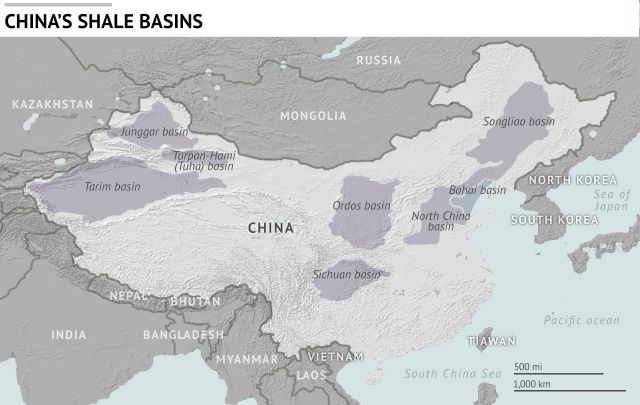
While partnering with international oil companies has been successful in many ways, China is moving to the point where private investors are being allowed to invest without partnering with these international firms. This was first allowed in 2012 when China launched its third-round shale auction, in which domestic private companies were allowed to bid. Unfortunately for Beijing, the bidding round has not produced very successful results in exploration activities. First, due to the historic dominance of the Big Three, China never developed private oil companies with the access to technologies needed to unlock shale gas resources that even the Big Three had little to no experience with. Now, China is aiming to take private investment freedom one step further and allow foreign firms to secure oil and natural gas blocks in some areas and operate them themselves.
Second, and more important, CNPC and Sinopec hold almost all of the promising areas for any hydrocarbon production potential. It should be no surprise, then, that China's winners in the third round have had little success. Moreover, foreign companies would not be interested in buying up blocks with little potential. There are only two solutions to this problem, and both put Beijing's interests squarely against those of Sinopec and CNPC: Reclaim parts of Sinopec's and CNPC's land, or allow international oil companies to operate independently of Sinopec or CNPC on their land. Breaking down Sinopec's and CNPC's dominance in areas like this is one of the reasons that diminishing their political power is key, especially in areas where shale development will be popular, such as Sichuan province where Zhou held the State Council's top office.
Beijing will use a combination of both options to solve the exploration problem. It likely will reclaim some of Sinopec and CNPC's land and auction it off. Moreover, Beijing is considering the establishment of a shale demonstration zone in an area roughly the size of Germany in the southern half of the country, where it will auction off rights to private companies in land likely currently administered by Sinopec or CNPC. Beijing is also considering a two-tiered system of oil and natural gas rights. The details are not clear, but it could involve letting Sinopec and CNPC retain the rights to conventional oil and gas deposits in a block while auctioning off the rights to underlying shale resources to other companies. Regardless of the extent of these plans, they will mark the first time that foreign companies are allowed to invest directly in China's upstream sector alone — a fundamental shift in the way China's energy sector operates — and will force Beijing to introduce rules and regulations on entities it has very little control over.
Big Three Reorganization
Although CNOOC is known for being lean and similar to Western corporations, Sinopec and CNPC are not. Like most national oil companies, Sinopec and CNPC are bloated with employees, and shedding workers has been difficult for political and social reasons. With oil prices low and domestic wages rising, inefficiencies such as this will limit CNPC's and Sinopec's profitability. That, coupled with both trying to develop more expensive resources, is forcing Beijing to take a long look at the organization of these companies, not to mention corruption. With Beijing now potentially attempting to bring in foreign operators, it will be critical for both companies to become more agile and efficient to maintain competitiveness at home and abroad.
Some of the most bloated entities are oil field service subsidiaries and affiliates. Some of these subsidiaries will be reorganized and sold off to investors to become private service companies. Like the exploration and production segment of the upstream sector, arms of the Big Three — not private providers — make up a large portion of the oil field service sector. There are a few large private oil field service providers, such as Anton Oilfield Services Group, but not many. Not only will selling off these arms make the parent organizations more nimble, it also will allow for competition between them, forcing the new oil field services companies to abandon inefficient practices and drive down the cost of their services.
The midstream sector — pipelines — has long been dominated by monopolies or regional monopolies, typically CNPC's. CNPC has been rumored to be preparing to sell its midstream assets or at least reorganize them, giving them near-complete autonomy. CNPC's pipeline dominance plays into the competition among the Big Three over natural gas markets. CNPC has the capability to import gas from Russia — it has signed two large deals with the Russians — whereas Sinopec and CNOOC do not and are forced to import liquefied natural gas.
Pricing Regulation
The reorganization of the sector and its companies gives Beijing exactly what it wants: competition driving down energy prices. While oil and natural gas price deregulation has been ongoing over the last few years, it has become more important for several reasons. First, oil prices had risen to well above $100 per barrel, forcing Beijing to become more flexible with its domestic pricing, and then the price of oil collapsed to half of its previous price. While Beijing could control those prices in step, government-controlled petroleum product pricing is inherently reactionary, and even now Beijing only changes prices every 10 days. Second, natural gas is becoming an important source of energy domestically, but the most promising resource — shale gas — is expensive, requiring China to adapt pricing to incentivize its production, leading to a two-tiered natural gas price market.
Eventually the end goal for both natural gas and oil, much like the electricity sector, is the entire deregulation of prices, forcing refiners, importers and distributors to compete. No timetable for complete deregulation has been made public. The process of building up the institutions and platforms needed to support market pricing is likely to be slow, especially if international oil prices rise back to levels seen a year ago.
Another critical factor is the liberalization of crude import licensing and allowing private refiners to access international crude oil. Historically, only Sinopec, CNPC and CNOOC were able to import oil. Other companies that wanted to import oil had to either import it through the Big Three or import fuel oil, which was more expensive. Two provinces in China — Sichuan and Shandong — have vibrant, small-scale refineries called "teapots." At first, China sought to eliminate some of the smaller ones and issued a timeline for the shutdown of refineries under a specific capacity. The teapots merely increased their capacity. The teapot refining capacity totals about 10-15 percent of China's overall refining capacity, providing a valuable mechanism in pricing petroleum markets.
This is why giving the teapots equal footing by liberalizing crude import quotas, restrictions and prices is important. In 2012 China began allowing import quotas for state-owned SinoChem, which operates a number of teapot refineries, and in February 2015 Beijing issued rules to other teapot refineries on exactly what they will need to do to qualify for import quotas in the future. They must have a minimum capacity and adhere to certain environmental efficiency standards.
Finally, futures and spot trading of Chinese oil and oil products will play a fundamental role in allowing market-oriented pricing mechanisms to take root across the country. China has several regional commodities markets where oil is traded, but these historically have been externally focused, allowing companies to hedge against international oil prices, as opposed to physical markets trading.
