

A new milestone is fast approaching in Hungary's complex relationship with the European Union. On Oct. 2, Hungarian voters will decide in a referendum whether to accept an EU plan to redistribute asylum seekers across the Continent. The European Commission originally proposed the idea in late 2015 to alleviate the burden migration has placed on countries such as Greece and Italy. But so far it has largely failed in the face of members' decision to ignore it, and only a handful of asylum seekers have actually been relocated.
The Hungarian referendum, to a great extent, is more the result of political calculation at home than an attempt to shutter a plan that was not being enforced in the first place. The government in Budapest is hoping to increase its popular appeal and cast itself as a defender of the country's sovereignty, identity and security. After all, Hungary ranked near the top in Europe for the number of asylum applications it received last year relative to its population. In addition, the country served as a major transit state for migrants trying to reach Central and Northern Europe. Prime Minister Viktor Orban responded to the influx of people by closing Hungary's borders, building fences and sending migrants a clear message: They are not welcome in Hungary. The move aligned with the nationalist rhetoric that the Fidesz party has frequently used over the past decade to consolidate its position as Hungary's dominant political force and to prevent voters from shifting their support to the even further-right Jobbik party.

But the show Budapest is putting on is not meant just for its citizens; it is also meant for Brussels. Hungary wants to make clear that, along with its Central and Eastern European neighbors, it will resist the European Union's attempts to impose decisions on member states. The government's entire referendum campaign has been laced with Euroskepticism. Nowhere are the Orban administration's political aims more apparent, however, than in the way that the referendum question is worded: "Do you want the European Union, even without the approval of the Hungarian parliament, to be able to prescribe the mandatory resettlement of non-Hungarian citizens in Hungary?"
A Victory for Budapest in the Making
The leading nature of this phrasing is just one of many factors that, together, point to a likely win for the Hungarian government. Legally, more than 50 percent of Hungarian voters must participate in the vote for it to be deemed valid. Politically, however, Stratfor sources in the country suggest that Budapest could consider a 40 percent turnout a victory, since it would signal that Fidesz is capable of mobilizing enough voters to secure a comfortable majority in the country's 2018 general elections.
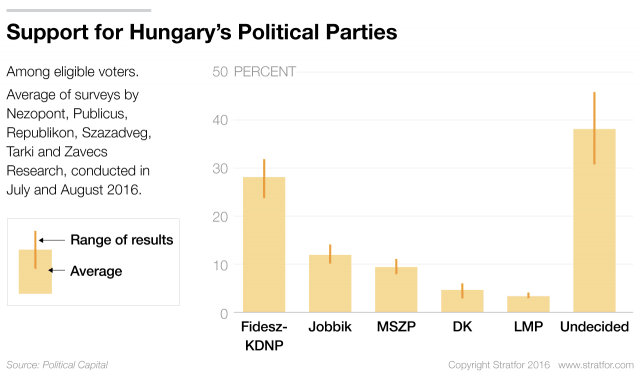
The vote will have important implications for the wider Continent as well. A referendum result in the Hungarian government's favor, especially if won by a large margin, would cement its position as one of the most Euroskeptic administrations in Europe. The members of the Visegrad Group — which, in addition to Hungary, includes Poland, the Czech Republic and Slovakia — have all rejected the EU relocation scheme, but Hungary is the only state putting it to a vote. Once the referendum is complete, Hungary will probably try to pressure its fellow Visegrad countries to move forward with an EU treaty reform proposal that would repatriate powers from Brussels to national parliaments. The Visegrad Group already expressed its interest in such an amendment during an informal EU summit in Bratislava on Sept. 16, though it has yet to present any concrete ideas about the policies in which it would like national parliaments to have a greater say. Migration could be a starting point, should Hungary rally a visible show of support on the issue from its population.
Either way, the referendum will do little to improve Hungary's tense relationship with the European Union. Budapest will undoubtedly use the results to question the authority of the European Commission and claim that voters have authorized the government to ignore EU rulings beyond the realm of immigration. In return, the commission will likely threaten to impose sanctions on Hungary. Brussels has already said it might suspend development funds for countries that fail to adhere to its redistribution plan. Should Brussels make good on its threat, Hungary — a net receiver of EU funds — would be dealt a serious financial blow.
Of course, the chances that the European Union would level any meaningful sanctions against Hungary are slim. In the wake of the United Kingdom's decision to leave the bloc, EU governments and institutions have been hesitant to impose sanctions on member states for fear of exacerbating the Euroskepticism sweeping the Continent. Spain and Portugal, for instance, were not punished in July for their failure to meet the bloc's 2015 deficit targets. Furthermore, sanctions against a member state would require unanimous approval — something Brussels is unlikely to get, considering that Poland already has said it would veto any move to sanction Budapest. In exchange, Hungary has vowed to protect Warsaw in the event that its ongoing dispute with Brussels over the rule of law in Poland flares up.
In the meantime, the Hungarian referendum could inspire like-minded governments and political parties in Europe to call for similar votes. Should Budapest see a massive show of popular support on Oct. 2, administrations elsewhere may try to imitate Fidesz's strategy, whipping up nationalism in their own countries to boost their political standing. Euroskeptic parties across the Continent will almost certainly praise the Hungarian vote after it has finished, and several — France's National Front, the Netherlands' Party for Freedom, Austria's Freedom Party and Italy's Five Star Movement, to name a few — have promised to hold referendums on their nations' EU or eurozone membership.
The Limits of Hungarian Euroskepticism
Though the Hungarian vote will fuel nationalist and Euroskeptic sentiments while eating away at Budapest's ties with Brussels, it is unlikely to result in any notable change in Hungarian policy. The Fidesz government is ideologically opposed to the idea of supranational integration, and it views the European Union as a pact among sovereign nations rather than a project in federalism. Consequently, Hungary will continue to resist any attempts by Brussels to exact sovereignty from EU members, avoiding eurozone membership and remaining skeptical of plans to advance European economic or political integration in the coming years.
Yet in spite of Hungary's interest in altering the EU treaty, Europe has little appetite for significantly restructuring the bloc's institutional framework. Amid the European Union's worsening political fragmentation, amendments are currently out of the question because they carry the risk of unknown consequences for a Continent already reeling from the Brexit. A consensus on such a measure would be nearly impossible to reach anyway, given Europe's wide array of regional priorities and visions for reform. To make matters even more complicated, the Continent's biggest players, Germany and France, will hold general elections in 2017. Any substantive changes in the European Union's operations likely would be delayed until those are over. For the time being, EU members will be more prone to ignoring Brussels' central institutions than reforming them.
Hungary, moreover, is neither ready nor willing to leave the European Union. The country still depends on the bloc's funds and subsidies for economic growth, and as a manufacturing hub for goods heading to Western Europe, it cannot afford to lose its access to the EU internal market. Though Hungary is not nearly as concerned with potential Russian aggression as is Poland or Romania, Budapest sees EU membership as a key component of its security strategy. Opinion polls also show that a majority of Hungarian citizens want to stay in the European Union.
The Hungarian government will therefore continue to be one of the European Union's loudest critics, but Budapest will calculate its moves so as not to endanger its membership in the bloc. Hungary may side with countries that want to transform the European Union into an intergovernmental system instead of a federal one, but that is a far cry from putting its participation in the bloc to a vote. Even so, its strategy is not without risk. Persistent Euroskeptic rhetoric and a strong far-right opposition could force the Hungarian government into a corner, prompting the administration to skew further toward nationalism in its policies, alienating allies and investors and spurring instability in the process.
