
I arrived in Johannesburg, South Africa's bustling commercial capital and largest city, not knowing what to expect. I knew that the country had undergone a major political transformation when apartheid ended in 1994. I also knew that, like so many trading nations around the world, South Africa was in difficult economic straits because of the plunge in global commodity prices. But beyond that, I had no preconceived notions of it; most of what I heard from friends who had visited or lived there was too contradictory to offer much guidance.
On the way from the airport, I chatted up my Uber driver, a jovial and soft-spoken black African in his mid-to-late 20s. He told me times were tough. Despite rising food and fuel prices, wages remained the same, and the government was rife with corruption and chaos. Like many others I spoke to on my trip, he believed that President Jacob Zuma would be replaced before the next elections in 2019. But when I asked whom he would vote for, a candidate from the ruling African National Congress (ANC) or one from an opposition party, he replied that he did not support anyone.
His disillusionment stood in stark contrast to the euphoria that swept the country in 1994, when the ANC, led by Nelson Mandela, won South Africa's first universal elections. Mandela, who had been released from prison only a few years earlier, guided South Africa out of the apartheid era as the first president of the newly democratic country. He is now revered as an unrivaled national hero in South Africa, as the many banknotes, statues and murals bearing his likeness will attest.
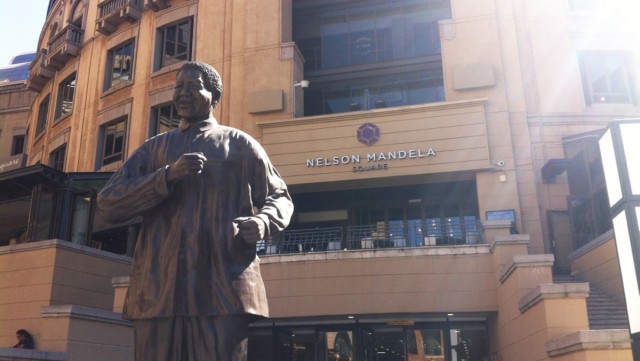
In South Africa, monuments to Nelson Mandela like this one in Johannesburg abound, confirming the former president's status as an unrivaled national hero.
Although the ANC has won every subsequent election in South Africa, the enthusiasm and hope that Mandela inspired has steadily declined over the years. In part, this is because the leaders who succeeded Mandela, first Thabo Mbeki and then Zuma, could not match their predecessor's larger-than-life persona. On top of that, much of the country's population — especially its large underclass — is no better off economically today than it was during apartheid. The recent fall in commodity prices and the precipitous decline in South Africa's mining industry have only made matters worse, financially and politically.
Pilanesberg National Park
From a shuttle to Pilanesberg National Park, a game reserve about 200 kilometers (roughly 120 miles) northwest of Johannesburg, I witnessed the desperation firsthand. Shantytowns of tiny derelict shacks, populated exclusively by black Africans, lined the road. We also passed several platinum mines along the way. Next to each mine sprawled camps of makeshift huts where the mineworkers lived. Thousands had been laid off in the recent mining slump, and some of them — mostly young men — sold fruit on the side of the road or sat around in groups. Those who retained their jobs faced difficult work conditions and strained relationships with their employers. Strikes are a common occurrence in South Africa's mining industry, and they sometimes become violent. In 2012, police opened fire on strikers at a mine in Marikana; the incident, dubbed the Marikana massacre, garnered international attention.
The driver of the shuttle, a white South African in his mid-30s, showed little sympathy for the miners. Originally from Brits, a small town about 60 kilometers west of Pretoria, the driver complained that it was hard for white South Africans to find work. South Africa's Black Economic Empowerment initiative, he said, gave employment preference to groups disadvantaged under apartheid. The driver openly admitted his distrust of black Africans, saying he had been robbed several times and could not respond to the thefts for fear of being labeled a racist. His political views were equally direct: He considered Zuma a "corrupt idiot" who should be removed from office immediately. But he conceded that he had never voted in his life.
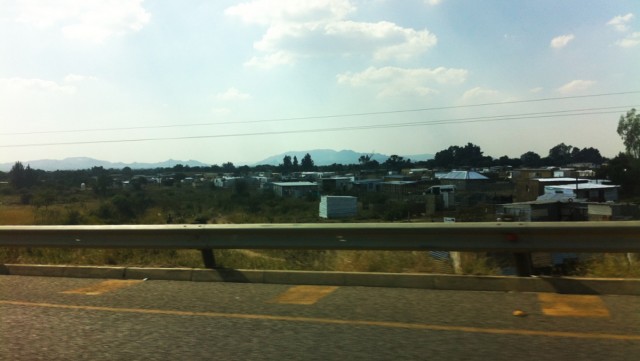
Shantytowns line the road from Johannesburg to Pilanesberg National Park.
Once I arrived at Pilanesberg, the park's manmade elements interested me more than its diverse flora and fauna did. In Sun City, a nearby resort town, I found pristine golf courses and luxurious hotels, some of which charge upward of $1,000 per night for a room. Almost all of the visitors were white or Indian (Indians make up a sizable ethnic minority in South Africa), but nearly all of the staff members were black, a potent reminder of the inequality that persists in South Africa. Since the end of apartheid, socio-economic change has not accompanied political enfranchisement for most of the country's black population, which includes a large number of immigrants from other African countries.
To Cape Town
During a trip to Cape Town, I met a middle-aged man who had moved to South Africa from Zimbabwe in 2008. He told me that he fled his country after the ruling party's security apparatus put a hit out on him because of his brother's involvement in an opposition party. Zimbabwe's longtime president, Robert Mugabe, does not tolerate dissent. Even cursory connections to opposition factions can lead to imprisonment or death, particularly in election years such as 2008. Having barely escaped his home country, he now lives in Cape Town and works as an Uber driver. The transition has proved difficult for him — he worked as a teacher in Zimbabwe. Nevertheless, his adoptive country affords him safety that his homeland did not.
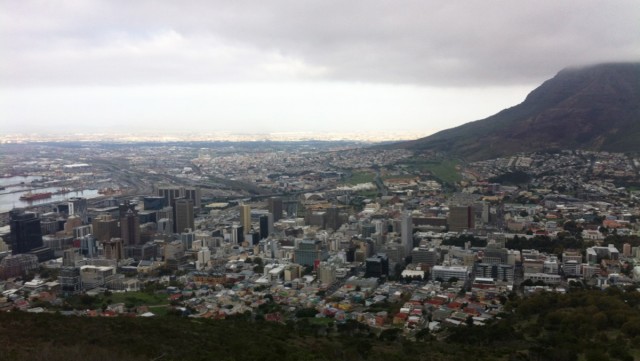
Cape Town's inequality is as striking as its scenic views of mountains, coast and cityscape.
Cape Town itself is a beautiful city on South Africa's Atlantic coast. Unlike inland Johannesburg, with its congested urban sprawl, Cape Town offers a picturesque blend of ocean, mountains and cityscape. But it, too, is a place of striking inequality. Posh neighborhoods with gourmet restaurants and hip cafes belie the vast shantytowns just outside the city. A Cape Town resident informed me that more than 25 percent of South Africa's population lives in townships. In Cape Town's metropolitan area — where nearby townships, such as Khayelitsha, house hundreds of thousands of people — the proportion is much higher. Developed areas abut pockets of astonishing poverty.
A Long Road Ahead
But to portray South Africa as a country simply divided between black and white, rich and poor, would be misleading. The legal barrier separating the country's black and white populations has been broken. Despite the unmistakable socio-economic boundary that still exists in the country, South Africa has come a long way. In Cape Town's central entertainment district, well-dressed and iPhone-wielding South Africans — black and white — mingle in bars. In Johannesburg's Braamfontein district, a young and heterogeneous crowd watches a similarly diverse band play rock and reggae hits with equal ease and skill. Less than 25 years ago, these sights would have been unthinkable.
Still, South Africa faces tremendous challenges. The country's official unemployment rate exceeds 26 percent and is likely much higher in reality. Meanwhile, a commodity slump has stunted its economy, and its president and ruling party are quickly losing popularity. South Africa continues to deal with the lingering effects of apartheid, and the political, economic and social pressures on the country seem to be mounting. But for all its complexities, the country has proved resilient in the past. As more trials loom on South Africa's horizon, its resilience will come in handy.
