
A new standoff has emerged between South African President Jacob Zuma and several key officials within his coalition ahead of the country's critical municipal elections. While the ruling Tripartite Alliance is no stranger to factional disputes, tension between Zuma's allies and enemies has never been higher.
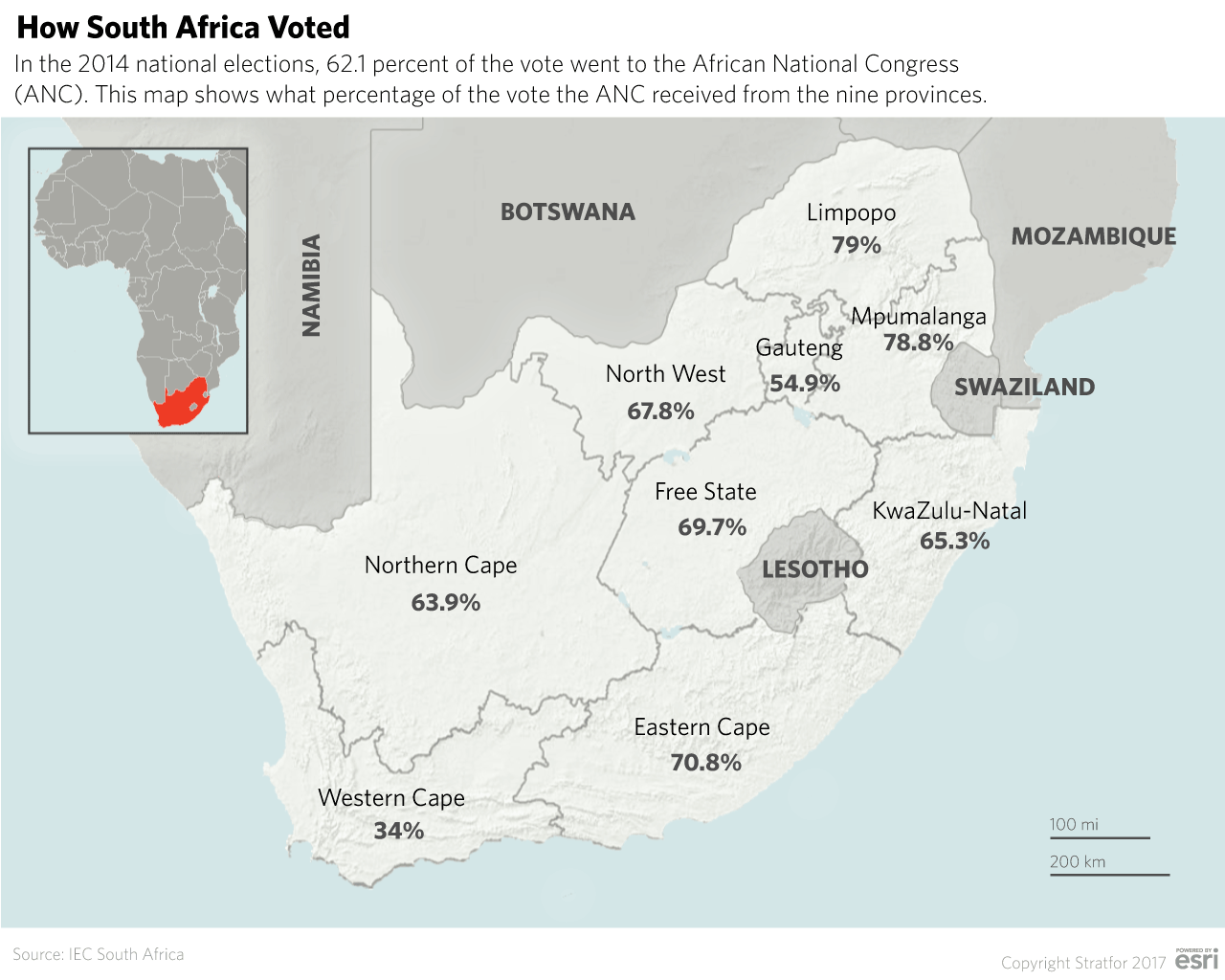
Amid rumblings of discontent, the president's rivals have begun to shift their support to various candidates who could someday replace him. Though no clear successor has emerged yet, it is a distinct possibility that Zuma could be booted from office before his final term ends in 2019. Zuma's own party, the African National Congress (ANC), may sideline him as its leaders prepare for a post-Zuma presidency. For now, the ANC has the grassroots and ethnic support base to retain its electoral standing. But as the economic, political and social troubles that have plagued South Africa for that past five years persist, the party will likely see its stranglehold on South African politics weaken.
Throughout a presidency marred by scandals and corruption, Zuma has retained his position by striking a careful balance among the different factions in the Tripartite Alliance. But more often than not, the strategy has led to indecisive policymaking. The coalition, which comprises the South African Communist Party, the Congress of South African Trade Unions and Zuma's own ANC, serves constituents with a variety of ideologies and ethnicities that often have competing goals.
For the most part, Zuma has relied on the support of Zulu and liberation-era groups, as well as the country's intelligence and security apparatus, to defend his place at the top of his party's hierarchy. In exchange, Zuma has generously rewarded his supporters — some excessively so — which has not sat well with other members of the Tripartite Alliance.
Rifts Form Within the Ruling Coalition
Over the past three years, the decline of South Africa's economy has only added to the criticism mounting against Zuma. Prices of commodities, which account for over half of the country's exports, have tumbled, exacerbating the structural issues undermining the South African economy. Though these problems would be difficult to fix by any standard, Zuma's mismanagement of the economy and Pretoria's finances have elicited disapproval from across the political spectrum.
Meanwhile, the ANC has become increasingly divided between Zuma's supporters and opponents. Lately, the party's disunity has been clearest in South Africa's Finance Ministry and revenue agency. In December 2015, Zuma replaced Finance Minister Nhlanhla Nene with the relatively unknown and untested David van Rooyen, despite the ministry's reputation as a highly competent organization that was largely untouched by the scandals afflicting the rest of the government. The move rattled markets and created controversy in the ANC. Party pressure and the economic fallout of the shuffle forced Zuma to replace van Rooyen with Pravin Gordhan, South Africa's former and well-respected finance minister, a few days later.
Since then, the proxy battle between pro- and anti-Zuma factions has shifted to the South African Revenue Service, where a special investigative unit is widely believed to be looking into politically connected corporate deals. Some of those deals involve members of Zuma's inner circle, or in one case, Zuma's own private residence in KwaZulu-Natal. However, Tom Moyane — the service's current chief and a Zuma loyalist — has begun to investigate Gordhan's involvement in the special unit during his tenure at the head of the South African Revenue Service. (Moyane opened his investigation after Gordhan threatened to resign if Moyane was not removed.)
The disputes between Zuma and his party's leaders, on one hand, and between Moyane and Gordhan on the other, reflect the broader fissures in South Africa's ruling establishment. Some of the president's opponents have allegedly proposed removing Zuma from office before his term is finished, much like it did to former President Thabo Mbeki in 2008.
However, Mbeki's situation was slightly different than Zuma's is now. In 2008, the ANC had two rival centers of power: Mbeki, the head of government, and Zuma, the head of the party. And during party congresses, the party tends to trump everything else. With the ANC united against him, Mbeki lost his position as party chief to Zuma. Mbeki's opponents, sensing his vulnerability, called for his ouster and removed him from the presidency soon after.
By comparison, the ANC has not united against Zuma — at least, not yet. Still, several potential successors are emerging that could rally the party's support. One candidate is Deputy President Cyril Ramaphosa, who hails from a minority tribe and has garnered the most support from South African businesses and the Congress of South African Trade Unions. However, though a useful figurehead, Ramaphosa is not a powerful leader and will have a hard time uniting the ANC behind him.
Zuma's former wife, Nkosazana Dlamini-Zuma, may also be a logical choice for the presidency. A competent politician, Dlamini-Zuma currently heads the African Union and has the backing of the ANC Women's League. As a Zulu-speaking candidate, she would also receive the support of the party's biggest power base: the Zulu-speaking KwaZulu-Natal province. (Over the past two decades, the ANC has lost a considerable amount of influence in all other regions of South Africa.) Of course, there are other potential Zulu candidates as well, including party Treasurer-General Zweli Mkhize and Home Affairs Minister Malusi Gigaba. While the Zulu will eventually unite behind a single Zulu candidate, they have yet to declare their support for any one of Zuma's potential successors.
Harder Times Ahead for Zuma
Because the ANC has not joined forces against Zuma — and perhaps more importantly, because the president has not lost his hold over South Africa's security establishment — Zuma faces no immediate threat to his office. But all that could change in the next 18 months.
The ANC's next party congress is set for August 2017. Since South Africa's constitution prohibits Zuma from being re-elected in 2019, he will have a hard time maintaining his position at the head of the party. Should he lose his post to someone outside his inner circle, Zuma could easily find himself in the same position as Mbeki in 2008: He would become the face of government ineffectiveness as the party begins to back its newly elected leader.
It is unlikely that Zuma will be able to better his standing by improving his country's economic outlook, either. The bulk of South Africa's financial and economic problems is structural and would take substantial reforms to correct. At the same time, Zuma lacks significant support from the country's business community. Growing dissatisfaction with the economy will likely make the second half of Zuma's presidential term contentious. Zuma probably will not be removed from office before the ANC's next party congress, but his presidency could still come to an untimely end.
In the meantime, Zuma's opponents will focus on South Africa's upcoming municipal elections set to take place sometime between May and August. The ANC will campaign hard to fend off challenges from the far left and center, giving the appearance of unity. But behind the scenes, there is little doubt that Zuma's critics will use the results of the elections to challenge the president's hold on power.
