
Thanks to Israeli opposition, U.S. arms contracts for Kuwait, United Arab Emirates and Qatar have been delayed for years. Kuwait has a pending sale, already delayed by two years, for 28 F/A-18 Super Hornet fighter jets, with an option for 12 more. The United Arab Emirates has a pending deal for 30 F-16 Block 61 fighters. And Qatar has a pending deal, also delayed for two years, for 73 F-15SE Silent Eagles. And while Israel has voiced alarm over the Kuwait and UAE deals, it has actively opposed the Qatari one, in large part because of the country's support for Hamas and its anti-Israeli stance in the region in general.
Israel is concerned that it will lose its status as a highly exclusive U.S. partner. But even as the United States develops its Middle East balancing strategy, Israel will by no means lose all the benefits of the countries' decadeslong friendship. The current U.S. administration, and undoubtedly the next one, will stay committed to supporting Israel's military advantage. Even now, Washington is finalizing negotiations on a potential $40-50 billion aid deal with Israel, set to go into effect in 2018. No other country in the region can boast that level of U.S. financing.
Still, Israel fears its ample funding from the United States will gradually diminish. After all, it was over Israel's vehement protests that Washington signed a nuclear agreement with Iran, and lately the superpower has been seeking cooperation with multiple Middle Eastern countries to jointly create a balance of power in the unstable region. Working with Egyptian President Mohammed Morsi and with the Muslim Brotherhood in Egypt (which also angered the Israelis) before it was ousted in July 2013 was part of this strategy.
Israel's military edge over its peers has become more fragile over the last decade. GCC states, especially the United Arab Emirates and Saudi Arabia, have spent hundreds of billions of dollars upgrading their air forces and now fly more combat aircraft that are on par with Israel's. The Israelis are slated to receive the F-35 fighter planes, but there is no guarantee that the United States will abstain from selling the jets to GCC states as well.
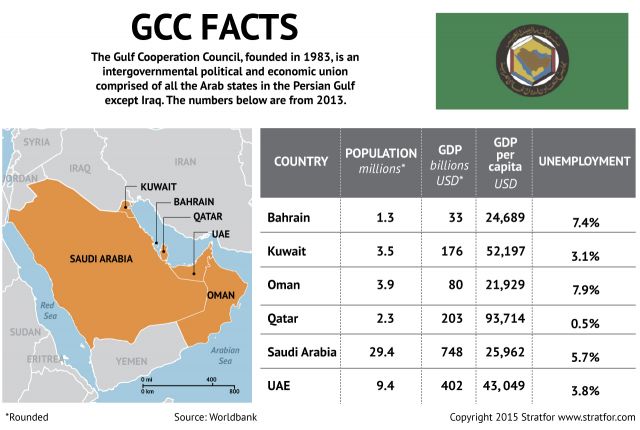
But Gulf states are growing more frustrated with the years of delay caused by Israeli opposition and U.S. bureaucratic red tape. While they await a closed deal, Kuwait and Qatar have sought other smaller contracts, pursuing 28 Eurofighter planes and 24 French Rafale fighter jets respectively. These deals are victories for European arms companies, who stand to benefit the most as potential alternative suppliers for the GCC. If the Gulf countries do turn to other sources for their arms contracts, the United States will lose more than just privileged access to a lucrative market. The GCC is already upset over U.S. outreach to Iran and its perceived lack of support in Syria. Not coming through on critical arms sales would be seen as yet another sign of the Untied States' wavering commitment.
It would also hurt the U.S. defense industry. The Kuwait F/A-18 Super Hornet deal would give Boeing's Super Hornet production line another 14 to 20 months of life. Meanwhile, failure to conclude the Qatari F-15 deal could spell the death of the F-15 production line, which is expected to start closing down this summer. The deals are even entering U.S. domestic politics, with some U.S. officials advocating for a quick resolution. Navy Secretary Ray Mabus, for example, has voiced frustration with the convoluted export process — which involves the Departments of State and Commerce, the Office of the Secretary of Defense, and the White House — and has called for a quick sale to Kuwait.
Mounting pressure will push the United States to come to a decision within the next few months. Growing domestic interest, impending production line closures, and the possibility that GCC states will look elsewhere for military equipment all fuel a sense of urgency. And whether officials opt to finalize or scrap the agreements, there will be someone to pacify afterward — either an angry Israel harboring fears of U.S. abandonment, or a coalition of Gulf states suspicious of Washington's motives.
Now that the United States has opted for a balance-of-power approach in the Middle East, such trade-offs are inevitable. U.S. policymakers will have to juggle multiple interests in the region, testing their allies' patience in the process. And amid an accelerating arms race as Iran seeks to launch its own modernization program, the GCC's trust in the United States is wearing especially thin.
