
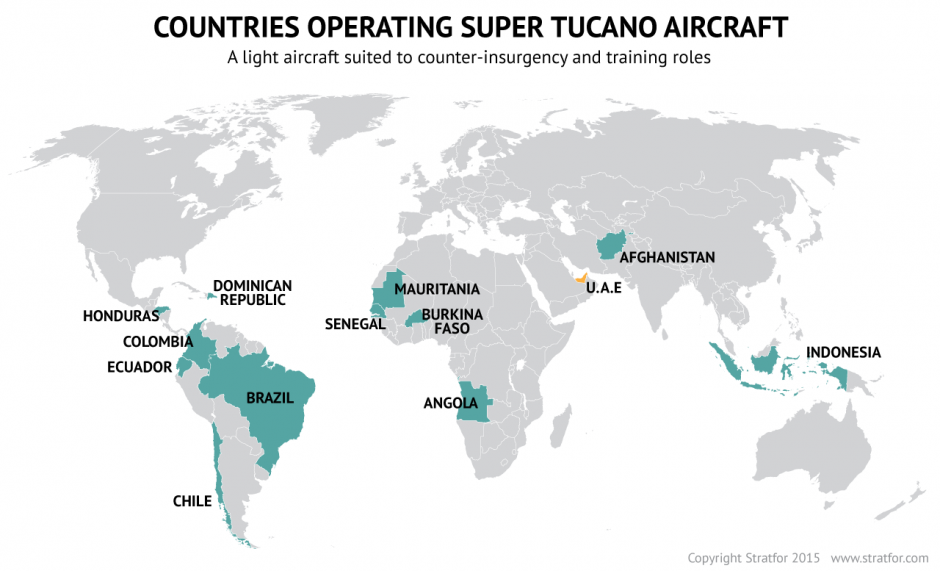
The EMB 314 Super Tucano is a tandem-seat single-turboprop aircraft developed by Brazil's Embraer. It is a further development of the highly successful Embraer EMB 312 Tucano basic trainer aircraft that has been optimized for a counterinsurgency and light attack role. Approximately a dozen air forces worldwide have fielded the Super Tucano, which is set to see increased combat service with the Afghan air force, and perhaps even in the United States. Indeed, the aircraft already has a proven combat record with countries as diverse as Brazil and Mauritania.
The United Arab Emirates is becoming increasingly aware that some of the biggest threats to its power do not necessarily originate from neighboring armed forces, but instead come from increasingly well-armed and -funded domestic and regional non-state actors. This accelerating trend has forced a number of regional countries including the United Arab Emirates to devote considerable funding to the acquisition of capabilities suited to the counterinsurgency mission.
Alongside a number of other Gulf Cooperation Council countries, the United Arab Emirates has embarked on an ambitious military modernization program over the past few decades, with a focus on airpower. As Stratfor has previously explained, the UAE focus on building its airpower stems from a desire to protect itself against major regional powers like Iran as well as to provide flexibility and force-projection capabilities that a modern air force affords.
Buoyed by significant funding derived from its energy resources, the United Arab Emirates has focused heavily on purchasing advanced warplanes such as the F-16E/F Desert Falcon that have greatly bolstered its war fighting capabilities. With the United Arab Emirates' increasing willingness to embark on military missions across the region, however, the United Arab Emirates has had to evaluate the type of capabilities it requires for such missions. The multirole Desert Falcon is eminently suited to both deter Iran and launch high-precision strikes over extended distances. The conflicts the United Arab Emirates is currently involved in, namely Syria (and reportedly Libya), suit the Desert Falcon's capabilities. Still, it is not necessarily the most effective aircraft in a persistent close-air support role over friendly forces.
Over the last few years, the United Arab Emirates has therefore gradually sought to invest in light aircraft that could prove useful in counterinsurgency operations against non-state actors with limited air defense equipment. The United Arab Emirates has already modified an unspecified number of Cessna 208 aircraft into "Combat Caravan" versions capable of carrying air-to-ground Hellfire missiles. It has also purchased ten AT-802U aircraft, which are agricultural and fire-fighting aircraft modified for a counterinsurgency role with the addition of engine and cockpit armor, self-sealing fuel tanks, and the ability to carry weapons and bombs. Delivery of these aircraft began in early 2011.
The purchase of a batch of 24 Super Tucano aircraft represents the largest step forward in the fielding of light aircraft dedicated to a counterinsurgency role. These aircraft are ideal against non-state actors such as the Islamic State that are a growing threat in the region. They are also particularly useful in non-contested air space where the Super Tucano's increased vulnerability relative to high-powered jets is less of an issue. In addition, the Super Tucano is highly suited to the trainer role, which is a welcome bonus for the growing UAE air force.
With the United Arab Emirates increasingly active across the region and with large numbers of armed and dangerous non-state actors operating across the Middle East, its need for such aircraft is unlikely to diminish anytime soon.
