
The Ukrainian political system has been in disarray over the past several weeks. Support for Yatsenyuk and his People's Front party has eroded and several parties have officially left the ruling coalition. The government Yatsenyuk put together after the Euromaidan uprising in 2014, when he and President Petro Poroshenko were elected into office, initially had broad popular support. Yatsenyuk's People's Front party won 82 seats in the 450-seat legislature, and 132 seats went to the Poroshenko Bloc. They then formed a broad-based coalition of pro-Western groups that included the Self Reliance, Radical and Fatherland parties to secure a solid 288-seat majority.
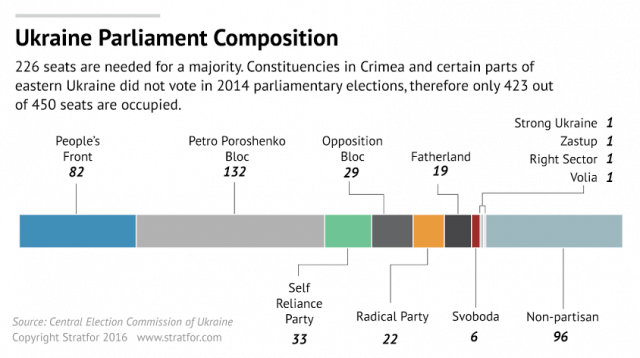
But Yatsenyuk's mandate to govern has all but disappeared over the past year. The economic downturn and ensuing painful austerity measures, combined with concern over political corruption, turned the public against him. Then in September, the Radical Party quit the coalition — leaving it with barely half the seats in parliament — over controversial constitutional amendments that would have decentralized the Ukrainian state. With the loss of the Fatherland party on Feb. 17 and of the Self Reliance Party the following day, Yatsenyuk's coalition is now limping along with only 217 seats, no longer a majority.
At the same time, Yatsenyuk himself is in danger of losing office. Once they left the coalition, the Self Reliance and Fatherland parties joined a growing number of Ukrainian lawmakers who are calling for Yatsenyuk to step down. Earlier this week, the legislature voted that his government was "unsatisfactory," leading to a no-confidence vote on Feb. 16 that would have triggered early elections. Yatsenyuk narrowly escaped by 32 votes.
Building a New Coalition
Now that he has survived the no-confidence vote, Yatsenyuk has time to regroup. By law the parliament cannot threaten him with another vote until July, and in the meantime he can reach out to the parties that turned on him to rebuild his coalition. He may even still have some support from Poroshenko. The president has publicly criticized Yatsenyuk, but the fact that certain members of Poroshenko's bloc voted to keep Yatsenyuk in office means that the two may be closer than they appear.
Perhaps most crucially, Yatsenyuk has Western support. The United States in particular sees Yatsenyuk as the best chance to prevent Ukraine from sliding back into chaos, and political stability is essential to Ukraine's economy. The IMF earlier in February threatened to suspend payments on its $17 billion bailout to the country if the political instability kept stalling efforts at political reform. Even Yatsenyuk's opponents are wary of losing the funds altogether, which may keep them from pushing for early elections until later this year or even early next year, when Ukraine has already received a few more tranches of the loan.
Meanwhile, Yatsenyuk has made it clear that, though he is willing to reorganize his Cabinet, he has no intention of stepping aside. In fact, he is already in negotiations with the Radical Party, trying to convince it to return to the coalition and re-establish its majority in parliament. With the no-confidence vote over, the prime minister has weathered one threat to his power, but he will have to overcome many challenges in the next couple of months to rebuild an effective coalition.
