
Colombian President Juan Manuel Santos ordered Colombia's armed forces and police Feb. 8 to intensify operations against the ELN. Santos also demanded that the militant group release two of its hostages as a precondition for formal negotiations. Since 2014, the ELN and the government have periodically held confidential meetings to open a formal peace process. But so far, the most the two sides have agreed upon is a roadmap for talks similar to that of the FARC negotiations, and the ELN continues to insist on a cease-fire before talks begin — something the government refuses to accept.
But the ELN is at far more risk than the Colombian government. Even if the FARC and the government reached a political settlement in the coming months, there is no guarantee that the ELN would receive the same treatment. Unless the state explicitly allows the ELN to receive the benefits of the FARC peace agreement (such as access to transitional justice mechanisms), the two peace processes will remain separate.
Meanwhile, the government has not made up its mind about the ELN's future. The ELN will probably try to open talks this year, if only because the alternative — the group's degradation, if not destruction — is unacceptable. Remaining in the Colombian hinterland or in Venezuela is not a viable option either. Cuba's rapprochement with the United States and Venezuela's economic collapse could eventually cost the group these havens abroad, so some of the ELN's leaders likely feel the need to come to a settlement with the government.
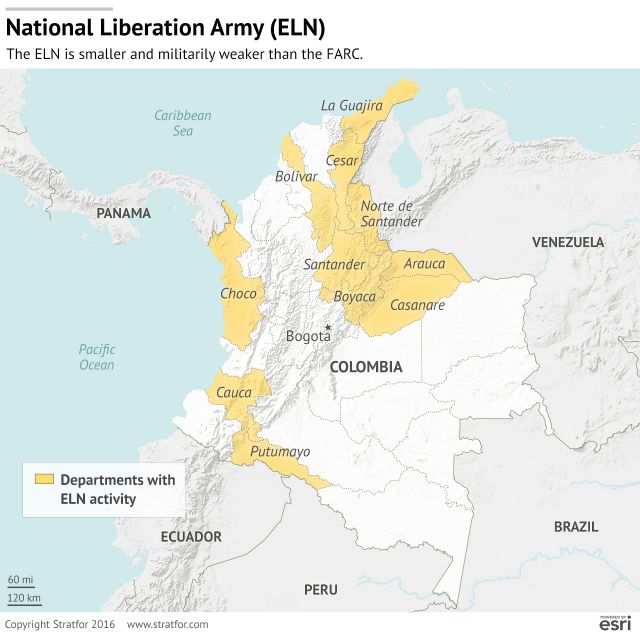
But the group's window of opportunity to open talks is narrowing. Unlike the FARC, which has more fighters, more money and a wider area of operations, the ELN lacks any major influence outside of the departments of Choco, Norte de Santander, Santander, Boyaca, Casanare, Arauca, Bolivar, Putumayo and La Guajira. The Santos administration's term also ends in 2018, and there is no guarantee that a new government would give the ELN any better treatment. The government has no incentive to engage in a long, drawn-out peace negotiation with the group, especially if the militants constantly object to the government's terms. Eventually, if the peace talks turn the FARC into a more diffuse and less politically motivated and dangerous threat, the government could choose to target the ELN and other criminal groups militarily. The ELN would quickly become a more manageable problem for Bogota.
So far, one impediment to negotiations appears to be divisions within the ELN. One of the insurgency's units, the Domingo Lain Front, is less inclined to enter negotiations with the government. The front is heavily involved in the extortion of private businesses, including oil companies and oil services firms in northeastern Colombia, particularly in the departments of Norte de Santander, Boyaca, Casanare and Arauca. As a result, of all the ELN's units it poses the greatest threat to the government even as its better financing makes it less likely to negotiate. Indeed, its commander is openly opposed to peace talks. As long as these divisions persist, a settlement between the government and the ELN as a whole may do little to halt attacks on energy producers. Thus, the government will likely resist opening talks with the ELN until the group can present a more united front.
Another reputed obstacle to negotiations is the ELN's connection to Venezuela. A section of the ELN allegedly requested that Venezuela be a location for negotiations and that Venezuelan President Nicolas Maduro be involved in the process. Such demands will only delay talks. Moreover, even if the Colombian government does agree to such a request, the Venezuelan opposition is undermining Maduro's weakened government, which could further complicate the ELN's negotiation strategy.
Time is on Bogota's side; it is the ELN that really needs a negotiated settlement. Even unsuccessful talks will not create significant security problems for the Colombian government, particularly if, and likely when, as a result of talks the FARC breaks into smaller organized crime groups. With a strong, centralized and politically motivated FARC insurgency disbanded, the government's full counterinsurgency capabilities will likely focus on smaller insurgent and criminal groups such as the ELN.
