
The events of the coming months will be crucial in shaping the contours of an eventual peace agreement. Much of the groundwork has already been laid: The government and the FARC have been working to erect transitional courts for over a year. The September agreement reflected the understanding between Bogota and the FARC that the government will guarantee that an unspecified number of rebels will not face prison if they agree to confess to their crimes before the transitional court. It seems that the question of whether militants will receive similar amnesty deals for crimes related to drug trafficking — the biggest factor impeding the group's demobilization thus far — has been answered sufficiently enough to convince the rebels to remain in negotiations. Indeed, Colombian President Juan Manuel Santos has already publicly said his government will try to prevent the extradition of FARC members for such crimes.
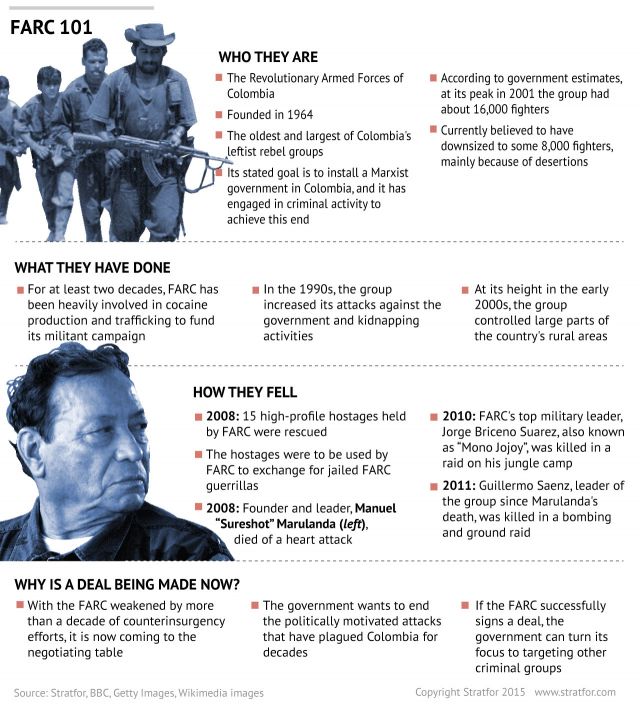
It is unclear, though, how the Colombian government will implement the final peace deal. The success of any agreement would likely require the government to make significant concessions to the FARC to ensure its members avoid extradition and can participate in Colombian politics. Lawmakers will likely grant Santos the power to implement parts of the agreement by decree. Meanwhile, Congress will turn its attention toward approving three things: the legal framework that will underpin the transitional court, the means by which a peace deal will be enacted and codified into law (likely via national referendum), and the legislation needed to prevent the extradition of FARC leaders.
The future of the final peace deal still hinges on the question of amnesty, but the available evidence suggests that the government and the FARC will reach an agreement on the issue. Shielding the FARC from extradition would likely require both houses of Congress to pass a national law. While such a piece of legislation would generate controversy in parliament, the Santos government has enough support among lawmakers to pass it. Only a simple majority in each house of Congress is required to pass the amnesty legislation, and Congress authorized Santos' negotiations with the FARC in 2012. The right-wing Democratic Center and the divided Conservative Party — the only significant forces opposing a peace deal — together hold only 23 percent of the seats in the lower house of Congress and 37 percent in the upper house. So barring the revelation of any truly controversial concessions in the confidential deals struck in Havana, it is unlikely that Santos will encounter any major roadblocks to a peace agreement in Congress.
The Promise of Peace
The FARC's actions on the battlefield suggest that the militants believe a lasting peace agreement is within reach. Since the militants implemented a one-sided cease-fire July 20, violence has significantly declined across the country. In September, the FARC carried out just a single direct attack. Even in the country's more violent areas, such as the southwestern departments of Caqueta, Narino, Putumayo and Cauca, there have been relatively few attacks against security forces, foreign energy interests and civilians. If militant-related violence remains low in the months ahead, it will clearly indicate that the FARC continues to consider a peace deal possible and is making an effort to de-escalate the conflict in preparation for a full demobilization.
As the government and the FARC make progress toward an agreement, Colombia's smaller National Liberation Army (ELN) will likely push for its own arrangement with Bogota. ELN commander Nicolas Bautista posted a message online Oct. 5 that said the group's confidential talks with the government, which have been ongoing since January 2014, are nearly at an end and that public talks may begin in the near future. Because the ELN is smaller than the FARC and poses only a limited threat beyond a few isolated enclaves in Colombia's northeast and southwest, reaching a peace deal with it is a lower priority for the Colombian government. If Bogota reaches an agreement with the FARC and fails to open talks with the ELN, the smaller group will remain a low-level threat to the government in the coming years.
Over the next few months, Bogota will focus on pushing talks forward with the FARC and figuring out how the group will demobilize. In the background, the Santos administration will work toward new legislation to ensure that the militants can stand down without fear of incarceration or extradition. As the government edges closer to an agreement that would dramatically reduce politically motivated violence in Colombia, it will be up to the country's negotiators to actually seal the deal.
