
Ecuador has made some dramatic political changes at a delicate time for its economy. The Ecuadorian National Assembly legally removed term limits from the presidency on Dec. 3, allowing the president to potentially run for office as many times as he wishes. Remarkably the amendment, which in theory could promote stability by establishing continuity of leadership within the presidency, could actually weaken the country over the next four years. The decision bars President Rafael Correa from running until 2021, forcing potentially less popular and untested politicians to run in his place for the ruling Alianza Pais in the next election in 2017. Conceivably, it could even usher in an opposition candidate, should the still-disparate political group coalesce.
Regardless of who wins in 2017, the next president will have few options to improve the country's sagging economy, which will make it more difficult to retain constituents' loyalty. Low oil prices have hurt the exports that Ecuador depends on for economic growth. To maintain public finances, the government will have to continue making cuts to spending, raising the risk of igniting protests among groups that have come to rely on generous social programs. In the end, barring a quick rise in oil prices, the next Ecuadorian president's term will be marked by slower economic growth and potential social unrest.
Failure to Coalesce
For the most part, Ecuadorian politics are characterized by fragmented parties centered on powerful individuals. But in recent history, especially when oil prices were high, Correa, who has been president since 2007, became so popular that other political leaders simply stopped contesting his rule. In fact, in the last election, the ruling party was so popular that it won a large majority in the National Assembly in addition to winning the presidency.
To maintain power, Alianza Pais passed several constitutional amendments in the National Assembly the week of Nov. 30. One of these amendments removed term limits from all elected positions, including the presidency — something Correa needed to legally seek another term. In response, Ecuador's divided political opposition protested the amendments, fearing that it might be shut out from power permanently if leaders without term limits became entrenched.
But the loose coalition of opposition parties failed to coalesce to meaningfully pressure the president to withdraw his bid for further terms in office. Instead, Correa publicly denied he would stand for office in 2017, preventing the opposition from using his re-election as a rallying point for further demonstrations. Alianza Pais supported his choice, and the constitutional amendments passed, with an additional rule prohibiting any current elected figures — including Correa — from running in the next electoral cycle. Alianza Pais must now choose a new candidate for the 2017 presidential race, one who will almost certainly be less popular and less well known among voters.
Economic Hardship
But even if Alianza Pais' candidate fails and the presidency goes to the more business-friendly Ecuadorian opposition, Ecuador's deep-seated economic problems will persist. Declining export revenues will be any future president's primary concern. Ecuador relies on energy exports, which make up around 40 percent of the country's export revenues. The remainder of the country's exports consists of mostly low-value agricultural products. Because the U.S. dollar is the national currency, Ecuador cannot devalue it to increase the competitiveness of its exports. Moreover, the depreciating currencies of other trading partners, such as Peru and Colombia, relative to the dollar will further diminish Ecuador's export competitiveness. The Ecuadorian government will likely continue cutting government expenses over the coming years to curb currency outflows.
The country also suffers from a widening trade imbalance. Ecuador had a trade deficit of about $1.8 billion in 2014, and that shortfall will likely deepen this year and in coming years, exacerbated by low global oil prices. Despite its 2008 default on foreign debt, the country still retains access to foreign loans tied to its oil exports to fill financing gaps in the national budget. Ecuador gained access to a Chinese credit line of $5.3 billion in 2015, including $500 million for government investments over an unspecified time period. The government has also leveraged oil exports to Thailand for a $2.5 billion credit line through an unspecified period. However, loans make up only around 2 percent of the government's overall reported income, while nearly half comes from taxation.
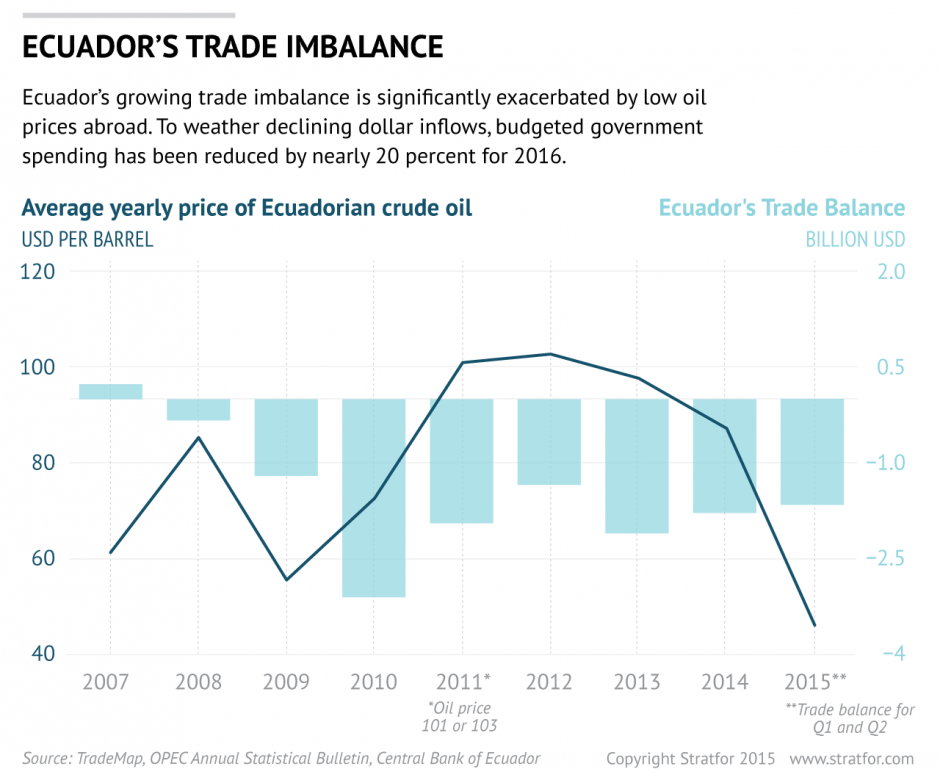
Through all of the economic hardship, public finances have so far weathered the declining dollar inflows but only because the government has tightened its spending — something it will continue to do in 2016 as it slashes its budget by nearly 20 percent. Steep reductions in public spending, particularly Ecuador's large social investments, could eventually turn voters against the ruling party, and some of the more restive rural groups that have grown accustomed to generous social spending and years of high economic growth could protest more frequently to demand concessions from the state. Although it is divided into factions for and against Alianza Pais, the Confederation of Indigenous Nationalities, which is the largest political organization of indigenous ethnic groups in Ecuador, may become a significant protest group against future government policies, as it was during protests in 2009.
Though Ecuador is not on the verge of major economic and political upheaval as a result of its slowing economy, it is unlikely to receive the increased investments it needs in the coming years. Relatively low global metal prices will hurt Ecuador's mining sector as well as foreign direct investment. Low oil prices and sudden, heavy-handed regulatory changes concerning oil investments have also discouraged future investments into the country's important energy sector. For example, in 2010 the government demanded that energy firms operating in Ecuador switch from production-sharing contracts to service-based contracts, threatening to expropriate companies that did not comply. The policy guaranteed greater revenue for the state, but it also made potential investors extremely cautious in considering Ecuador for investment. Ultimately, Ecuador will continue to be a relatively less attractive destination for investments in the extractive industries than its neighbors as it heads into a period of political and economic uncertainty.
