
Forecast
- Regional developments will further align Israeli and Turkish interests over time, ultimately leading to a formal reconciliation.
- In the short term, cooperation between Israel and Turkey will continue behind closed doors.
Israel and Turkey may once again be taking steps toward repairing their relationship, which has been damaged since the Mavi Marmara flotilla incident in May 2010. On June 22, Haaretz reported that the new director general of the Israeli Foreign Ministry, Dore Gold, met in Rome with an undersecretary in the Turkish Ministry of Foreign Affairs, Feridun Sinirlioglu. The pair reportedly discussed mending ties between their countries, something that the Israeli and Turkish governments have tried several times to achieve over the past five years. Israel in particular maintains a deep interest in improving its relations with Turkey, while the weak performance of Turkish President Recep Tayyip Erdogan's Justice and Development Party (AKP) in recent elections may have cleared some of the obstacles preventing the two countries from burying the hatchet. Though Israel and Turkey still must overcome a significant amount of inertia to fully revive their relationship, the two share too many common interests to remain at odds over the long term.
Reconciliation: A History of Stalled Attempts
Many attempts have been made to restore Israeli-Turkish ties. Perhaps the most notable occurred during U.S. President Barack Obama's visit to Israel in March 2013, when he cajoled Israeli Prime Minister Benjamin Netanyahu into apologizing to Erdogan, Turkey's prime minister at the time. By May, Netanyahu's office was optimistic enough to announce that an agreement with Ankara was imminent. However, the draft deal agreed to by both sides sat on Netanyahu's desk for months and ultimately remained unsigned. The following February, a new round of talks led to yet another agreement that was again derailed by Netanyahu's reticence and Erdogan's demands that Israel include a written pledge to lift the Gaza blockade — a request that, according to Israeli media, had not been included in the reconciliation deal. Obama tried to pressure Erdogan to accept the proposal, but to no avail.
The most recent olive branch, then, should be viewed with a healthy dose of skepticism. But putting aside the unpredictable stops and starts of what has become a convoluted diplomatic process, it is important to note who is publicizing the most recent revival of talks: Israeli sources quoted in an Israeli newspaper. Turkey, for its part, initially stayed silent on the matter, neither confirming nor denying the report until Turkish Foreign Minister Mevlut Cavusoglu verified the rumor two days later. Equally strange was the initial report's claim that Gold did not inform the team tasked by Netanyahu to develop the 2014 draft agreement about the meeting — information that normally would not be included in a report about a secret diplomatic meeting. Meanwhile, an Israeli Foreign Ministry spokesperson confirmed that Gold went to Rome but did not reveal why. While it remains unclear who initiated the meeting in Italy, it is clear that it was Israel that wanted the world to know about it.
Two Possible Explanations
There are two possible explanations for Israel's eagerness to highlight the renewed talks. The first centers on internal Israeli politics. Netanyahu's May 25 appointment of Gold as the Foreign Ministry's next director general — a post that has been conspicuously vacant since Avigdor Lieberman resigned May 4 — signaled the prime minister's intention to empower and solidify control over the ministry. Lieberman's irreverence toward the very idea of reconciliation with Turkey was one of the main sticking points on the Israeli side preventing talks from moving forward. Because Netanyahu also never particularly trusted Lieberman, he appointed several of his own special envoys to carry out sensitive diplomatic missions, including reconciliation with Turkey, while Lieberman was in office. Once Lieberman's position became available, the Times of Israel speculated that Netanyahu would give the post to Zionist Union leader Isaac Herzog in order to persuade his party to join the ruling coalition. But Netanyahu's decision to select Gold instead, when taken together with his initial choice to leave the post vacant for a spell, indicates that the prime minister intends to essentially run the Foreign Ministry himself. Gold has long been Netanyahu's confidant; his trip to Rome and the subsequent leaks emphasizing the exclusion of other key Israeli officials involved in Israeli-Turkish relations could be a move by either Gold or Netanyahu to reassert the Foreign Ministry's control over Israeli foreign policy. In addition, Netanyahu's use of Gold, a trusted adviser and an accomplished diplomat, rather than previous envoys as the primary negotiator in Rome could indicate how serious he is about healing the rift between Israel and Turkey this time around.
The second explanation is that Netanyahu sees the results of Turkey's recent general elections, which have at least momentarily curbed the influence of Erdogan and the ruling AKP, as an opportunity to reopen a dialogue with Ankara. All of the AKP's potential coalition partners have publicly criticized Erdogan's enmity toward Israel. It is possible, then, that the leaks were designed to test the waters and signal that the Israelis are ready to reconcile if the Turks will meet them at the table. Netanyahu may even be hoping to subtly influence the coalition-building talks currently underway in Turkey. Sinirlioglu's attendance at the Rome meeting indicates that the Turks, though they have not publicly admitted as much, continue to be serious about normalizing relations with Israel. (Sinirlioglu served as Turkey’s ambassador to Israel from 2002 to 2007, and he is a well-respected figure within Turkish diplomatic circles and the ruling party.)
With Converging Interests, a Better Outlook
The Israeli government, for its part, is deeply interested in smoothing things over with Turkey. Israel is a small country in a hostile neighborhood that depends on its relationships with regional and global powers to ensure its survival. But there are also a number of specific areas in which partnering with Turkey could prove beneficial to Israel. For example, the Islamic State's attempts to carve out a caliphate alongside the ongoing rebellion in Syria have created chaos on both the Israeli and Turkish borders. The conflict has hit particularly close to home for Israel's Druze community. On June 11, Syrian militant group Jabhat al-Nusra killed 20 Druze villagers in Idlib province, prompting Israel's 130,000-strong Druze community to pressure the government to help their Syrian brethren. Neither Israel nor Turkey wants to see the Syrian conflict spill over their borders, and thus the two countries share the common goal of keeping the violence contained.
The energy sector provides another attractive opportunity for cooperation with Turkey. Israel hopes to become an exporter of natural gas, but the steep cost of developing Israel's giant Leviathan field will require substantial foreign investment to fund the construction of the necessary export infrastructure. Theoretically, a pipeline running through Turkey would face many obstacles, but it is nevertheless an appealing idea for Israel. On the security front, Turkey maintains ties with Hamas and the Palestinian National Authority. While Israel views Turkey's relationship with Hamas with suspicion, the Israeli government would gain legitimacy with other regional and global powers if it established friendly ties with Ankara.
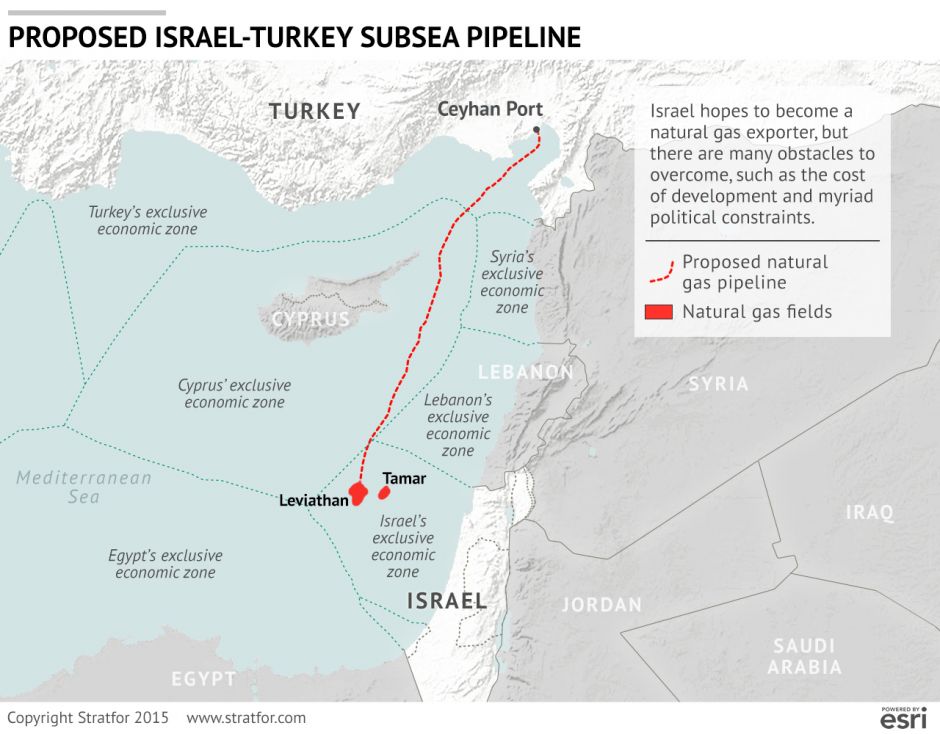
One of the most important factors driving Israel toward Turkey has nothing to do with Ankara and everything to do with Washington, which has been consistently pushing Israel and Turkey to mend ties. Netanyahu's personal relationship with Obama has been publicly antagonistic, and rekindling Israel's relations with Turkey could at least somewhat lessen the tension between Israel and its most important patron.
For Turkey, its relationship with Israel is more complicated. In 2010, when Israeli-Turkish ties first disintegrated, Stratfor noted that Israel was a liability to Turkey's expansionist agenda at the time. But in the years since the flotilla incident, the rise of jihadism in Syria, the eclipse of the Muslim Brotherhood in Egypt and the AKP's recent electoral setbacks have aligned Turkey's interests more closely with those of Israel. Stratfor sources have also suggested that the Turkish military is pushing for normalization in the hope that it could receive military training and aid from Israel — an arrangement that was once robust. With Erdogan and the AKP facing so many challenges at home, revitalizing Turkey's relationship with Israel may be an easy compromise that placates Turkey's many political parties and figures who believe strong ties with Israel to be in Turkey's best interest — especially since Israel is at odds with Iran, Turkey's natural competitor in the Middle East.
At this point, many of the issues that continue to separate Israel and Turkey are more personal than geopolitical. Lieberman's resignation from the Israeli Foreign Ministry may help the reconciliation process, but Netanyahu's pride could continue to stand in the way, as it has in previous attempts to reach a deal. Erdogan, for his part, has consistently made public and inflammatory statements about Israel over the past few years, as has Turkish Prime Minister Ahmet Davutoglu. However, reports suggest Davutoglu's influence may be waning, which could further open the door to a normalization.
Even so, it would be premature to assume that one secret meeting in Rome indicates Israel and Turkey are finally ready to resolve their differences. (As if to underscore this point, a new flotilla will soon depart from Athens in an attempt to break Israel's blockade of Gaza — a stark reminder of the flotilla that derailed Israeli-Turkish relations in the first place.) Though Erdogan's power has been temporarily diminished, any Turkish government formed will likely be short-lived; new elections, if held, could restore at least some of Erdogan's previous authority.
Still, the process of patching up the Israeli-Turkish relationship, however circuitous, continues. This time, though, regional developments are bringing the two countries' interests closer together, which will eventually lead to a formal reconciliation. In the meantime, cooperation between Israel and Turkey will continue, if only behind closed doors.
Lead Analyst: Jacob Shapiro
