
In the March general elections, Netanyahu's Likud party won 30 seats in Israel's 120-seat legislature, giving the party a comfortable lead over its opponents. More important, the margin gave Netanyahu flexibility to negotiate with potential coalition partners.
Netanyahu has signed a coalition agreement with United Torah Judaism, a party representing an ultra-Orthodox constituency. Another ultra-Orthodox party, Shas, joined the coalition as well. One of the key demands of these parties is the reversal of a law passed under the previous coalition that forced young men from ultra-Orthodox communities to serve in Israel Defense Forces, eliminating a long-standing exemption from conscription for members of these religious communities. Another policy demand is that the new government reinstates higher welfare payments. These two parties alone will make the new government more conservative in nature.
Competing Political Forces
But the government includes a mix of parties. The religious, nationalist Habayit Hayehudi (Jewish Home) party of Naftali Bennett, who served as economy minister under the previous government and is now expected to serve as minister of education, is one such party. Bennett's party conducted difficult negotiations with Netanyahu's Likud up to a few hours before the deadline for forming a coalition, forcing the prime minister to agree to a series of concessions, including awarding the sought-after position of minister of justice to a member of the party. Moreover, Netanyahu has come to an understanding with Kulanu, a new center-right party led by former Likud leader Moshe Kahlon, who ran for office with the promise of bringing housing and tax reforms. Kahlon will serve as minister of finance.
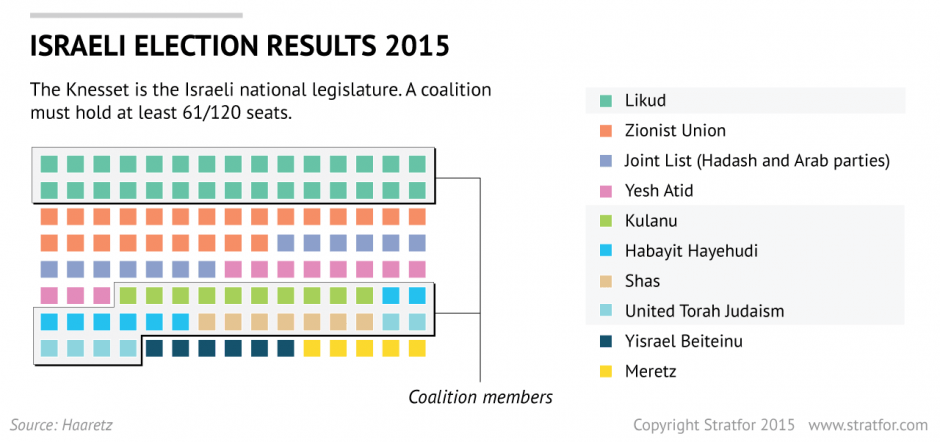
Although Netanyahu has negotiated with enough factions to secure a majority and form a government, this new coalition will have to confront diverging interests that could undermine its coherence. With only a slim majority, the coalition will be hostage to the interests of even a very small number of members of the Knesset to approve legislation. At the same time, policy platforms of parties also contrast greatly with one another. The ultra-Orthodox parties will focus on boosting social benefits and securing legislation favorable for Israel's religious communities. Centrist parties such as Kulanu, meanwhile, will seek economic reforms benefiting the middle class.
Israel's previous coalition government collapsed in part because of disagreements between centrist parties — Yesh Atid and Hatnua — and more conservative forces over budgetary issues and a bill designating Israel as a Jewish state. Netanyahu's new coalition may suffer similar divisions. In the coming months, members of the Likud party will likely seek to reach out to more partners — whether in the secular, nationalist Yisrael Beiteinu party, which has refused thus far to join the government, or among the centrist and center-left parties — to give the government an opportunity to govern effectively. Reaching out to such a diverse set of partners for the coalition, however, will risk further polarizing its members and undermining its coherence.
Changing Foreign Affairs
Simultaneously, Netanyahu will focus on shaping U.S. policy in the region, if he can. The United States is working to create a regional balance of power between Saudi Arabia, Iran and Turkey so it can reduce its involvement in the Middle East. The United States is already working with Iran to fight the Islamic State in Iraq, while also aiding the Saudi-led coalition in battling the Houthis in Yemen. So far, Israeli leaders have been unable to derail negotiations between the United States and Iran. And while the United States will maintain its relationship with Israel, Washington will not elevate Israeli policy preferences above its need to reduce its burden in the region.
Israel will respond by using energy policy to forge closer relationships with Egypt and Jordan. In March, a private Egyptian firm signed a seven-year agreement to import Israeli natural gas. Israel will use Egypt's energy needs to strengthen economic and political ties between the two countries.
Israel will use similar energy policies to entice Turkey to re-engage with Israel. Though their relationship is still strained, Turkey is becoming more active in Israel's periphery. But Israel, which is involved in discussions with Egypt and Cyprus over natural gas cooperation, could invite a thus far excluded Turkey into the energy projects in the Eastern Mediterranean. Of course, Turkish participation will be contingent upon progress in discussions between Turkey and Cyprus over the status of Northern Cyprus. Only an agreement over the status of the area and surrounding waters could enable Turkish participation in commercial natural gas operations in the region.
In the Palestinian territories, Israel's new government will face a largely weak and divided Palestinian leadership. Sudan has stopped its transfer of supplies to Hamas, allegedly because of pressure from Saudi Arabia. Egypt has clamped down on arms deliveries to the territories through the Sinai Peninsula. Iran's involvement in the conflicts in Syria and Iraq has strained Tehran's finances, limiting Iranian assistance to Hamas. Finally, Hamas is taking steps to preserve its political dominance in Gaza and crack down on jihadist activity in the area. Along with a weak Fatah in the West Bank, a starved Hamas will benefit Israel by preventing the emergence of a unity Palestinian government.
The new Israeli coalition government will face a host of internal divisions that will undermine its long-term cohesion and could ultimately hurt Netanyahu's popularity. At the same time, Israel's leaders will face a weaker Palestinian leadership. While Israel will take steps to reach out to countries such as Egypt and Turkey, the Israeli government will not be able to challenge the United States' strategic goals in the Middle East or the rise of regional powers, including Saudi Arabia, Iran and Turkey.
