
Election day in Israel is designed to lead into a toilsome process of coalition building. Israelis will vote for 25 party lists, each of which must pass a 3.35 percent threshold to enter the 120-seat Knesset. No party has ever won the 61 seats necessary to rule the Knesset by itself, which ensures that multiple rounds of horse-trading will ensue before a government is finally formed.
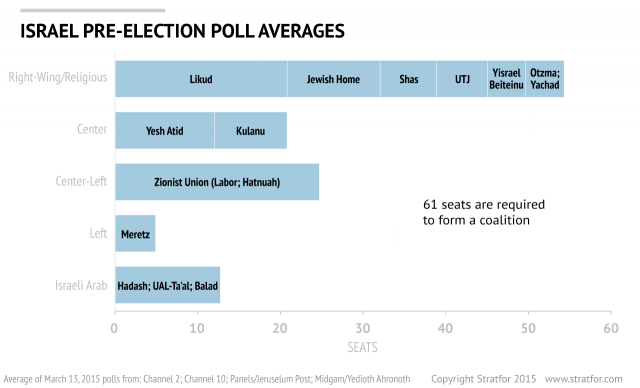
According to the latest polls, incumbent Prime Minister Benjamin Netanyahu's right-wing Likud party is trailing Isaac Herzog's center-left Zionist Union by at least three seats, with both parties still needing around 40 seats to form a coalition. Though it is customary for the leader of the party that wins the most seats to be tasked with forming a coalition, it is up to the president to decide which party leader will head up the process, which can take up to three rounds before new elections have to be called. Should he be given the opportunity, Netanyahu will likely be in a stronger position than the Zionist Union to build a coalition drawing from Israel's assortment of religious and right-wing parties. Already, Netanyahu is preparing the groundwork for a courtship with Israeli right-wing parties by declaring on the eve of the election that there will be no Palestinian state if he is re-elected.
Regardless of which party comes out on top, Israel's foreign policy will continue to be grounded in the same constraints that have defined Netanyahu's nine years in office.
Nuclear Negotiations Moving Forward
The most immediate issue confronting Israel is the likelihood of a U.S.-Iranian nuclear agreement. Netanyahu spoke before the U.S. Congress in early March and succeeded in galvanizing enough Republican senators to raise doubt in Tehran by broadcasting an inconvenient fact: Any agreement signed by U.S. President Barack Obama will not be binding for the next American leader. But the warning seems to have done little to dissuade Iran in the negotiation. In fact, both Iran and the United States are preparing to send their agreement to the U.N. Security Council for approval, a prerequisite for lifting the council's sanctions on Iran related to enrichment activities, the supply of nuclear materials and technology, and weapons proliferation. By lifting sanctions in the U.N. body, the European Union will have the mandate to lift its own sanctions, and the next U.S. administration will already be on a course toward normalization that will be that much harder to reverse.
Of course, bringing the agreement to the five permanent members of the U.N. Security Council raises the question of how Russia will vote. Russian President Vladimir Putin has no shortage of distractions, a reality that was only underlined during his recent 10-day disappearance from public view. Russia could welcome the opportunity to throw a wrench into the negotiation in hopes of keeping the United States preoccupied with the Middle East while Putin tries to manage conflicts closer to home. However, Russia has also been working to insert itself into the nuclear deal by playing the role of nuclear fuel supplier to Iran. So long as Russia continues on the path of integrating itself into a deal instead of derailing it, Washington and Tehran feel comfortable taking the nuclear agreement to a U.N. Security Council vote.
The negotiation with Iran extends well beyond the nuclear issue, as Israel knows well. Just as Iranian forces have been leading the first big offensive against the Islamic State in the Iraqi city of Tikrit, U.S. Secretary of State John Kerry told Face the Nation on CBS on March 15 that there is only a political — not military — solution to the Syrian conflict and that the United States and its allies "will have to negotiate in the end" with Syrian President Bashar al Assad. Any negotiation between Iran and the United States will entail a recognition of an Iranian sphere of influence that encompasses Syria, Lebanon and Iraq, even as the United States continues to work with Sunni powers that will challenge Iranian power. Though Kerry's words have attracted ire from Sunni states such as Turkey, he was merely acknowledging the reality of the situation. The reality of Israel's principal patron working with Iran — and selectively acknowledging Iran's allies and proxies — is something Israel will have to accept, however begrudgingly.
Hamas and Iran
Iran is active not only on Israel's doorstep in Syria and Lebanon but also in the Palestinian territories. The debate over whether Likud or Zionist Union will negotiate the creation of a Palestinian state is somewhat meaningless at this stage because there is no Palestinian partner with whom Israel can or will negotiate. Fatah remains a weak and divided force in the West Bank, while Hamas and Iranian-backed groups such as Palestinian Islamic Jihad in Gaza are fighting to hold their ground against a growing jihadist presence that has taken root in Sinai.
In this environment, there is little impetus pushing Palestinian groups toward moderating their stance politically or militarily in order to negotiate with Israel. The Israel-Palestinian negotiation is also lacking an effective mediator and enforcer, with Egyptian President Abdel Fattah al-Sisi's hard-line policy against the Muslim Brotherhood damaging the government's long-standing working relationship with Hamas. While Israel can be somewhat relieved that it has an ally in Cairo with a zero-tolerance policy toward Hamas, that relief will be short-lived as Hamas' isolation brings it closer to Iran while creating more opportunities for Sinai-based jihadists to augment their presence at the expense of Hamas.
Saudi Arabia, now under the leadership of King Salman, is alert to this danger. With financial offers on the table, Riyadh has been leaning on the Sudanese leadership to distance itself from Iran and Hamas in hopes of undermining a critical supply route that Iran uses from the Red Sea through Sudan and up the Sinai Peninsula to ship weapons to Gaza. Saudi Arabia has also been leaning on al-Sisi to moderate his stance on the Muslim Brotherhood and Hamas. That the Cairo Court of Appeals is considering an appeal on an earlier ruling to declare Hamas a terrorist organization points to the growing debate in Cairo over how to manage Islamist groups that cannot be eradicated.
That debate will not be resolved anytime soon. In the meantime, a weak and isolated Hamas does not necessarily work in Israel's favor if both Iran and jihadists stand to benefit. The best Israel can do in this situation is focus its efforts on intelligence collection and security operations to mitigate threats from the Palestinian territories, but Israel's inability to rely on Sunni Arab leaders to shape the behavior of the groups posing that threat will continue to hamper this policy in the end.
