
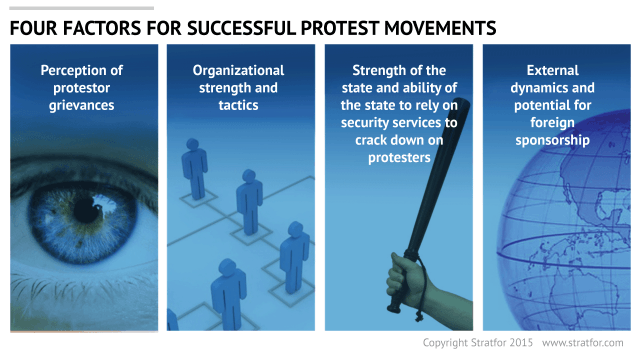
The success of protest movements often hinges on four key factors. The first is society's perception of the protest movement's grievances. Movements whose concerns generate outrage against the status quo and support for the movement from a broad range of citizens are more likely to succeed. The second important element is organizational capability; groups that can manage complex logistics and ensure access to food, sound systems, tents and other amenities can present a serious challenge to governments. A well-organized movement that sets up a camp and a supply chain is relatively difficult to remove and can sustain itself for a long period of time.
The third key factor is the strength of the government and its ability to rely on security forces to crack down on protesters. Fragile coalition governments and governments that do not have strong control of security forces are more susceptible when protests break out. Finally, external support from foreign governments — whether direct support such as funding and training or indirect support such as encouragement — can strengthen protest movements.
Ukraine's Protests
In February 2014, following three months of large-scale and ultimately deadly protests, Ukrainian President Viktor Yanukovich's government was ousted. The protest movement's grievances appealed to a broad spectrum of Ukrainian citizens, and the movement had superior organizational skills and external support. Moreover, some protesters used violent tactics to undermine the government's position.
The protests that led to the government change in Ukraine were rooted in the Orange Revolution — another major protest movement that occurred after elections in 2004. In those protests, hundreds of thousands of Ukrainians rallied in support of the pro-Western presidential candidate, Viktor Yushchenko, who allegedly had been poisoned by his rivals during his campaign. The non-violent Orange Revolution forced the government to allow a rerun of the election, which brought Yushchenko and a coalition of nominally pro-Western factions to power. For the pro-Russia Party of Regions and for the Kremlin, the Orange Revolution highlighted the dangers that mass movements can pose to Russia's interests and geopolitical strategy in the region. The Orange Revolution's achievements were later reversed, and with the Party of Regions firmly in power, a protest movement emerged in late 2013 to again challenge the government.
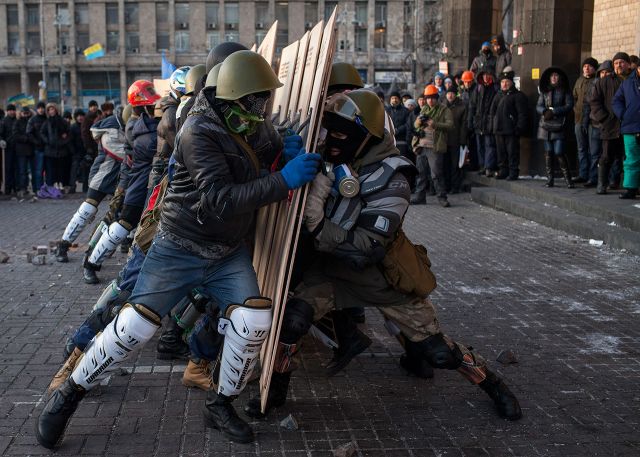
Protesters take part in a training exercise in Maidan Square on Jan. 27, 2013, in Kiev.
(ROB STOTHARD/ Getty Images)
Perception of Grievances
Yanukovich's decision to reject an EU association and free trade agreement in November 2013 angered some pro-Western political parties and civil society groups. However, it was government efforts to hinder protests at Maidan Square that galvanized the opposition and transformed the protesters' grievances from those of select political groupings to those of a wide-ranging movement. Clashes between police and protesters and the start of a violent crackdown on protesters the weekend of Nov. 24-25 changed public perception of the movement. Videos and pictures of the violence against protesters inspired many Ukrainians who were not particularly active in politics to join the movement. On Nov. 24, about 100,000 people protested in Kiev. Following the government crackdowns, the numbers swelled, with 350,000 people protesting in Kiev's Maidan Square on Dec. 2.
Organizational Strength and Tactics
Once protests began, a group of opposition factions — former Prime Minister Yulia Timoshenko's Fatherland Party, boxer Vitali Klitschko's Ukrainian Democratic Alliance for Reform and the nationalist Svoboda party — set up joint headquarters. Meanwhile, a mixture of civil society and political party activists began coordinating logistics around Maidan Square, including the management of donated food, firewood and tents. These groups built on their experiences during the Orange Revolution to organize an effective movement. Protesters took control of several key buildings in downtown Kiev, including the trade union building. Councils were set up to coordinate among different political parties and civic groups to provide security for the square. Physical control of the Maidan area and the ability to deliver supplies to thousands of people at the height of the Ukrainian winter helped the protest movement resist repeated government attempts to disperse the protesters.
Strength of the State and Reliability of Security Services
Yanukovich's Party of Regions enjoyed strong support in Ukraine's parliament, the Verkhovna Rada, as well as in many regional governments. Moreover, Yanukovich and his allies had a strong hold on Ukraine's security forces, using police and hired provocateurs to violently crack down on protesters. Nevertheless, some protesters, including radical and far-right activists, responded to the crackdown with violence. It was this turn of events that undermined the Yanukovich government: Once some citizens were willing to resist government forces violently, and once clashes escalated and the death toll mounted, the government lost its legitimacy with many Ukrainians. In mid-February 2014, during violent clashes in the streets of Kiev, Yanukovich fled the country, and his government was replaced.
External Dynamics and Potential for Foreign Sponsorship
Support from Western governments also played a role in galvanizing both protesters and protest leaders. For the Kremlin, Ukraine is an essential strategic buffer that separates Russia from the West. Thus, Russia has long invested financial and political resources in boosting its influence among Ukrainian political circles, oligarchs and key economic entities. In turn, Western governments — including the United States and Germany — had long invested resources in supporting the development of civil society in Ukraine. Some protest leaders, such as Klitschko, had close ties to Berlin. Several civil society groups that became involved in the protests also had longstanding ties to Western nongovernmental organizations and government institutions. During the protests, Western politicians and officials openly endorsed and encouraged the protesters. Some Western officials even visited Maidan Square and pledged support for Ukraine's EU integration.
The element that sets the Ukrainian protests apart from other recent Eastern European protest movements, and the most important factor in the fall of Yanukovich's government, is that some protesters violently resisted security forces. Protesters threw Molotov cocktails and set up barricades in a confrontation that lasted weeks, and far-right groups played a major role in striking back at government forces. Coupled with the protest movement's strong grievances, superior organization, and external encouragement, violent resistance led to the fall of the government.
The Fall of Successive Bulgarian Governments
The formation of complex coalitions and frequent political and corruption scandals have led to the collapse of two Bulgarian governments in the past two and a half years — one government led by the center-right Citizens for the European Development of Bulgaria and one led by the center-left Socialist Party. Unlike the Maidan protests in Ukraine, Bulgaria's generally non-violent protests led to changes in government that did not affect the country's geopolitical goals. Bulgaria's governments fell because of their weakness and the widespread grievances against them. Despite its popularity, Bulgaria's protest movement was not highly organized and did not benefit from the support of foreign governments.
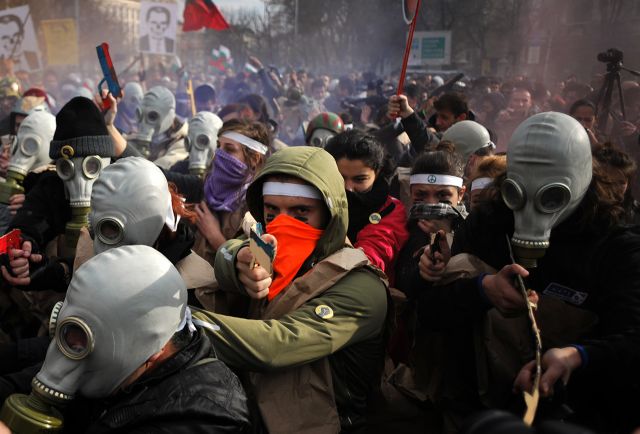
Students with cardboard weapons protest on Nov. 20, 2013, in front of the Bulgarian parliament in Sofia. (NIKOLAY DOYCHINOV/AFP/Getty Images)
Perception of Grievances
Protests against the center-right government of Prime Minister Boyko Borisov began in early 2013 in the southwestern city of Blagoevgrad and then spread across the country. High utility bills triggered the demonstrations, quickly garnering the attention of many Bulgarians as utility costs reached nearly one-third of the average Bulgarian monthly salary. Self-immolations beginning in mid-February 2013 drew the public's attention to the issues of poverty and unemployment and undermined support for the governing coalition. Protests then took place in dozens of cities across the country. On Feb. 17, three days before Borisov stepped down, tens of thousands rallied in Sofia, while 20,000 protested in the coastal town of Varna and 7,000 gathered in Plovdiv. In June of that year, when Borisov's successor, Prime Minister Plamen Oresharski, appointed a controversial media mogul to head the State Agency for National Security, the ensuing scandal sparked daily protests as grievances regarding corruption came to the fore.
Organizational Strength and Tactics
During the protests against the Borisov government, protest groups did not create a unified organizational structure. However, they attracted a variety of groups, including nationalists, left-wing and civil rights activists along with groups that had spent years fighting high utility prices, such as the Sila civil union. With the support of this wide ideological spectrum, the Bulgarian protest movement quickly spread. Although protesters did at times clash with police and block roads, on the whole the movement was non-violent. Months later, during the demonstrations against the Socialist Party-led Oresharski government, civil society activists held "coffee drinking" rallies — during which protesters gathered to drink coffee provided by the organizers — in front of parliament to force the government to resign. Students occupied university buildings as well.
Strength of the State and Reliability of Security Services
Borisov, who had headed a minority and relatively unstable government since 2009, was in a weak position when protests broke out in early 2013. Similarly, Oresharski's Socialist Party led a weak coalition with the largely ethnic Turkish Movement for Rights and Freedoms starting in mid-2013. The coalition also relied on the support of the far-right nationalist Ataka party. The inherent instability of these coalition governments made them more susceptible to destabilizing protests. The government firmly held security forces, but with the exception of a few clashes between protesters and police, both sides largely refrained from violence.
External Dynamics and Potential for Foreign Sponsorship
Foreign powers did not take sides in the protests, and Borisov and Oresharski's governments had similar geopolitical goals and constraints. As a member of the European Union and NATO, Bulgaria benefits from financial assistance and defense cooperation from Western institutions. But Bulgaria also depends on Russian energy imports. Moreover, Russia has long-standing business ties to Bulgaria, including local oligarchs. The crisis in Ukraine shifted Bulgaria's stance, leading to greater cooperation with the country's Western partners, but it was the external crisis that drove Bulgaria's adjustment. Internal changes played only a minor role.
Bulgaria's protest movements contributed to the fall of two governments, though they effectively fulfilled only two criteria for successful movements. The protesters were able to find strong grievances that appealed to a wide audience and at times brought thousands of protesters to the streets, and they operated against governments whose weakness was the chief factor in the movements' success.
Macedonia's Internal Crisis and Negotiated Transition
Macedonia's polarized political spectrum, corruption and history of ethnic conflict have contributed to government instability. In May 2015, a series of demonstrations against the Macedonian government led to Western-mediated talks between the government and opposition parties. Though negotiations are ongoing, with the opposition expressing some concerns, there is a preliminary agreement for early elections in April 2016.
Perception of Grievances
The grievances of Macedonia's protesters included corruption and abuse of power — concerns shared by a large portion of Macedonia's electorate. Since February, opposition Social Democratic Union of Macedonia leader Zoran Zaev has been releasing leaked tapes regularly, claiming that the tapes are the result of the wiretapping of 20,000 Macedonians. The release of an audio recording allegedly implicating the government in the cover-up of the murder of a young protester in 2011 caused widespread outrage and violent clashes in early May. A deadly crackdown on alleged ethnic Albanian militants in the town of Kumanovo on May 9 further undermined the government's credibility in the eyes of many Macedonians and contributed to a large turnout at an anti-government demonstration a week later.
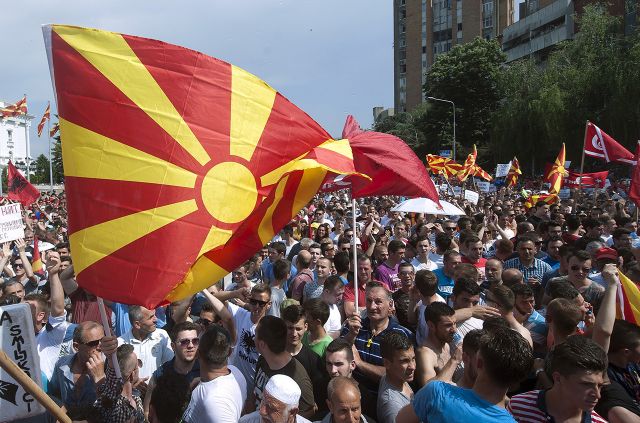
People wave Macedonian flags during an opposition rally in Skopje on May 17, 2015.
(ROBERT ATANASOVSKI/AFP/Getty Images)
Organizational Strength and Tactics
The May protests in Macedonia brought together opposition parties — led by the Social Democratic Union of Macedonia — and civil society groups. Both anti-government and pro-government forces set up small protest camps in Skopje. Still, with the exception of a protest on May 17 that drew tens of thousands of participants from different ethnic and social groups, attendance at most protests throughout the month was relatively low.
Strength of the State and Reliability of Security Services
The Macedonian government, a coalition led by Prime Minister Nikola Gruevski and his Internal Macedonian Revolutionary Organization-Democratic Party for Macedonian National Unity, has a comfortable majority in parliament. Nevertheless, Macedonia has long contended with fractious parliamentary politics, frequent corruption scandals and ethnic tension. The opposition is boycotting parliament, a move it has used in the past as a form of protest. In 2011, a Gruevski-led government called for early elections due to pressure from opposition parties. As demonstrated during the May 9 violent security operation in Kumanovo, the government has firm control of the country's security forces. However, the use of these forces amid a political scandal further undermined the government.
External Dynamics and Potential for Foreign Sponsorship
Western governments are greatly involved in mediating between the government and opposition parties. For the West, avoiding instability and violence in Macedonia, which could potentially spill over to countries such as Kosovo, is a priority. Macedonia is seeking membership in the European Union and NATO, though accession is unlikely for now because of Macedonia's internal instability and some EU and NATO members' opposition to further expansion. However, the European Union still has influence in Macedonia, chiefly though financial assistance. Throughout May, both the U.S. ambassador and the EU envoy to Macedonia attended meetings between the governing and opposition parties in Skopje. The party leaders traveled to Brussels for mediation as well. On June 2, European Neighborhood Policy and Enlargement Negotiations Commissioner Johannes Hahn brokered a provisional deal that set early elections in Macedonia, though negotiations will likely continue.
Macedonia's protest movement succeeded in bringing the government to the negotiating table because it met the four main criteria for effective protests. The protests were relatively well organized, protesters had strong grievances, and the Macedonian government was not in a strong position. The main element that propelled change, however, was the involvement of outside governments. Direct mediation by Western officials, especially from the United States and the European Union, led to the negotiations for early elections.
Hungary's Fragmented Protest Movements
Since Hungarian Prime Minister Viktor Orban's government came to power in 2010, its controversial policies have drawn strong criticism from opposition groups and foreign governments. But despite relatively frequent demonstrations from a mostly liberal-leaning opposition, the government's strength and divisions within the opposition have undermined efforts to create a cohesive, large-scale protest movement in Hungary.
Perception of Grievances
Protests in Hungary have typically focused on specific grievances. For example, proposed tuition hikes led to student protests, pension changes for public sector employees led to workers protests, discrimination led to minority Roma protests, and controversial media laws led to civil society protests. The opposition has struggled to effectively unite citizens from across Hungarian society around a cohesive set of grievances.
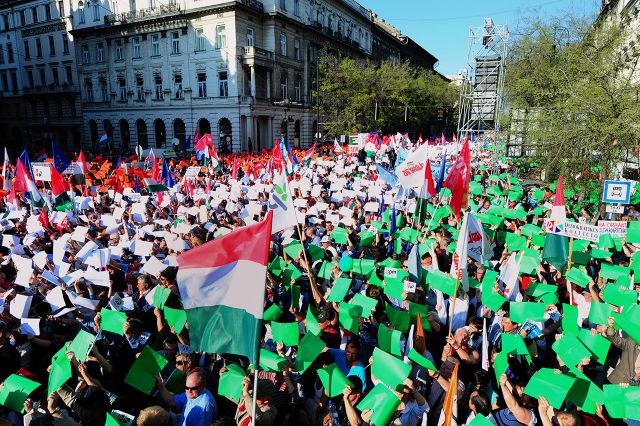
Rally participants hold colored papers to create a giant Hungarian tricolor as sympathizers and opposition party members gather in front of the Hungarian State Opera in Budapest on March 30, 2014.
(ATTILA KISBENEDEK/AFP/Getty Images)
Organizational Strength and Tactics
Hungary's opposition is fragmented and has thus far been unable to coalesce into a sustainable large-scale protest movement. Opposition to some of Orban's policies sparked new, non-traditional platforms of opposition, such as the Facebook groups Milla (One Million for the Freedom of Press in Hungary) and 100,000 Against the Internet Tax (which attracted more than 200,000 supporters on social media). However, tension among the opposition political parties and mistrust between the new civil society groups and traditional political parties have hindered cohesion and dampened public confidence in the opposition. Though protests are frequent, they generally attract a low number of attendees and fail to weaken the government's position.
Strength of the State and Reliability of Security Services
Orban's government has worked to consolidate its power over the past few years, boosting its role in the economy, changing electoral laws and gaining control of much of the media. Despite its declining popularity in opinion polls, the government maintains a strong hold on parliament, the police and large portions of the judiciary.
External Dynamics and Potential for Foreign Sponsorship
Hungary is an important country for both the West and Russia because of its location in the borderlands and membership in both NATO and the European Union. Moreover, Hungary has the ability to send natural gas reverse flows to Ukraine and is included in several different proposed extensions of the Turkish Stream pipeline, which would bring Russian natural gas to Central Europe.
Hungary is legally bound by a wide variety of European regulations, though the government led by the ruling Fidesz party has on numerous occasions broken EU law. European institutions and Western governments have been highly critical of some government policies, especially concerning civil rights and economic measures targeting foreign businesses. However, there has been no direct external effort to facilitate a change in government.
Hungary's protest movements failed to gain traction in large part because it failed to fulfill the four criteria for creating sustainable large-scale protest movements. Without robust organization, grievances that elicit support form across Hungarian society and outside support, the protest movements could not effectively challenge the government.
Emerging Movements in the Borderlands
The success of protest movements in Central and Eastern Europe during the past few years has varied, depending on popular appeal, organization, external support and the strength of the governments they oppose. As protest movements emerge in other borderland countries, such as Moldova, tracking these factors will be key for tracing their evolutions and potential geopolitical shifts they could create. As the competition between Russia and the West for the borderlands continues, protest movements will indicate what strategies Moscow and the West will follow in the region.
Lead Analyst: Lili Bayer
Production Editor: Robin Blackburn, Graphics: Robert Zavala
