
The Burundian leader has held the presidency since 2005. His bid to seek another term in office generated widespread domestic opposition. Officials in Burundi dispute whether Nkurunziza was contravening the Burundian constitution's two-term limit. Nkurunziza argued that he had been elected president by popular vote only once, in 2010, and therefore should be eligible for the 2015 elections. (He was elected by the parliament, not the general population, for his 2005-2010 term.)
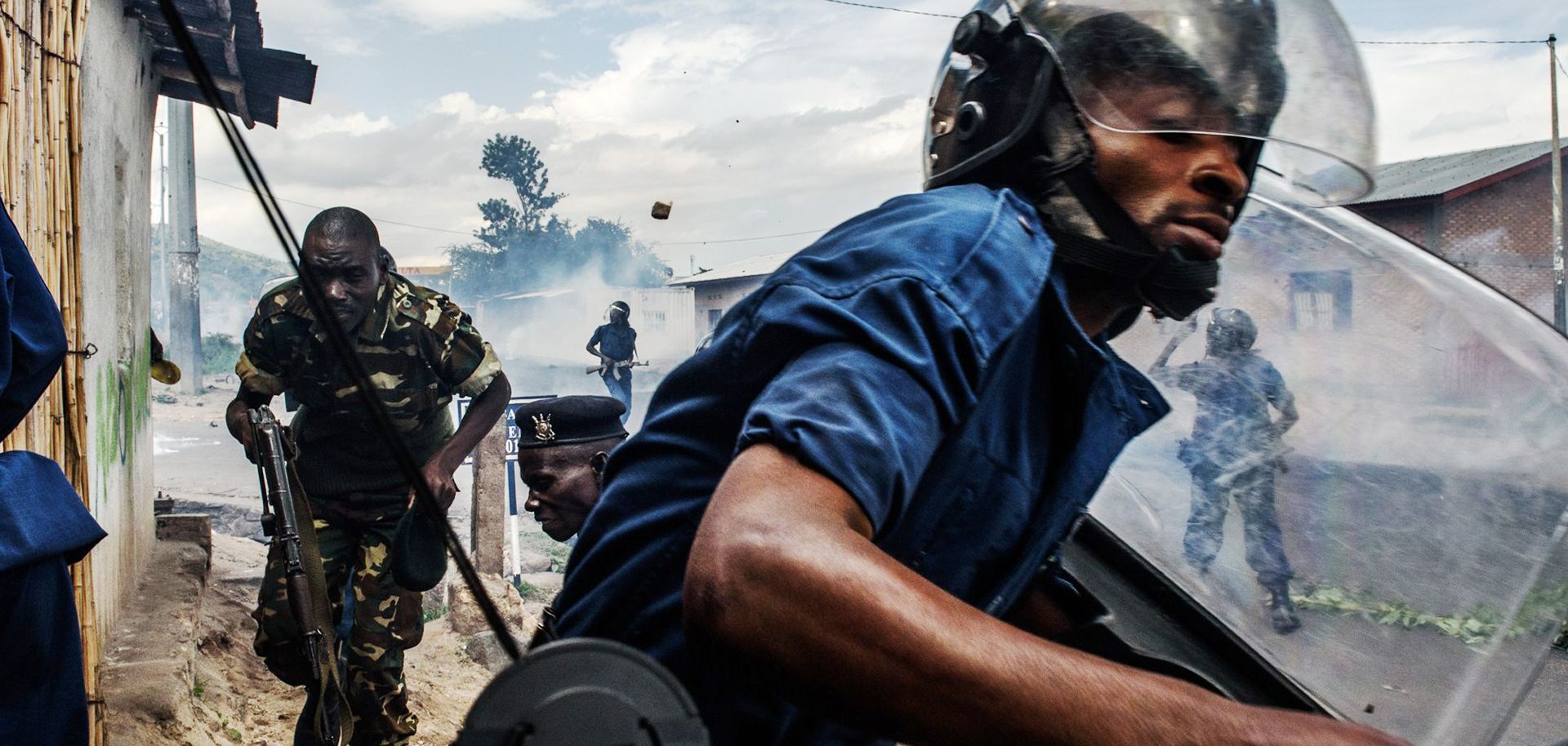
Constitutional arguments aside, the Burundian president's narrow and exclusionary pursuit of another term in office divided the country's major constituencies, including the military. The dismissal in February of Maj. Gen. Godefroid Niyombare as Nkurunziza's head of intelligence revealed opposition from within the security services to the Burundian president's then-unannounced bid for another term. Once unity in the country's security forces broke down, it became more difficult for Nkurunziza to seek another term in office.
Burundi's borders and airports are closed under military orders, while dueling factions struggle to consolidate their positions. Nkurunziza fears returning to Bujumbura, the capital, given security considerations. If the Burundian president's aircraft were shot down while trying to land in Bujumbura, it could trigger concern of a repeat of the 1994 genocide following the downing of the aircraft carrying then-Rwandan President Juvenal Habyarimana and then-Burundian President Cyprien Ntaryamira in Rwanda. However, another genocide is unlikely, given the diplomatic attention being paid to Burundi and the country's engagement with neighboring states and powers further afield. (For example, the U.S. assistant secretary of state for African affairs is currently in East Africa, working principally on the Burundi issue.) In 1994, genocidal fighting had been going on for weeks before the international community took notice.
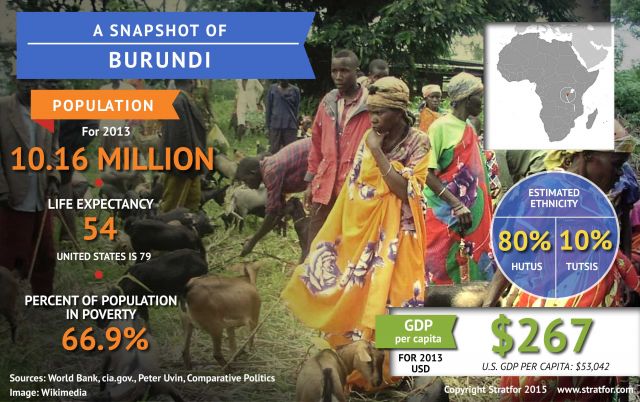
Moreover, unlike in 1994, this conflict is not ethnic-based. Both Hutus and Tutsis are part of the ruling National Council for the Defense of Democracy-Forces for the Defense of Democracy party. Both groups are part of the political and civil society forces that oppose the third term mandate, and neither side is calling for the extermination of the president's opponents or attacks on the basis of ethnicity. That said, the situation could become very dangerous given the ethnic tensions raised by the ruling party's youth militias, which have already prompted tens of thousands of people to flee after they received threats because of their perceived lack of support for the president's third-term mandate. That problem will be exacerbated if continued uncertainty over the military's allegiances causes the militias to go on the offensive, but there is a huge difference between this kind of fighting and the ethnically charged environment of 1994.
Mediators in East Africa likely will put forth an agreement that includes suspending elections (which had been planned for June 26) to reduce immediate hostilities. The mediators will struggle over how to handle the conflicting illegalities in Burundi. On the one hand is clear domestic opposition and general international recognition that Nkurunziza's third-term bid is improper. For some states, particularly Tanzania — which is, in a way, Burundi's patron in the East African Community — the president's bid for another term was embarrassing. On the other hand, Niyombare and other Burundian military members' suspension of civil order and government in the country is a move no leader in Africa could tolerate. Thus, the mediators gathering in Dar es Salaam are likely to craft a compromise that curtails the incumbent president's term in office and reverses Nkurunziza's exclusionary political activity. While neighboring states will not impose a resolution on Burundian leaders, sanctions and isolation would be placed on the country until it normalizes its political situation and outlines a path to fresh democratic elections.
On a broader level, the attempted coup in Burundi against an incumbent president seeking an extra term in office will give support and encouragement to others in Africa who oppose incumbents seeking to extend their hold on power. Nkurunziza's Burundian opponents probably were emboldened by successful moves toward similar ends elsewhere on the continent. Although Nigerian President Goodluck Jonathan was stopped democratically in April from having another term in office, rumors of splits and dissatisfaction in the Nigerian military were likely not far from the truth, and such divisions would have posed a threat to the Nigerian leader had he tried to stay in office another four years. In the November 2014 coup in Burkina Faso, the military fractured and some segments joined with civil society to block the bid by then-President Blaise Compaore to either hold office for another term or install his brother as his successor.
In Africa, blocking an incumbent from seeking a controversial extra term requires not only activism from civil society but also support from the country's security services. As long as a country's military remains united behind the government leader, as appears to be the case in Angola, for example, civil society and political opposition can do little to unseat the incumbent. If the military is not uniformly behind the leader — such as in the Democratic Republic of the Congo, South Sudan, Somalia, Uganda, the Republic of the Congo, Rwanda, Benin and Guinea — the outcome of any bid for an extra term will be uncertain.
