
The electricity reform is part of the larger package of energy reforms passed in 2013 that opened Mexico's upstream and downstream energy sectors to private investment. The secondary legislation, passed in August 2014, implemented similar changes in the electricity sector. The new legislation will allow greater investment in generation and more private participation in the maintenance and construction of distribution and transmission networks, which have been the sole responsibility of the state-owned Federal Electricity Commission. The legislation also establishes a wholesale electricity market where power generators will be able to sell electricity to distributors and end users.
Mexico is at a crossroads regarding its electricity sector. Failure to implement the reform would put the country at a severe disadvantage in several decades. High demand for manufactured goods in the neighboring United States has spurred a Mexican manufacturing boom, which has in turn increased electricity demand. Medium and large industries consume around 58 percent of total electricity sold. The heavily subsidized residential sector, which accounts for around 25 percent of total electricity use nationwide, drives demand even higher, as do rising population growth and urbanization.
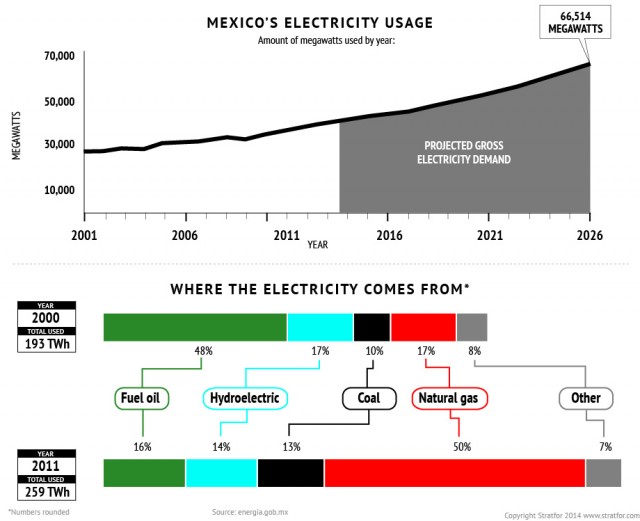
This rising electricity demand will require investments that the current regulatory authorities simply cannot handle by themselves. Bringing more private investment into the electricity sector will offset some of the burden on Mexico's increasingly constrained federal finances and, in the long run, could improve Mexico's highly inefficient national grid. With increased efficiency lowering generation costs, Mexico could eventually reduce the considerable subsidies in place for residential consumers.
The State's Limitations
The previous regulatory structure placed the federal government at the center of electricity generation, distribution and transmission. Before 1992, the federal government owned and operated the entire grid through the Federal Electricity Commission. That year, the government implemented some tentative reforms to allow private investment in generation because financial constraints prevented the state-owned company from taking on additional debt to fund itself. By 2014, private generators accounted for just over 20 percent of total generation.
Mexico's geography and domestic politics have limited the government's ability to optimally meet future demand. Although the gap is narrowing, generating electricity in Mexico has traditionally been more expensive than in the neighboring United States, where cheaper fuel and an efficient grid hold down costs. Mexico has few large rivers it can use to generate low-cost electricity with hydroelectric dams, so it has typically relied on more expensive (and often imported) refined petroleum products to meet power demand. Since 2000, imports of natural gas, mostly from the United States, have supplanted some of the more expensive inputs such as fuel oil. Some industrial electricity prices in Mexico have fallen by more than 30 percent since last year because of declines in the price of oil and natural gas.
Although higher rates have not hampered investment in the past (other expenses such as wages are far lower in Mexico than across the border), the heavy subsidies the government must provide for domestic users limit the ability of the Federal Electricity Commission to reinvest in the grid. The state-owned company posted a year-end loss of nearly $2.4 billion in 2013; the company's revenues would have been 27 percent larger if allowed to charge full price for the electricity it generated. Rampant theft further weakened the utility's revenues. Nearly 11 percent of the electricity generated in Mexico gets lost in transmission (by comparison, the United States loses about six percent), but the Federal Electricity Commission takes a larger hit from unpaid electricity use. By one account, nearly 20 percent of electricity sold in central Mexico is stolen by end users who either connect to the grid illegally or simply do not pay their bills.
Consequently, a major liberalization of the rules governing investment in the electrical grid became necessary. Like its energy sector overhaul, Mexico's electricity reform is an attempt to resolve immediate difficulties concerning public sector finances that could have long-term benefits for the private sector. By its own estimates, the Federal Electricity Commission will have to invest around $6.2 billion in generation, transmission, distribution and grid maintenance in 2016. The utility has fallen well short of that number in recent years, and given the possibility of budget cuts due to the low price of Mexican crude, a major rise in reinvestment and expansion of the grid is unlikely. The drop in oil prices in 2014 led to a nearly $650 million cut in the commission's funding for 2015. If the price of crude oil remains relatively low going into 2016, the company's finances will be even more limited.
The Expected Effects of Reform
Relief could come soon in the form of increased investment in generation and other parts of the national grid, but the regulatory foundation to allow this investment must be implemented first. Although the new regulations prevent individual firms from simultaneously investing in several sectors of the industry, the electricity reform will open new opportunities for capital, particularly because electricity demand is not expected to drop in the coming decade. Even so, if investment comes into Mexico, it may be disjointed and targeted at ensuring electricity for specific industrial centers, not the grid as a whole. If this happens, Mexico's generating capacity would increase on paper but not necessarily meet growing electricity demand nationwide.
Over the next several years, the Mexican government will implement regulatory measures to expand investment and create a market for electricity to be sold domestically. Although the timeline is not set, the transitory legislation in Mexico's electricity reform suggests that the market will be up and running at some point in the next two years. The market would allow private and public generators to sell electricity supplies to end users (or distributors who would then sell it to end users). Still, the Federal Electricity Commission would maintain a dominant position in the market; its market share is currently near 70 percent. The commission could significantly influence electricity prices in this market to maintain its operating revenue amid low income and budget cutbacks. Consequently, the Federal Electricity Commission will likely maintain its stake in the current system for the short term, and prices are unlikely to become competitive until more investors enter the sector.
