
The possible inflow of capital through the electricity reform could help Mexico overcome its significant financial and technological challenges. In recent years, the Federal Electricity Commission — the entity charged with funding and administering the electrical sector — has been consistently unable to fully fund the continued expansion and maintenance of the national electric grid.
Subsidies and Inefficient Transmission
Considerable electricity subsidies that have been in place since 1973 are partially responsible for this shortcoming. In 2013, Mexico spent about $6.5 billion on electricity subsidies, reducing potential revenues by nearly 27 percent. These subsidies mostly benefit sensitive political sectors such as residential consumers, agriculture and small businesses. Eliminating them could therefore cost the governing Institutional Revolutionary Party significant political support, perhaps explaining why the legislature chose to allow the president to postpone their reduction.
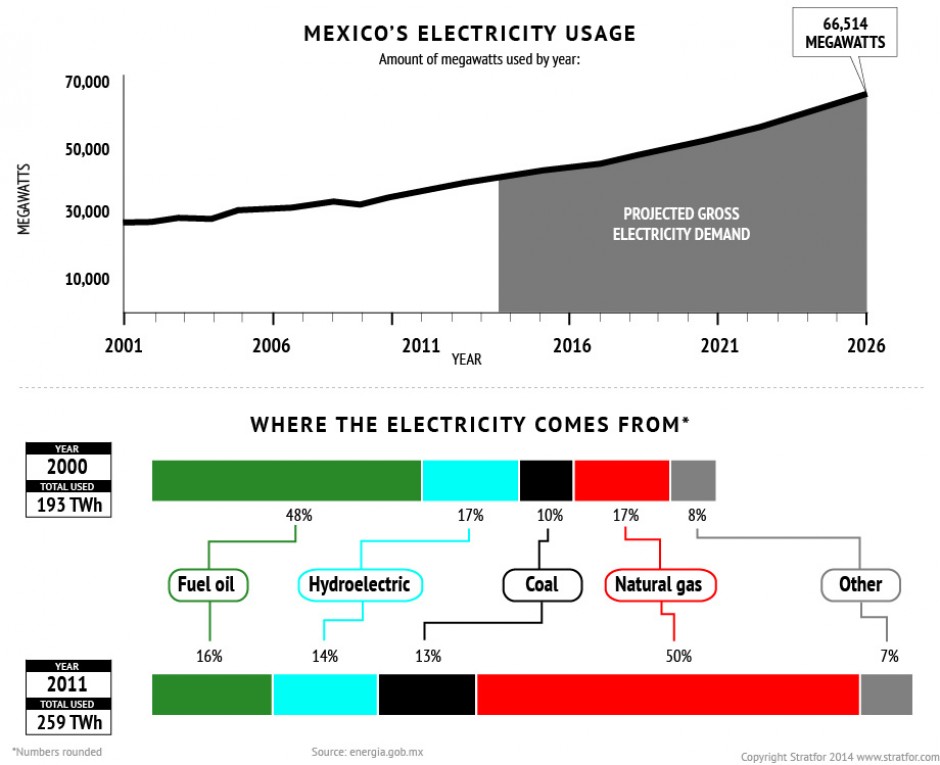
Because of these constraints, the Federal Electricity Commission has fallen short of its targets for reinvesting into the national grid in recent years. The commission estimated it needed $7 billion to optimally expand and maintain the grid in 2013. However, it only managed to invest $2.8 billion into the grid that year. In 2012, it predicted it would need $7.4 billion, but reinvested only $4.5 billion. With annual electricity consumption expected to grow to 311,200 megawatt hours by 2019, expansion of capacity beyond the currently consumed 206,000 megawatt hours will be necessary. The commission estimates it will need $54.45 billion from 2014-2019 to invest in new generation capacity, transmission lines, distribution centers and maintenance. Attracting significant investment into the electrical sector would likely reduce the considerable financial burden of this expansion on Mexico.
Implementing Reforms
Over the next two years, Mexico will take concrete steps toward implementing the new regulatory framework for the electrical sector. Under current rules, private investment is allowed into electricity generation, but the transmission and final distribution to customers remains in the hands of the Federal Electricity Commission. Though this has been the case since 1992, nearly 20 percent of installed capacity connected to the public grid is now in private hands.
Under the old law, private generators had to sell electricity to the Federal Electricity Commission. Under the new law, private firms will be allowed to partner with the government in the construction, financing and maintenance of the transmission and distribution networks. They will also participate in a newly created wholesale electricity market where private firms may sell electricity to each other, or to the Federal Electricity Commission, who will supply it to small businesses and residential consumers. Private generators and end users may also sign bilateral contracts for the purchase of electricity. To avoid conflicts of interest, businesses investing in one part of the electrical sector will not be allowed to invest in another.
The pace of the upcoming reforms means that private investment will not immediately begin flowing into Mexico. According to the text of the reform legislation, the political entity charged with administering wholesale electricity should be established six months after the president's approval of the reform. The spot price for electricity in that market and the types of contracts allowed with private firms must be determined a year after that entity is created. The first contracts with private firms will be signed six months after the contracts are determined, meaning that investment probably cannot begin until 2016 at the earliest.
The Role of Natural Gas
Given the increased availability of natural gas as a feedstock for power generation in coming years due to increased imports from the United States, most investment in new power plants will likely focus on natural gas-fired plants. The success of the electricity reform depends on the degree of investor interest, and the availability of natural gas as fuel will likely combine with the terms of the deregulation to make investment more attractive.
The projected availability of natural gas from the United States will likely spur investment into the electrical sector and private businesses. About half of Mexico's electricity is currently generated from natural gas that, while available at a reasonable price from the United States, is relatively expensive for generating electricity. Because of the projected increase in availability, most of the new generating capacity scheduled for construction in the next five years is from natural gas-fired plants.
Mexico's existing pipelines, which last year carried 658.3 billion cubic feet of natural gas into the country, are pumping at close to their maximum capacity. To address this constraint, several pipeline projects will raise Mexico's capacity to import natural gas just as the regulatory framework for the electricity market is coming into force.
The Federal Electricity Commission will likely launch bids for five pipeline projects in 2014. The planned pipelines will transport what news reports say will be 1.78 billion cubic feet per day of natural gas from the United States into Chihuahua state through Ojinaga, and into Sonora state at San Luis Rio Colorado. Three other pipelines — the Northwest pipeline, the Chihuahua pipeline and Los Ramones pipeline — will be completed in 2015 and 2016, adding a combined capacity of 3.6 billion cubic feet per day of natural gas.
The degree of investor interest in the electrical sector will likely determine the success of the reform. If the reform attracts significant investment, Mexico may be able to offset the financial burden of expanding and maintaining its electrical sector. However, the Federal Electricity Commission will continue to be burdened by subsidies. If investment over the next several years is not enough to finance the cost of expanding or maintaining the grid, the government may have to consider reducing subsidies.
