
The unity of the coalition government in Kiev is again at risk. On April 7, Ukrainian authorities legally challenged the privatizations of several companies that former President Viktor Yanukovich's government sold in 2012 and 2013. Although Ukrainian President Petro Poroshenko presented the decision as a step toward reducing the influence of Ukraine's oligarchs, this move may be designed to give some oligarchs, including Poroshenko, the opportunity to redistribute coveted assets among themselves. This decision may signal increased cooperation among some oligarchs aligned with the pro-Western government. However, the renationalization and subsequent privatization of assets ultimately will alienate reform-minded members of the coalition government.
The Ukrainian Prosecutor General's office is seeking to annul the 2012 privatization of a stake in DTEK Dniproenergo, one of the largest thermal power companies in Ukraine. Ukrainian authorities are arguing that DTEK, the firm owned by Ukrainian oligarch Rinat Akhmetov, bought the stake in an unfair tender and at a price much lower than the market value. The Prosecutor General's office is also challenging a 2013 sale of a majority stake in power company Donbasenergo to one of Akhmetov's allies, Igor Gumenyuk, as well as the privatization of regional power distribution firm Zakarpattyaoblenergo.
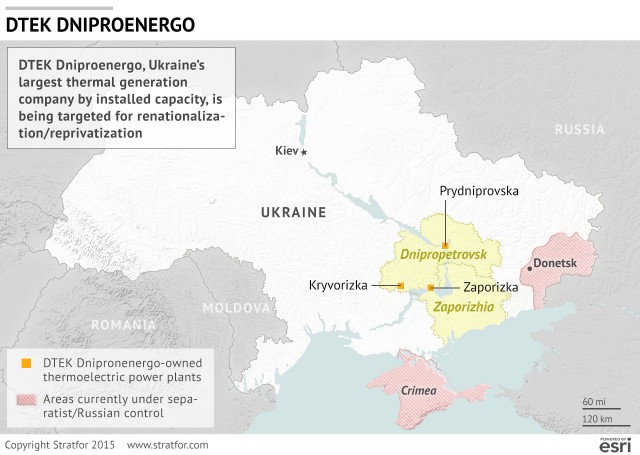
Although privatizations in Ukraine have often involved corrupt practices, the decision to target the assets of Akhmetov and his ally is the result of a change in the power dynamics among Ukraine's oligarchs following the onset of the crisis in the country's east. Akhmetov, formerly the most powerful oligarch in Ukraine, lost some of his influence in Kiev and suffered substantial financial losses as his allies in the Yanukovich-led Party of Regions lost power and as separatists took hold of parts of Donetsk province, the center of his business empire. Akhmetov's weakened position led to the prosecutor general's decision to target these particular companies.
Meanwhile, the change in government empowered certain oligarchs. Poroshenko became president, while Igor Kolomoisky became governor of Dnipropetrovsk and a highly influential player in Kiev. Poroshenko and Kolomoisky recently clashed over Kolomoisky's insistent assertion of control over two majority state-owned energy enterprises, including the use of armed men to take control of the firms' headquarters. Kolomoisky's subsequent dismissal as governor raised the specter of a political rift between the two oligarchs. Kolomoisky has not appeared in public since the appointment of his replacement and reportedly is spending time abroad.
Nevertheless, the decision to legally challenge past privatizations may indicate that Kolomoisky and Poroshenko have reached an accommodation, at least in the near term. Kolomoisky has publicly advocated for the reprivatization of some assets that he claims were privatized illegally in the past, arguing that such privatizations would help ameliorate Ukraine's budgetary problems. Kolomoisky and businessmen close to him, as well as Poroshenko and his allies, all have an interest in reversing past deals that benefited rival oligarchs and giving oligarchs close to the government an opportunity to purchase sought-after assets.
However, some members of the pro-Western coalition oppose the renationalization of oligarch assets. Prime Minister Arseniy Yatsenyuk, who is locked in a political rivalry with Poroshenko, has previously questioned proposals to annul past privatizations. Moreover, he has taken steps to slow down the process of redistributing the assets of oligarchs such as Akhmetov. Still, Yatsenyuk has called for regional energy distribution companies owned by Dmitri Firtash and Sergiy Lyovochkin, oligarchs who have close links to Russia and Yanukovich, to pay rent for using the state-owned pipeline system.
Foreign governments, the International Monetary Fund and Western companies will watch carefully as Ukrainian authorities proceed with their legal challenges to past privatizations. Once these assets are up for auction, international bodies and governments will want to ensure that the reforms and anti-corruption measures that Ukraine's government pledged to implement in exchange for extensive financial assistance are actively enforced. They will also make sure politicians and oligarchs associated with the coalition do not use their positions to gain an unfair advantage. Western companies, concerned about property rights, will follow these developments closely as well. At the same time, in the eyes of Ukrainian voters who supported the Maidan movement and new coalition government with the expectation of reforms and better governance, the outcome of reprivatizations will be a key test of the government's commitment to change.
Divisions among the coalition in Kiev could serve the Kremlin in its ambition to weaken Ukraine and hinder its integration with Western political and defense blocs. The annulment of past privatizations may initially be regarded as a step in Ukraine's reform process. But the reprivatization of these assets could reveal the continued influence of oligarch interests in Ukrainian politics, undermining the government's legitimacy and endangering Ukraine's economic prospects. As oligarchs such as Poroshenko and Kolomoisky work to redistribute assets, Kiev's credibility and cohesion will come under further scrutiny.
