
Gen. Hifter, who became a recognized leader of Libyan military forces under the Tobruk government in October, has been able to use fighter aircraft in combat operations since May, when a former Libyan air force unit joined his forces. Operating from the Al Bayda air base northeast of Benghazi, the MiG-21 and MiG-23 aircraft, as well as a number of Mi-25 attack helicopters, quickly came to support forces commanded by Hifter and his allies in the fight over Benghazi. They struck bases of the February 17 Martyrs' Brigade, one of the militias opposing Hifter's forces in the city. However, these aircraft failed to have a significant impact on ground combat, and the battle for Benghazi rages on as ground forces fight block by block.
Since then, the Libyan National Army, commanded by Hifter, has expanded its operations to the air bases at As Sidra and Wattiyah. These airfields, located along the center and west of Libya's coastline, respectively, have enabled Hifter to conduct frequent airstrikes on Libyan Dawn positions in Sirte, Tripoli and Misrata. From the Al Bayda air base in the east of the country, most of these targets would have been at the extent or beyond the strike range for the different types of aircraft the Tobruk-aligned forces operate. Control of these airfields in the west is therefore critical to the ability to reliably conduct sustained air operations in those areas.
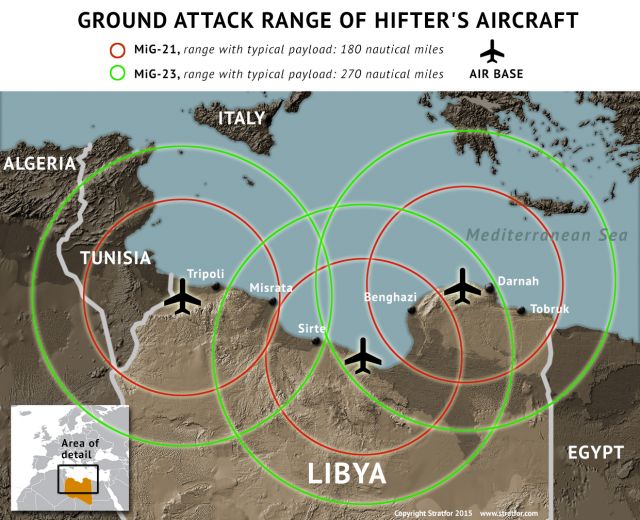
The As Sidra air base has been instrumental in protecting the oil terminals at nearby ports, although the limited number of aircraft causes this protection to be intermittent. It has also enabled Hifter's forces to strike at Sirte and its airfield, where Islamist militias operate. Use of the Wattiyah air base, protected by Zintan militia fighters on the ground, in turn enables aircraft to strike at Tripoli, which has been under the control of Libyan Dawn since September.
The Libyan Dawn forces that oppose Hifter and the Tobruk government, however, have now reportedly gained access to a limited airstrike capability as well. On Dec. 16, the first airstrikes on Libyan National Army positions were reported in As Sidra. While reports are hazy and claims contradictory, another airstrike at the same location on Dec. 30 seemed to confirm the ability of Libyan Dawn or forces allied with it to conduct airstrikes. It is unclear how many operational air assets Libyan Dawn militias still have at their disposal following claims that both an aircraft and a helicopter involved in the Dec. 30 strikes were destroyed during a retaliatory attack by Hifter's air force on the Sirte air base. Unlike Hifter's militia, which has had access to personnel from erstwhile Libyan leader Moammar Gadhafi's former air force to build its own, establishing this capability would be rather exceptional and possibly unsustainable for Libyan Dawn.
The Limitations of Air Power
The ability to sustain air operations is limited to a certain degree on both sides. The logistical support effort required to keep aircraft fit to fly, involving both proper maintenance and the availability of spare parts, is a daunting task. Hifter's forces have the benefit of relying to some degree on the remaining expertise from Gadhafi's air force, though even this is limited. According to officials in the Tobruk-aligned air force, at least two MiG-21 aircraft have already crashed due to mechanical failures since August. In the move to start operating from a number of different air bases across Libya, Hifter's forces have also faced difficulties in reliably accessing jet fuel at every location. The aircraft flying out of Wattiyah air base in the west were grounded for almost a week until fuel supplies reached them. Such logistical limitations, along with a high rate of attrition due to a lack of maintenance, has a significant effect on the tempo of operations and the ability of an already-small air force to effectively apply air power.
In order to mitigate these shortcomings, the Libyan National Army has come to depend on external support. While it initially started off with eight fighter aircraft when the air force unit stationed in Al Bayda joined Hifter's forces, at least three MiG-21 aircraft have already been lost during operations since then. At least two MiG-21 aircraft have been transferred, likely from Egypt, to the Libyan National Army, and some degree of maintenance and logistics support has likely accompanied them. Both Egypt and the United Arab Emirates, which support the Tobruk government, have also allegedly delivered more direct support when it comes to air power, as they were both reported to be behind several airstrikes in Tripoli in August, although these were limited in both volume and effect. More recently, on Jan. 6, an official in Hifter's militia claimed four Su-27 aircraft of unknown origin were delivered to them, though this has not been independently confirmed.
Military and Political Importance
As air power comes to play a greater role in the Libyan civil war, despite its many limitations, the Gadhafi-era air bases and airfields scattered around Libya have also become critical infrastructure shaping objectives in the ground war. The Wattiyah air base, from where Hifter's aircraft strike Tripoli, has been under constant attack from Libyan Dawn forces as Zintan militia fighters defend the air base from the ground. Thus, the ability of Hifter to deploy aircraft from bases across the country has also strained the alliances he has forged with other militias that oppose Libyan Dawn and the Islamist militias. Even smaller airfields in the southern Libya have become the focus of fighting as Ghat airfield, for example, changed sides twice over the weekend as Libyan Dawn forces, backed by Tuareg fighters, captured the facility before being pushed back by local militias supporting the Libyan National Army. While Ghat airfield is not necessarily critical to the offensive operations against the main objectives located along the coast, both sides still wish to deny each other control and potential use of it. Apart from hosting offensive air operations, for example, airfields across Libya could also serve to support the belligerent parties by facilitating smuggling operations to supply their war effort.
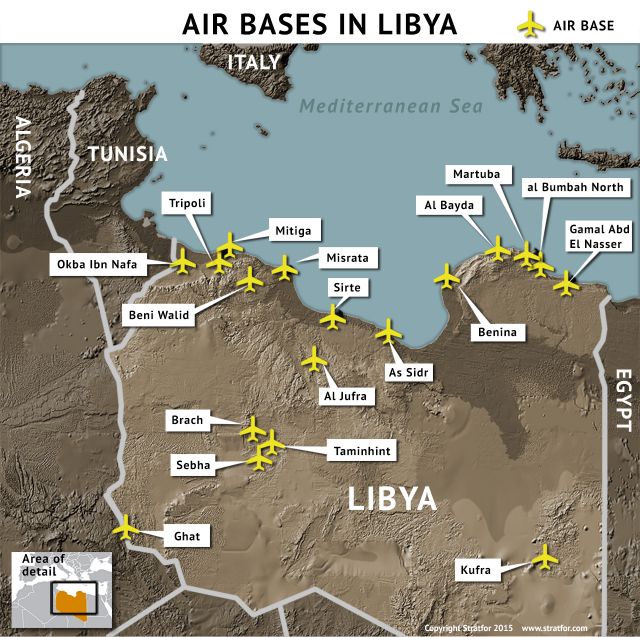
Despite the limitations on the effectiveness of the air assets used in the Libyan conflict and the substantial logistical support required to sustain them, the Tobruk government has been able to benefit from its air force already. Strikes of limited success on moving Libyan Dawn formations enable the Libyan National Army to focus its limited ground capabilities on Benghazi. Operations against Sirte air base also suppress Libyan Dawn's air operations. Still, these benefits pale in comparison to higher-level gains, mainly the perception of sovereignty over Libya by the Tobruk government. As illustrated by the Jan. 5 airstrike on a Greek-owned tanker near the port of Derna, the ability to interdict maritime and air traffic, and thus trade, to areas controlled by Libyan Dawn could make air power a significant tool in the conflict. This fact will likely compel Tobruk to expand, or at least sustain, its current air capabilities.
