
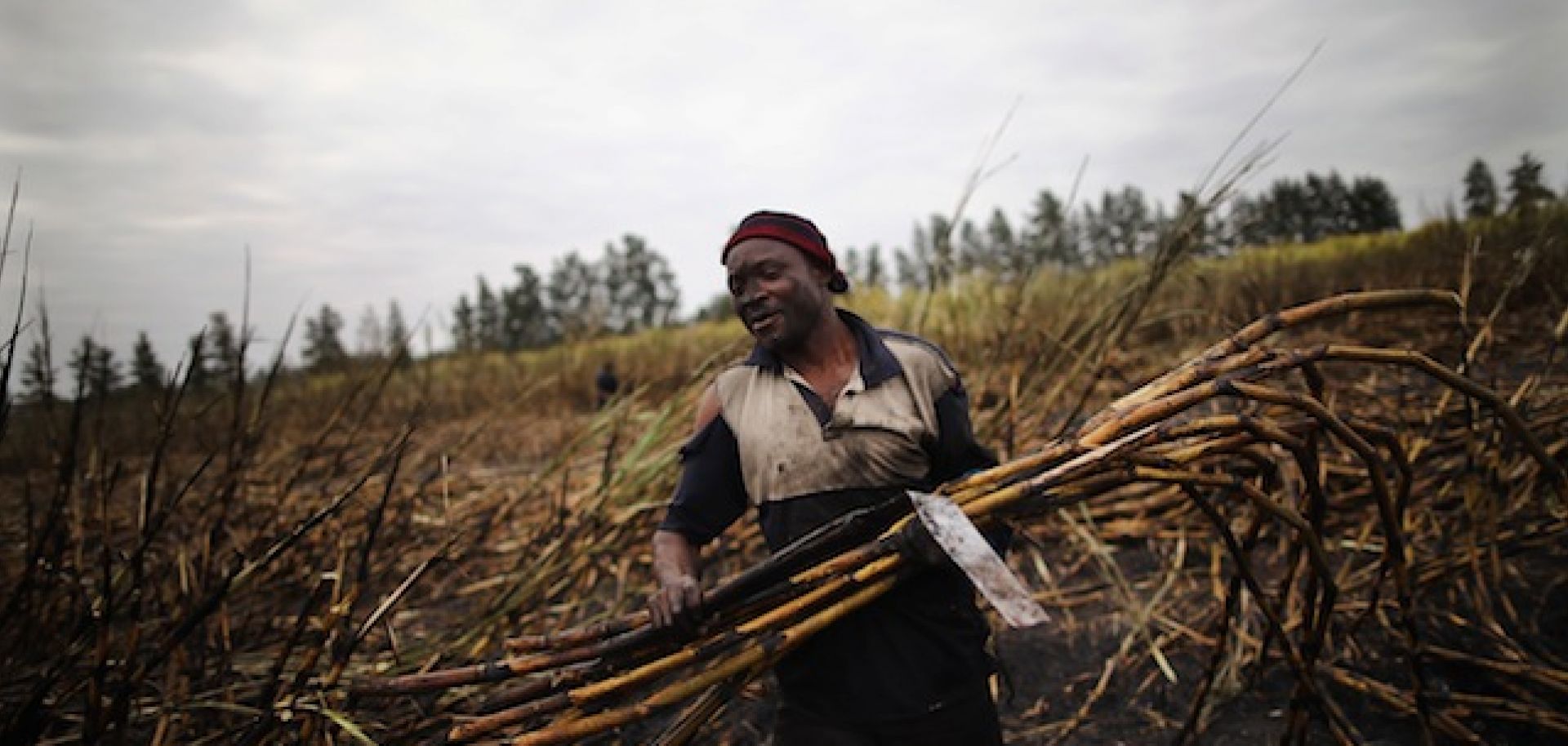
A man cuts sugarcane on a farm near the Kruger National Park in Komatipoort, South Africa.
The South African government is planning to sign into law the Restitution of Land Rights Amendment Bill. The legislation, which may be signed ahead of national elections scheduled for May 7, raises concerns over the politicization of land reform in South Africa, drawing comparisons with Zimbabwe. Along with maintaining food security, land reforms are meant to redress historic injustices over land ownership and usage. The South African government has pledged to let the legal process run its course and has already considered financial compensation for those affected by the new bill, which it hopes will allow for an orderly land reform process.
Any move toward land reform in South Africa raises concerns that the country is emulating the past behavior of neighboring Zimbabwe. Similar policies implemented by the Zimbabwe African National Union-Patriotic Front led to the effective collapse of Zimbabwe's agriculture sector, widely discouraging foreign investment in the process. Unlike in Zimbabwe, though, legal due process and financial systems to support South African land restitution are intended to prevent land reform from becoming politicized.
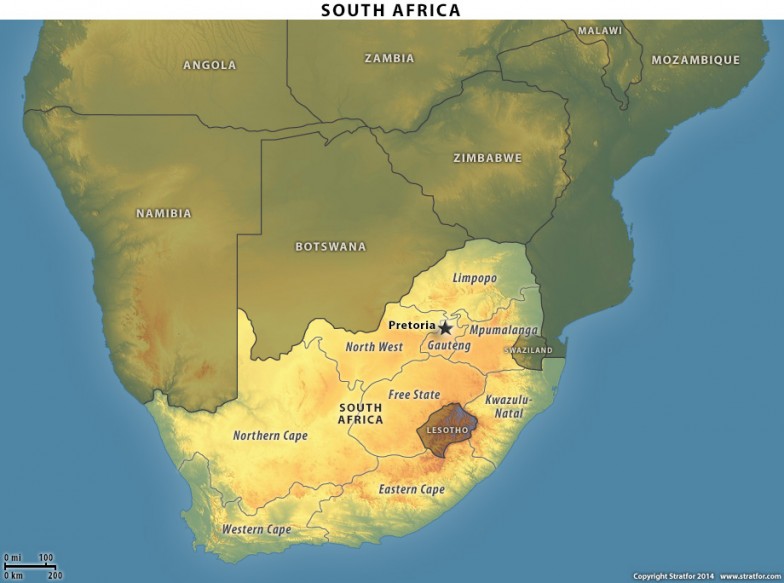
South Africans go to the polls May 7 to elect a new parliament. The ruling African National Congress, better known by its acronym, ANC, is likely to be reelected with a comfortable majority. The South African government has, however, been criticized for the country's slow pace of socio-economic transformation during the 20 years since the end of apartheid. Many black South Africans remain impoverished and reliant on government subsidies to support a minimal standard of living.
In the face of electoral competition from the left-leaning Economic Freedom Fighters and the center-right Democratic Alliance, the ANC may be pressured to adopt more populist policies in order to retain their seat of power.
Conducting land reform is one area where the government could win popular support, given the deep and almost universal emotional attachment that land ownership provides in Africa. The pending approval of the Restitution of Land Rights Amendment Bill is designed to give South African citizens a window through 2019 to lodge claims for — and seek to resolve — the restitution of lands they lost as a result of apartheid-era racially discriminatory laws and practices.
Neighboring Perspectives
Any comparison with Zimbabwe is revealing. The Zimbabwe African National Union-Patriotic Front came to power upon independence from the United Kingdom in 1980. Land reform, specifically redressing inequitable land ownership in favor of black Zimbabweans, was a significant component of the negotiations to transition Rhodesia (as Zimbabwe was formerly known) from minority white to majority black rule.
For much of its first two decades in power, the Zimbabwean government depended on external government funding — mainly British — to support land reform initiatives. Little in the way of reform was achieved, however, and the Zimbabwean government came to blame the British government for failing to fulfill commitments reached during the negotiations for independence. Land reform in the 1980s and early 1990s did not matter materially to the Zimbabwean government. It was only in 2000, when the Robert Mugabe-led government faced a real threat of electoral defeat by the Morgan Tsvangirai-led opposition — the Movement for Democratic Change — that the Mugabe administration in Harare made land reform a significant policy. With scant legal process and no financing — the British failed to deliver upon their funding commitments — the Zimbabwean government went about expropriating the majority of the country's farmland, then owned by its white citizens. Doing so turned Zimbabwe from being the breadbasket of southern Africa into a net food importer. The country is still struggling to recover from its era of economic nationalization.
Differing from Zimbabwe, South Africa's African National Congress does not face a real threat of electoral defeat. The government also has legal due process and funding in place to underwrite an orderly program, designed to redress historic land ownership claims and inequalities. The South African government has included in its 2014 budget a proposed 8.7 billion rand (approximately $829 million), to be spent over the next three years, to support resolving valid land claims. The South African government has already spent approximately 16 billion rand (roughly $1.5 billion) to support the resolution of land claims since 1998. Mindful of what happened in Zimbabwe, where farmers lacked credit to operate their newly acquired lands, the South African government is also financing a program that intends to empower resident farmers, equipping them to invest in their farms and plantations.
Deeper Concerns
The long-term question for South Africa will be how the African National Congress behaves when it does face a meaningful threat to its electoral hegemony. Some within the ANC, including President Jacob Zuma, have said that the African National Congress will rule "until Jesus returns." For all its weaknesses in terms of efficient governance, the African National Congress is the only political party in South Africa able to capture the votes of the majority of South Africa's black citizens. Rival political parties — or even civil society movements such as unions — speak only to narrow interest groups aligned on ethnic or economic lines.
The African National Congress also remains malleable and does shift and change its constituent groups. Organized labor's role is declining in its relative importance to the ANC, along with political entities such as the South African Communist Party. Disputes over economic policy have led the Congress of South African Trade Unions to periodically reconsider the alliance it maintains with the ANC in government, threatening to leave amid concerns of being sidelined in decision-making.
In contrast, tribal affinities are likely to rise in relative importance to the African National Congress in the years to come. President Zuma's core constituency is the Zulu tribe from KwaZulu-Natal province, representing the largest ethnic group in the country. By the 2019 electoral cycle, however, Zuma will have concluded his second term as president. Zuma's Zulu supporters will find their post-Zuma leadership aspirations challenged by their main tribal rival: the Xhosa of Eastern Cape province — the country's second-largest ethnic group. Previous Xhosa leaders include Nelson Mandela and Mandela's immediate successor, Thabo Mbeki.
Land reform in South Africa is an emotional and sensitive subject, dear to black as well as white South African interests. But financial support, a legal due process to conduct land reform initiatives and a government facing no imminent electoral challenge mean that land reform in South African will for now be orderly.
