
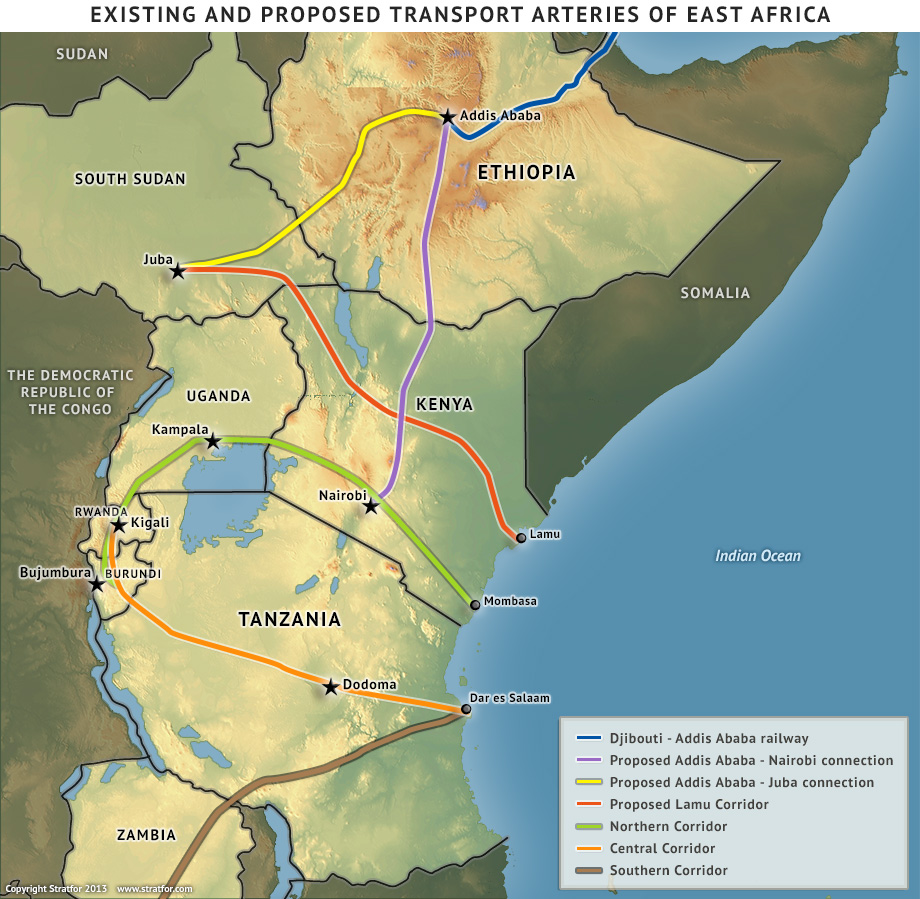
Many projects are in the works to upgrade Ethiopia's rail and road networks. Until recently, the country's railway network was particularly limited and outdated. A single meter gauge railway connected the capital of Addis Ababa to a seaport in neighboring Djibouti. This railroad, built by French colonists, became operational in 1901 and has remained the only railway in Ethiopia. It is now being replaced with a standard gauge railway. Not only will the new railroad increase the attainable speeds on the route, but the use of heavier steel tracks will also allow heavier loads to be moved.
This single route is a notable artery for Ethiopia's economy, since the country has not had its own coastline since Eritrean independence in 1993 and depends on Djibouti for all international trade. The completion of the new rail line connecting Addis Ababa to Djibouti will be a large step forward in Ethiopia's attempts to become an attractive destination for foreign investment
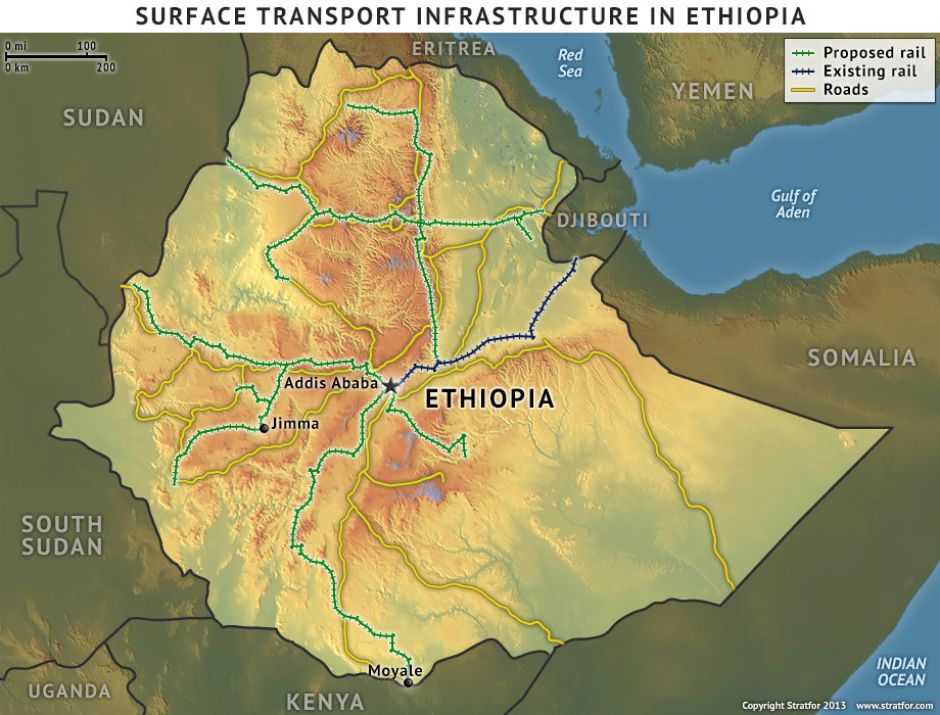
Expanding Ethiopia's Rail System
Ethiopia is also planning the construction of many other railroads that will branch out into the separate corners of the country. This will allow industrial projects and investment to target the vast territory of Ethiopia outside of Addis Ababa. Ethiopia itself is unable to deliver the necessary financing for these large infrastructure projects. Most of the necessary investments have been offered by the BRICS countries — Brazil, Russia, India, China and South Africa. Contracts for construction and the delivery of construction material have also gone predominantly to the BRICS.
China in particular has been willing to provide funds for this major infrastructure overhaul and has been very actively pushing for the construction of the new Addis Ababa-Djibouti line. Chinese companies have a stake in the Ethiopian connection to Djibouti due to their partial ownership of the Djibouti port, as well as their involvement in the development of several other ports in Djibouti. Other BRICS countries are equally interested in helping Ethiopia expand its transport infrastructure due to the country's potential as a manufacturing base. The need for cheap and efficient transport is one of the main constraints for Ethiopia to overcome to develop into a major destination for foreign investment in manufacturing.
As part of this infrastructure development, Ethiopia is putting down more than 2,000 kilometers (about 1,240 miles) of standard gauge track, 680 kilometers of which make up the Addis Ababa-Djibouti connection, and expects to complete this project by 2015. The $5.9 billion price tag, provided by loans from BRICS countries, includes the Addis Ababa-Djibouti connection as well as railroads to different corners of Ethiopia and two stretches of railroad intended to link up with the transport networks in other East African countries. Companies from Brazil have shown particular interest in the construction of a railroad running to South Sudan, while Russia has considered funding a rail line connecting to the proposed Lamu corridor that would be developed in Kenya.
The connections to South Sudan and Kenya would give Ethiopia separate advantages, although these are not as dominant in Ethiopia's infrastructure development as the country's access to global markets and the attraction of foreign investment in manufacturing. A connection to South Sudan could allow Ethiopia to function as a transit country for goods moving to and from South Sudan, and plans for an oil pipeline running from South Sudan through Ethiopia and into Djibouti have also been discussed. However, the possible development of the Lamu corridor as South Sudan's main connection to the Indian Ocean could disrupt these plans. South Sudan has put forth many proposals to establish reliable transportation infrastructure that reduces its dependence on Sudan's infrastructure. None have materialized, however, despite South Sudan's and Kenya's best efforts to raise funding for alternative pipelines, roads and rail. Juba has considered several different plans and has asked many outside parties for funding but has not raised any funds, so its pronouncements of new infrastructure routes lack credibility.
Ethiopia is also working toward its own direct connection to the Lamu corridor, through the construction of a railway and upgrading existing roads. This connection is unlikely to replace the Addis Ababa-Djibouti artery as Ethiopia's main access to seaports, especially after the construction of the new railroad along that route. A direct connection to Kenya would more likely focus on regional trade, while also opening up a secondary access route to projects in southern Ethiopia.
Potential oil production in the country could benefit from a connection to the Lamu corridor. This connection would provide easier access by surface routes for the provisioning of the oil projects and the possibility of exporting oil through the Lamu pipeline if and when it is completed.
Ethiopia's Planned Road Improvements
Ethiopia is also working toward the establishment of a reliable road network throughout the country. Many of the main roads in Ethiopia are still made of gravel, and China and India in particular have been showing support for the development of a network of asphalted roads and highways. More than 20,700 kilometers of road are to be upgraded at a cost of more than $1.5 billion during the current budget year. Last year, Ethiopia constructed and upgraded more than 19,500 kilometers of road. In total, the road construction efforts are meant to increase the road coverage of Ethiopia from the current 80,000 kilometers to 136,044 kilometers in 2015. The country has already improved its road coverage substantially, as it had a road network of only 48,793 kilometers in 2010.
Ethiopia may not be as interconnected with the rest of East Africa as other countries, but due to its own constraints and interests it has focused heavily on expanding its surface transport infrastructure. The country's economic prospects have also helped it to secure funding from the BRICS countries, without which Ethiopia would not be able to afford such extensive developments. This coordinated foreign support, covering both the funding and construction aspects of the projects, has also boosted the efficiency by which Ethiopia is expanding its rail and road networks, making the 2015 completion deadline plausible.
