
As one of the continent's most populous countries, Ethiopia has long been a pivotal economic player in East Africa. However, the government in Addis Ababa has struggled to develop a sufficient transport infrastructure to support the country's exports and facilitate trade with regions farther inland. A key constraint on these efforts has been the country's perpetual tensions with Eritrea, which broke free from Ethiopia in 1993 shortly after the end of a 30-year war between the two countries. Eritrean independence severed Ethiopia's access to the Red Sea and forced Addis Ababa to focus its foreign trade eastward through Djibouti.
The multiphase development of Ethiopia's rail network, which will involve both freight and passenger transport, is part of a much broader government plan to transform the Ethiopian economy over the next 25 years. During the first stage, which is already underway and expected to be completed by 2015, Ethiopian Railways plans to lay down some 2,000 kilometers (roughly 1,250 miles) of track. Overall, the project calls for 4,744 kilometers of new railroad throughout the country, connecting the network to planned and existing railways in Kenya, South Sudan, Sudan and Djibouti.
Interests of the BRICS
Much of the project's investment has come from the bloc of ostensibly emerging economic powers known as the BRICS — Brazil, Russia, India, China and South Africa. The entire rail expansion is expected to cost around $5.9 billion, more than half of which has already been signed for by investors from China, India and Brazil. Investment from Russia may soon follow, and South African companies have been overseeing construction of some of the lines. The projects in Ethiopia are needed to develop closer cooperation among the bloc's members. Moreover, Ethiopia's geographic and economic potential could allow the countries to reap considerable long-term gains from the rail investment.
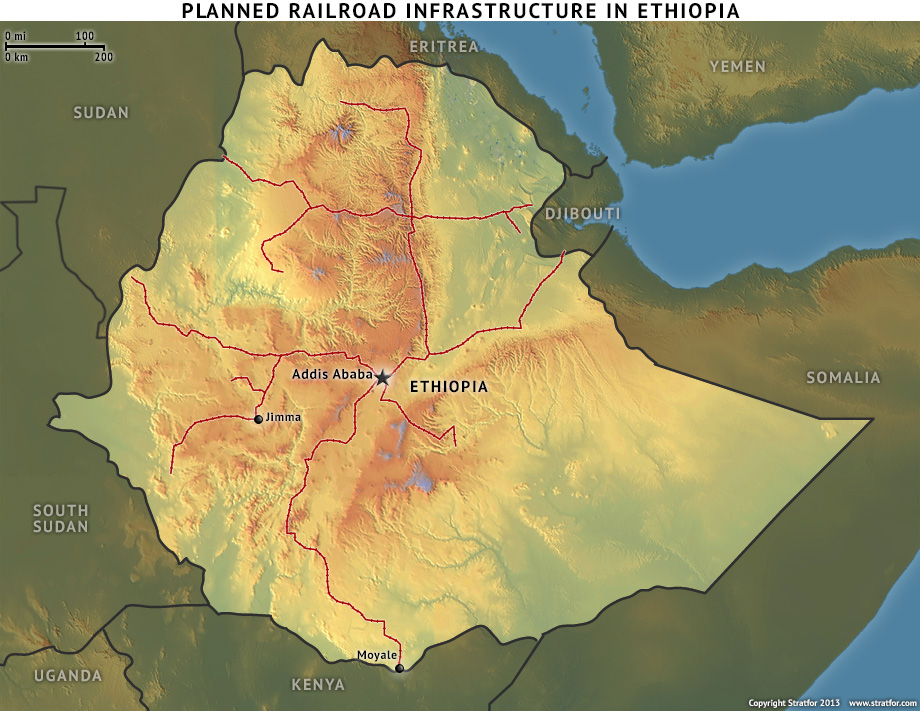
The project especially highlights China's increasingly central role in East African trade infrastructure. The country, which is also helping develop the Port of Djibouti, is funding two segments currently under construction by the China Civil Engineering Construction Corp. and the China Railway Group at a cost of more than $1 billion each. Another Chinese firm has partnered with a company from Turkey — a country that has also become increasingly active in Africa and interested in Ethiopian rail — to build a line heading north out of Addis Ababa.
India has also shown keen interest in Ethiopia, as demonstrated by a recent $300 million loan provided by the Export-Import Bank of India to develop some 656 kilometers of rail between Addis Ababa and Djibouti. Meanwhile, Russia has limited itself to a more supervisory role in the rail project, but the country is reportedly negotiating the financing and construction of the 587-kilometer railroad from Addis Ababa to the Kenyan border town of Moyale. This line is expected to eventually be extended through Kenya to connect to the Indian Ocean port city of Lamu.
In May, the Brazilian Development Bank announced that it will finance the construction of a line connecting Ethiopia and South Sudan. The 439-kilometer segment will run from Addis Ababa to Jimma, the largest city in southwestern Ethiopia, at a cost of roughly $1 billion. According to Ethiopian officials, technical and financial preparations for the line have been completed, and Brazilian construction company Andrade Gutierrez Participacoes is expected to begin work on the line soon.
South Sudan's Need for Export Alternatives
A rail connection to Addis Ababa will be particularly important to South Sudan, which is attempting to diversify its export routes. On June 17, the government in Juba signed a deal with South African investors and companies to transport oil by rail to Djiboutian ports on the Red Sea. In the past, South Sudan has sought to build pipelines that would connect the country to the Lamu Port — an idea that has attracted interest from China — but the feasibility of such a project will remain unclear unless foreign investment is secured. While transporting oil to Djibouti by rail would be more efficient than by road, as reportedly called for in earlier plans, rail would still only handle a small portion of South Sudan's daily oil production. However, the rail connection would be significant politically, since it would lower South Sudan's reliance on infrastructure in its northern rival, Sudan.
South Sudan's need to reduce its dependence on Sudanese oil infrastructure has been illustrated by the recent issues between the two countries such as an alleged attack on a pipeline by rebel groups on June 12. Only a small fraction of South Sudanese oil could be transported by rail through Ethiopia to Djibouti, and doing so would not eliminate South Sudan's dependence on Sudan for most of its oil exports. However, it would show the Sudanese government and potential investors that Juba intends to continue to explore every means of exporting possible.
For now, despite the promise of the region's ongoing infrastructure projects, the ability to export even small amounts of South Sudanese oil through Djibouti is still not guaranteed. Doing so would require the completion of the network expansion in Ethiopia and the additional extension from Jimma into South Sudan — a segment that has yet to see any progress. Thus, South Sudan is unlikely to benefit greatly from the world's growing interest in Ethiopian rail anytime soon.
