
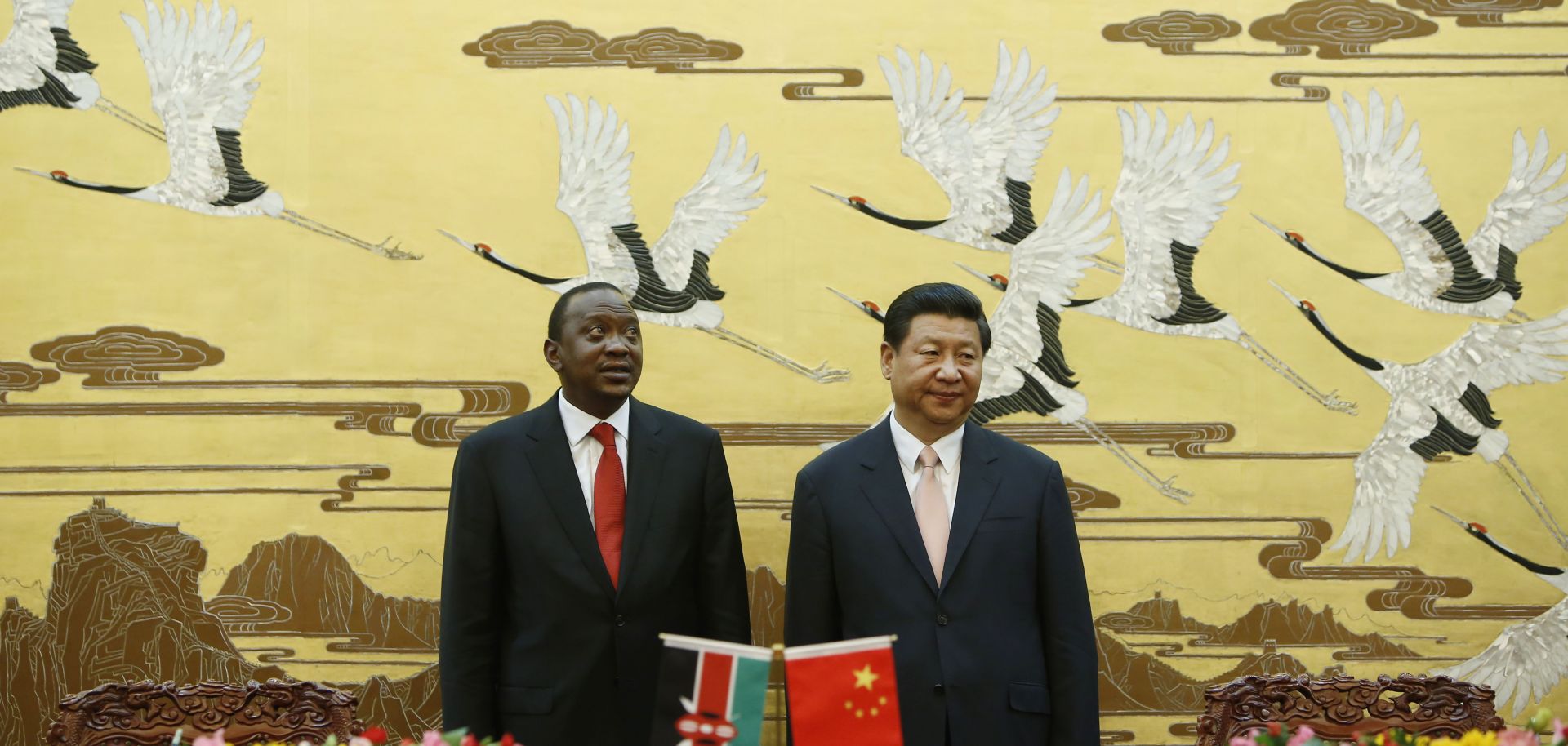
The investment deals that Kenyan President Uhuru Kenyatta has signed and is expected to sign during his visit to China fit with several important trends occurring in East Africa. On Aug. 19, the first full day of his visit, Kenyatta signed deals totaling $5 billion in investment from China. Several more deals or memorandums of understanding could be signed throughout the week as Kenyatta meets with Chinese business leaders.
Beijing has targeted most East African countries — including Djibouti, Ethiopia, Kenya, Tanzania and Uganda — for investment in key infrastructure projects to support those countries' economic development. The signing of these agreements also highlights the integration of East Africa with the rest of the Indian and Pacific ocean basin economy, thereby augmenting the economic potential of these emerging countries.
The deals that Kenya and China signed Aug. 19 include $1 billion in investment for energy-related products. It is unclear what specific projects this deal includes, but the money most likely will be invested into upgrading and rehabilitating Kenya's only refinery in Mombasa. The refinery, built in 1963, has not been adequately maintained and is in need of upgrades to process the harder-to-refine crude that Kenya and Uganda will be producing within the next five years. Additionally, there are three pipeline projects that the money could be destined for: one connecting landlocked Uganda's oil fields to the Kenyan coast, one connecting South Sudan to the Kenyan coast, and another linking Kenya's own oil fields in the northern portion of the country to the coast.
The deal also calls for the rehabilitation of a railway originally built by the British that is supposed to connect Mombasa to Kampala, Uganda. Maintenance has been an issue, and the railway is not completely operational from the Kenyan capital of Nairobi to the Ugandan border. The railway is of great importance not only to Kenya but also to neighboring Uganda because of the freight potential that it brings for the landlocked country.
A glaring omission from the deals signed thus far concerns the Lamu port. Kenya has been trying to find financing for the massive $27 billion project, which includes the port itself, a railway, a pipeline to South Sudan and a regional highway, but it has struggled to secure the necessary funding. For South Sudan, the project is important because it would provide a second outlet for the country to export its oil and avoid its complicated relationship with Sudan. China has sponsored the project with some funds, but not nearly enough to ensure that the project develops as quickly as planned. Even worse for Kenya, China signed a deal in March to expand the Tanzanian port at Bagamoyo, a project that could cost $10 billion if all follow-on road and rail infrastructure gets built. That agreement could signal that China prefers Bagamoyo over Lamu.
China's East Africa Investment
East Africa's infrastructure is underdeveloped and has been one factor holding the region's development back, but China and others are investing the necessary money to reverse this. Beijing has been a major supporter of developing a railway into the heart of Ethiopia to help Chinese-backed textile manufacturers export their products.
For China, these deals also assist Chinese construction companies and provide an outlet for Chinese steel and other raw materials. Chinese companies often win the construction contracts for these Chinese-backed deals, recycling most of the money back into the Chinese economy. For instance, Kenya — using Chinese-backed funds — awarded the construction contract for the Lamu port project to China Communications Construction Co. While Kenya and other African countries would prefer that these contracts go to domestic contractors, they do not have the choice of financing the projects themselves.
The Indian and Pacific ocean basins are increasingly becoming the focal point of worldwide economic development, and East Africa is a part of this trend. This naturally means that regional economic powers — including not only China but also India and Japan — and smaller but quickly developing countries such as Kenya and Tanzania will increase their codependence in the coming years because of stagnated economic activity in the developed Western world.
When looking at Kenya and the rest of its region's development in that context, infrastructure developments of all types, including road, rail, ports, power plants and water sanitation, all become vital to supporting the region's ability to integrate itself with economic development in Asia. The manufacturing bases of the East African countries cannot grow without this infrastructure. Until now, East Africa has been unable to secure the financing for these projects, but as investment from China and others shows, this process is reversing itself and should enable the region to continue its strong growth in the coming years.
