
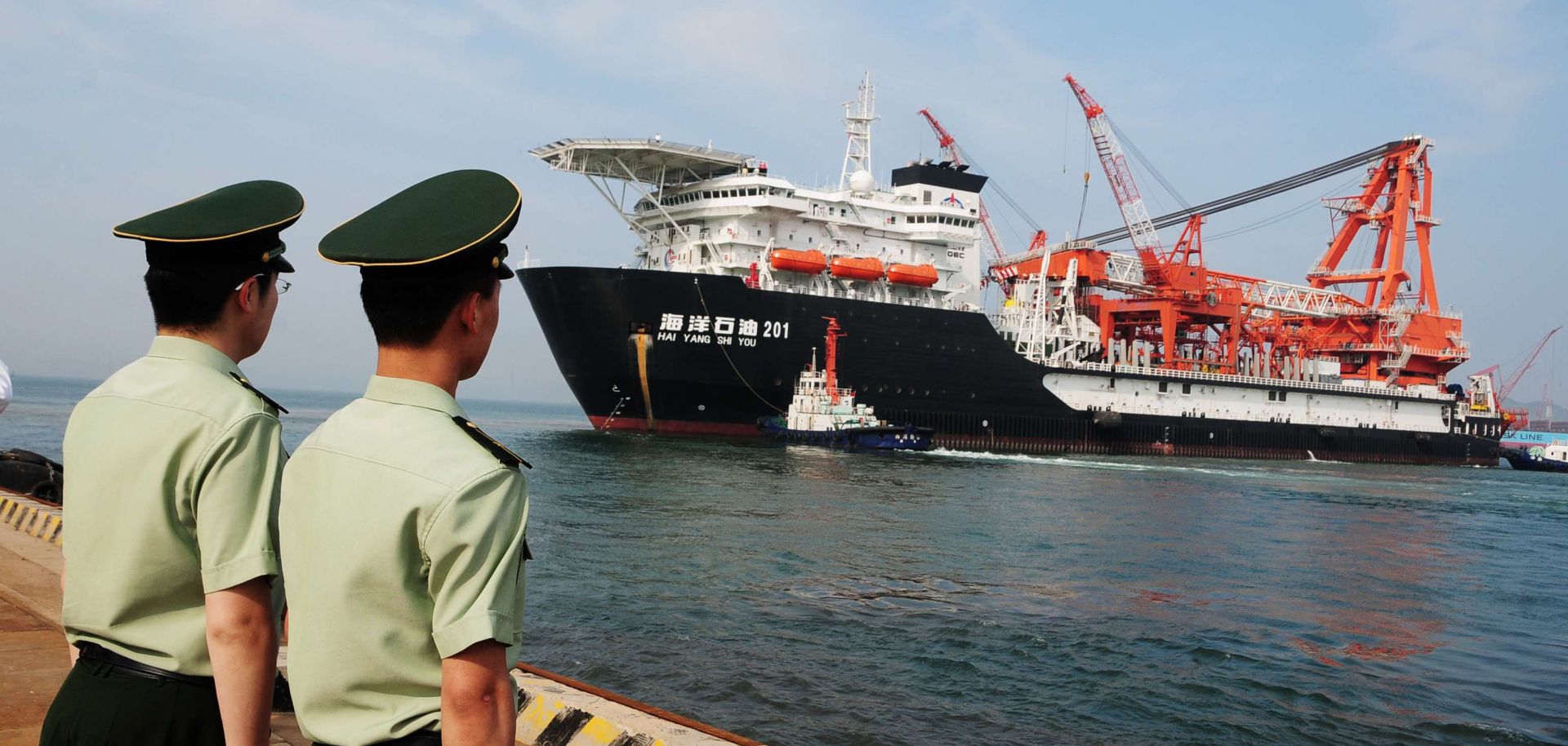
China National Offshore Oil Corp. (CNOOC) announced June 25 that it would open nine offshore oil blocks to joint operation with foreign companies. For Beijing, securing its territorial claims in the South China Sea and developing the region's energy resources go hand in hand. China's long-term strategy is to control the South China Sea — and its crucial shipping lanes — but doing so requires first countering and overcoming the claims of neighboring countries. In recent years, Beijing has turned to offshore energy exploration as a means of physically substantiating its territorial claims.
Despite its efforts to frame exploration as a cooperative activity (and thus neutralize political tensions), Beijing's moves will likely exacerbate regional competition for energy assets. China will continue to utilize energy exploration as both a means and rationale for exerting territorial claims in the South China Sea. This in turn may heighten regional competition for energy assets.
Of the nine oil blocks being opened to joint operation, seven are located in the Zhongjiannan Basin and two are located in the Wan'an and Nanweixi basins — a total area of 160,000 square kilometers (about 62,000 square miles). Most important, all of the blocks are on the western fringe of the nine-dash line, which demarcates China's claimed waters and overlaps with Vietnam's 200-nautical mile exclusive economic zone. Shortly after the announcement, Vietnam issued a statement condemning the move and calling on CNOOC to withdraw the invitation, noting that such a bid violated Vietnam's territorial sovereignty.
China's Expanded Technological Reach

As one of China's three major state-owned energy companies and the leader in offshore oil and natural gas exploration, CNOOC is central to Beijing's efforts to substantiate territorial claims in the South China Sea. Until now, relatively little formal deepwater exploration has occurred in the region, in large part due to long-standing political tensions. But in recent years, as countries like Vietnam and the Philippines have increasingly looked to partner with foreign energy companies with requisite deepwater drilling technology, and as China in turn has built its own capacity, competition has accelerated.
In line with Beijing's strategy, CNOOC has gradually shifted its focus in the past few years toward developing its deepwater exploration capability. By partnering with Western energy companies, CNOOC has significantly expanded its technological reach, which in turn bolsters Beijing's ability to exert its strategic claims in the region. In particular, the recent launch of CNOOC-owned ultra-deepwater rig 981, which gave China the capability to drill up to 3,000 meters (nearly 10,000 feet) below sea, is widely seen as substantiating Beijing's exploratory ambitions in disputed parts of the South China Sea. That said, the project remains in the nascent stages, and the prospect for independent drilling remains unclear. Vietnam and the Philippines, by contrast, still rely on joint ventures with more advanced companies to develop offshore oil and natural gas resources.
Implications
CNOOC's growing technological capabilities put it in an advantageous position with respect to Vietnam and the Philippines. Like these countries, China began exploring the region through joint ventures with foreign companies (beginning with Denver-based Crestone Energy in 1992), in an effort to develop the technical capacity to pursue solo exploration. This allowed China to compete more effectively with Vietnam in energy exploration in the region.
Against this backdrop, CNOOC's enhanced deep-sea exploration capability has also bolstered Beijing's strategy to move forward its joint exploration proposal in the disputed area, forcing claimant countries to reconsider their plans to exclude China from joint development projects. This is where CNOOC's announcement enters. On the surface, joint exploration appears to be an offer of conciliation. But that offer comes with a price: With Chinese state-owned companies leading the way by providing the bulk of funding and technology and laying most of the physical infrastructure, the move will significantly strengthen China's claims at the expense of those of its neighbors. Other countries will be invited to help and in turn reap some benefit, but in the end China will provide the rigs, money and manpower. And when the physical plant requires security or protection, it will be China's navy, not Vietnam's, that sails in.
In the short term, other countries' acceptance of such a deal would imply recognition of Chinese authority over these waters, de facto acquiescing to China's territorial assertions. This puts other countries in a dilemma, since in the face of Chinese military superiority, they are forced to either relinquish sovereignty if they accept the deal, or relinquish oil and natural gas if they do not.
CNOOC's move therefore lays the groundwork for what could become a direct threat to modern Vietnam's primary strategic imperative: securing control over the waters that surround its long coast. Not only does Vietnam rely on these waters for virtually all its oil and natural gas supply and fisheries (a major source of food and employment), it also looks to future energy exploration in the region to supplement current near-shore reserves, which are beginning to decline. Most important, perhaps, is the sea's centrality as a trade lifeline. While a China-imposed embargo on the waters around Vietnam is highly unlikely — even in the event that China could unilaterally assert itself in the region — it is a contingency for which Hanoi must nevertheless prepare.
Immediate Context
CNOOC's announcement was not a surprise, but after months of territorial disputes between China and other littoral South China Sea countries, it reaffirms the growing importance of state-owned firms as arms of Beijing's international policy. Most important, it directly follows two major developments from June 21. First came the formal ratification of the Vietnam Maritime Law, proposed by leaders in Hanoi as a formal reassertion of Vietnam's legal claims in the South China Sea as defined under the United Nations Convention on the Law of the Sea. While the U.N. law is the foremost international maritime legal apparatus, it is as yet largely toothless when it comes to settling ongoing disputes.
Just as Hanoi ratified its new maritime law, Beijing prepared its own announcement: to formally establish a new city called Sansha on Yongxing Island in the Paracels. According to Beijing, the new city will raise the administrative hub for China's three largest islands in the Paracel, Spratly and Macclesfield Bank island chains. Given that these islands sit directly across from Hanoi's geopolitical weak point (the long, thin and underpopulated trunk that connects north and south Vietnam), any move by the Chinese to further materialize control of the islands poses a potential threat to Vietnamese sovereignty.
While these two announcements provide immediate context for CNOOC's June 25 announcement, they are best viewed in the context of the general rise in tensions throughout the South China Sea region, not only with Vietnam but also with the Philippines and, to a lesser extent, other claimants such as Taiwan, Malaysia and Brunei. Beijing will continue to use CNOOC to both enforce territorial claims and enhance China's grip on energy resources in the South China Sea, which will in turn exacerbate competition between China and other regional players.
