
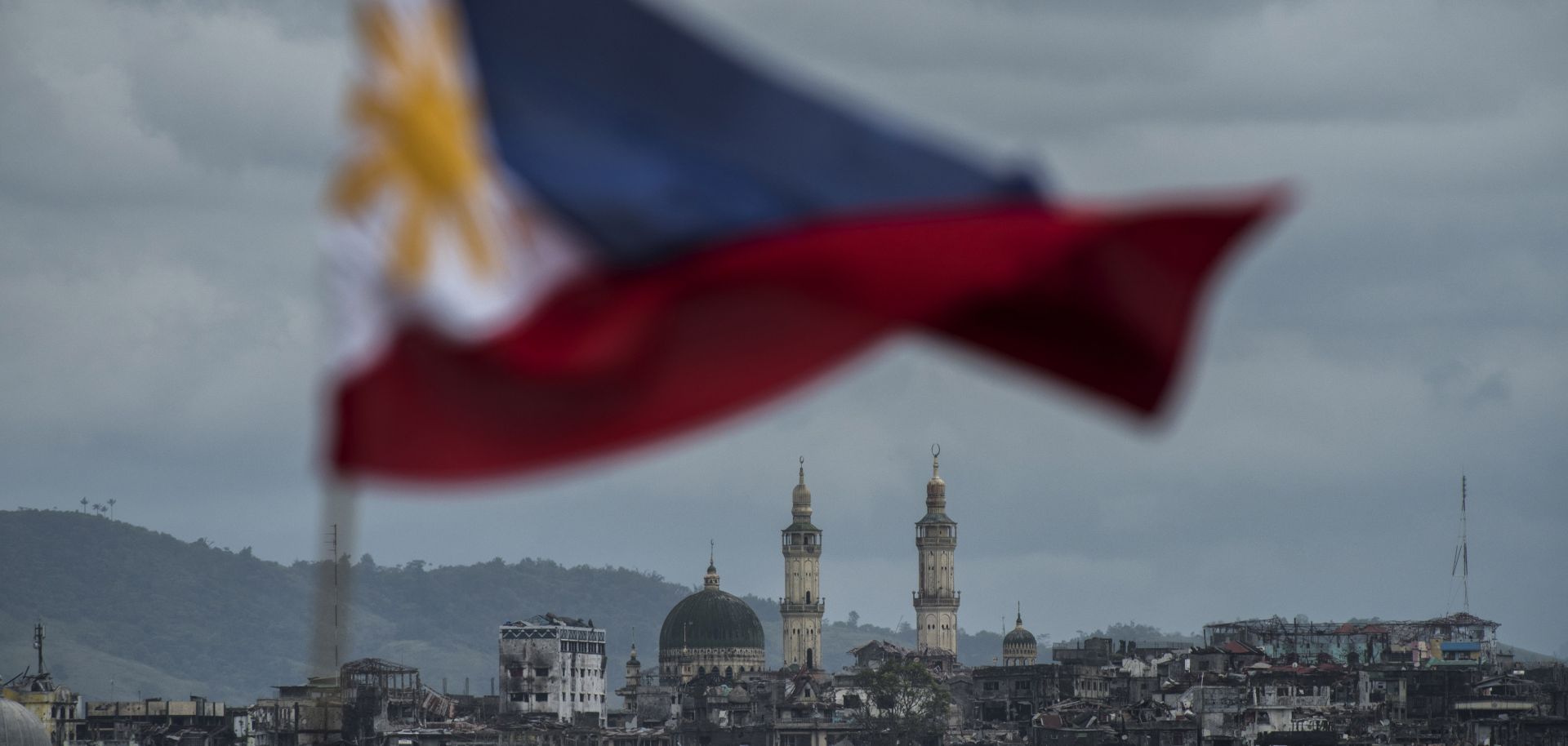
Since the Philippines' unification under Spanish colonial rule in the 16th century, the South China Sea and surrounding waters have been both the country's lifeline and its greatest source of potential political, economic and military insecurity. As a small, poor and primarily agricultural country, the Philippines has not always been capable of maintaining its political and maritime security, especially in the face of much larger powers. With the maritime environment in the South China Sea shifting, the Philippines must utilize its strategic location at the intersection of larger powers to secure its own domestic economic and energy needs.
Prior to the arrival of Western explorers, the Philippines did not exist as a coherent political entity. Ferdinand Magellan set foot on the island of Cebu in 1521, only to be killed three months later in a battle between rival tribes. Soon after, a Spanish force arrived and quickly installed a viceroy under which the country would be ruled until the end of the 19th century. The nearly 500-year Western colonial legacy gave rise to the modern Philippines' first imperative: uniting the islands under a central authority.

The Philippine archipelago consists of three distinct island clusters populated by peoples who were mostly culturally and politically independent before the Spanish occupation. The northern island cluster, now known as Luzon, is inhabited primarily by the Tagalog, who arrived thousands of years earlier from Southeast Asia. South of Luzon is a region known as Visayas, home to the Philippines' largest ethnic group, the Visayans. This group's geographic position at the center of the archipelago makes it the lynchpin uniting Luzon with the southernmost island chain, Mindanao. Populated by the predominantly Muslim Moro tribe, which has far more in common culturally and ethnically with Indonesia and Malaysia than the northern Philippine islands, Mindanao has always been a hotbed for political unrest and instability in the country.
For a country as culturally, ethnically and religiously diverse as the Philippines, unification requires gathering enough political force to deal with internal threats while simultaneously maintaining security against outside incursions along its long, vulnerable coastline. Securing the country's 36,000 kilometers (22,000 miles) of coastline is the Philippines' second imperative. Manila's perennial difficulty is achieving these imperatives at the same time. The near-constant domestic insecurity that the Philippine government faces in Mindanao severely limits the military's ability to protect its coast. In response, Manila must seek the protection of greater powers.
After the U.S. victory in the 1898 Spanish-American War, the Philippines became an American protectorate, except for a brief interlude during World War II when the Japanese ruled the islands. The Philippines gained political independence in 1946, but both Washington and Manila have seen reason to embed the country firmly within the post-war American global economic framework, which is built on U.S. naval power and its role as guarantor of global shipping lanes.
The Philippines' extremely limited ability to deter threats from the sea made having an outside patron even more important. Though the Philippines is an island nation, its army has always been far larger than its navy and accounts for the bulk of the country's military budget. In order to most effectively pursue its first imperative of uniting the islands, the Philippines has had to rely on a large army to deal with the numerous insurgent groups challenging Manila's authority. The army, with a force of 80,000 active personnel, is more than three times the size of the navy, and the navy too devotes a great deal of resources — including marines and amphibious landing ships — to maintaining internal security in the country's restive south.
How the Sea Influences the Philippines
For decades, the United States used naval bases scattered throughout the islands to maintain its pre-eminent role in shaping the Philippine maritime environment. For most of the 20th century, the U.S. Navy occupied a major base in Subic Bay just north of Manila on Luzon. Subic Bay, like all other U.S. bases on the Philippines, was eventually decommissioned and returned to Manila, but this represented more a shift in the politics of military relations between the two countries than a genuine break. In recent years, the Philippines has pursued a revitalization of military ties with the United States in an effort to supplement its own weak military capabilities, especially in light of China's expanding maritime ambitions.
Philippine-Chinese relations have been relatively peaceful since the two countries established formal diplomatic ties in 1975. At that time, China was poor and focused on improving its domestic economy and had extremely limited naval capabilities. As a land-based power with no way to enforce its territorial claims in the South China Sea, China throughout the 1980s rarely engaged in open naval competition with other countries in the region.
But that has changed since the 1990s. China and the Philippines engaged in a series of skirmishes following Beijing's move to occupy Philippine-controlled reefs in 1994-1995, followed by a similar skirmish between China and Vietnam in 1998. This in turn prompted Manila to reinvigorate military cooperation with the United States, a process that accelerated concurrent with China's growing naval presence in the region. While China's navy is still far behind the United States' in size and sophistication, it is the largest in East Asia. This, combined with the Chinese state-driven search for energy and mineral resources, has added a new impetus to Beijing's efforts to carve out a unified sphere of maritime influence. And because Beijing's claims overlap with those of other littoral countries like Vietnam, Taiwan and the Philippines, these countries have been forced to enhance their own maritime presence and capabilities.
As an archipelago, the Philippines relies on the sea as an economic lifeline, for everything from trade to fishing to energy exploration. All oil consumed in the Philippines is imported, accounting for more than 10 percent of the country's total imports by value. Moreover, the waters surrounding Luzon and smaller offshore islets like the Scarborough Shoal and the Spratly Islands are believed to contain massive underwater hydrocarbon reserves. (The Philippines already derives all of its natural gas supplies from a single offshore natural gas field near Manila Bay.) Beyond energy and trade, these waters are a crucial source of fisheries — an important source of employment and exports (roughly $370 million in 2011) and a key foodstuff for the Philippines.
The potential loss of access to new energy resources and existing fisheries are only two examples of how a shift in the regional maritime balance of power could negatively affect Manila. This in turn could destabilize Manila's fragile hold on maintaining unity between the islands amid the persistent, low-level threat from ethnic and political independence movements in the south. Therefore, achieving the Philippines' first imperative, however tentatively, will require that it fulfill the second: checking foreign encroachment, in this case China's, on Manila's maritime sphere.
Manila's Strategy
As the threat of separatism in the south ebbs and as China increasingly turns to indirect, non-military means of asserting its claims on surrounding countries, Manila is seeking to re-enforce its air force and navy. Given the Philippines' lack of extensive resources and the need for a major power sponsor when facing China, pursuing stronger economic and military ties with the United States has re-emerged as Manila's default approach. The Philippine air and naval forces are a far cry from China's, so Manila must utilize its strategic location in the United States' Asia-Pacific maritime alliance structure for its own benefit.
The United States, recognizing the potential for the Philippines as a strategic base in the Pacific, has accelerated arms and diplomatic support for Manila. On June 12, the U.S. military announced that it planned to provide land-based radar to the Philippines to help track ships off the island's coastline. Washington also continues to sell a number of vessels to the Philippines, including a Hamilton-class cutter that was transferred in 2011 under the U.S.-Philippines Mutual Defense Treaty and that is now the Philippine navy's flagship.
The Philippines is also seeking closer military ties with other friendly countries. The Philippine Defense Department announced June 9 that it was studying a military training agreement with Singapore that would allow its troops to train in Singapore. Manila is also currently considering a similar agreement with Australia and Japan.
Manila's strategy is not without risk. As one of the most vocal opponents of Chinese territorial claims in the South China Sea, the Philippines could face a political or even military backlash from Beijing. Given that China is the Philippines' third-largest trading partner (after Japan and the United States), China is capable of exerting widespread economic leverage, if it chooses.
