
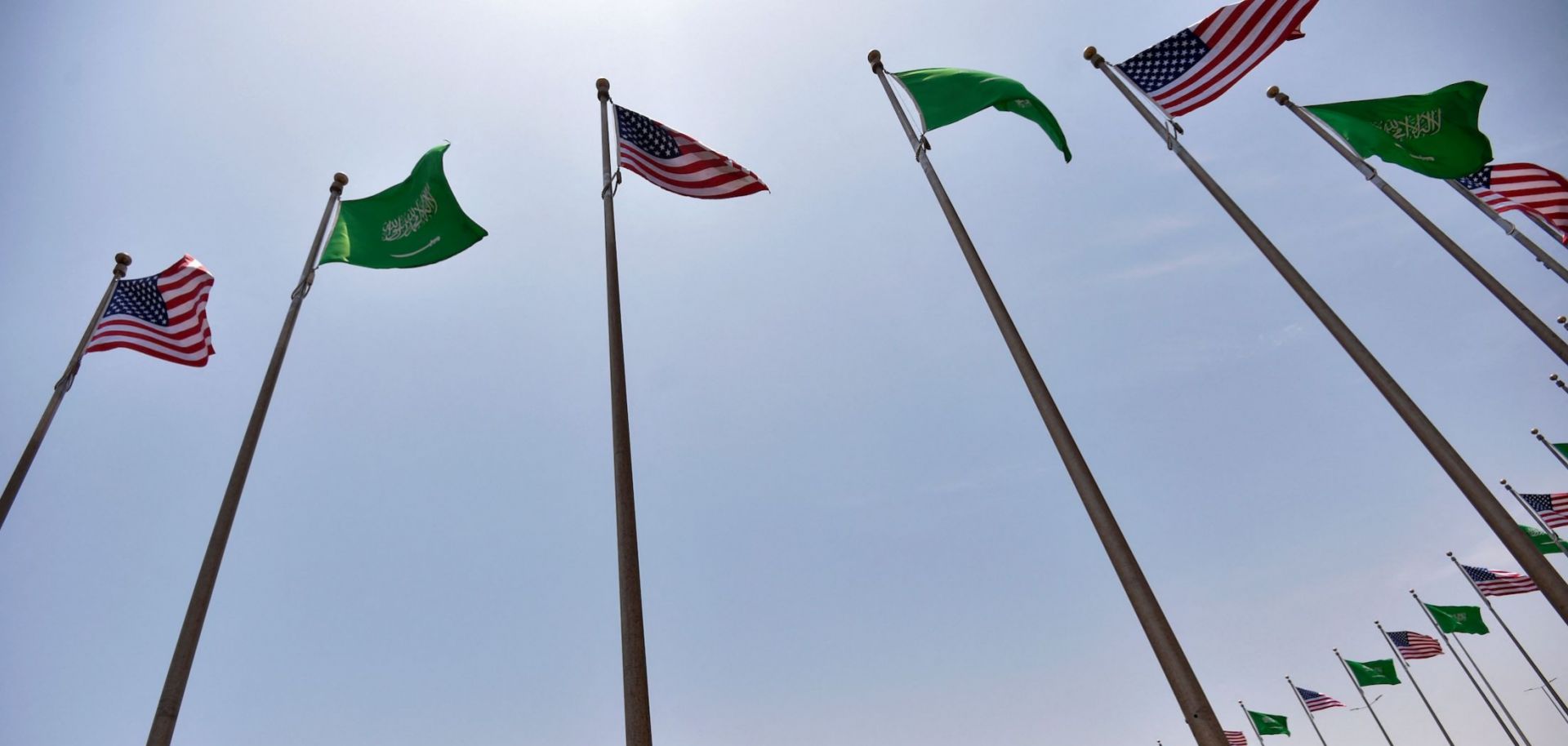
Saudi and U.S. flags line the King Abdulaziz Road in the Saudi Red Sea port city of Jeddah on July 14, 2022.
To paraphrase the United Kingdom's long-serving Foreign Secretary Lord Palmerston, the United States and Saudi Arabia are not permanent friends. Instead, their relationship has always been anchored by temporary alignments, born of the geopolitics of the era. In the final days of World War II as the Cold War dawned, a simple enough compact was born between them: Saudi Arabia would provide oil to stabilize the global energy market in exchange for U.S. military protection from Soviet-backed rivals that sought to overthrow the monarchy. This was possible because the world was in a bipolar moment in which states were pressured either into the communist East or the capitalist West, with little wiggle room in between for militarily weak but economically important countries like Saudi Arabia. Even with the fall of the Soviet Union in 1991, the fundamentals of the compact remained the same: the Saudis gave oil, and the United States provided protection from Saddam Hussein's Iraq, Iran and later al Qaeda.
This arrangement could not last. Over time, the United States began an energy pivot, both to produce more oil and to lessen its use of it. China rose as a growing competitor to the United States, drawing American strategic attention to Asia. The United States tried and failed to reorder the Middle East through nation-building, and Washington decided it was better to cut deals with rivals like Iran rather than remain locked in conflict. These were the ingredients that created an emerging multipolar world.
This era does not force Saudi Arabia to choose a side as cleanly as did the eras of the Cold War and the War on Terror. In fact, some of its greatest fault lines, like the U.S.-China confrontation and the Russia-Ukraine war, pose little direct threat to Riyadh itself. And so there is little reason for Saudi Arabia to use its oil heft on behalf of its U.S. friend; rather, there is all the more reason for Saudi Arabia to make what income it can from oil before technological developments and economic change reduce its value in the coming decades. And as Saudi Arabia and the United States remained destined to diverge, future events in the multipolar world will only drive them further apart.
The immediate context of OPEC+'s production cut
In July, U.S. President Joe Biden visited Riyadh and met with Saudi Crown Prince Mohammed bin Salman. The trip came as a political about-face, as Biden had promised to isolate Saudi Arabia over human rights violations during his presidential campaign in 2020. But by 2022, that promise had become hard to keep. Gas prices had soared in the United States in the wake of the Russia-Ukraine war, and the trip was aimed at convincing Riyadh to use its heft in the oil market to help lower prices and take some of the public pressure off the White House.
At first glance, the Biden administration seemed satisfied with the results of the trip, as it touted a supposed Saudi commitment "to support global oil market balancing for sustained economic growth." According to Washington, Saudi Arabia would help keep gas prices in America stable, thereby improving the Democratic Party's chances of holding at least part of Congress in otherwise difficult midterm elections in November, as well as staving off gas price-induced public war weariness that could threaten to affect U.S. policy toward Ukraine.
But Saudi Arabia did not see the visit the same way. Though the country did modestly increase output in August, a possible oil oversupply and a slowing global economy had changed minds by October, and Riyadh began to argue that market fundamentals should allow it to cut production to stabilize prices. That same month, OPEC+ agreed to a higher-than-expected 2 million barrel per day output cut, shocking the United States and spurring calls from Congress — and whispers from the White House — for retaliation against the Saudis for breaking their alleged promise.
Imperatives passing in the night
The production spat is just one of several ways the two countries no longer see eye-to-eye. Broadly, the United States believes Saudi Arabia, particularly under its brash crown prince, is too repressive to remain stable domestically, too willing to use force in places like Yemen without consideration for its impact on civilians, and that its old "oil weapon" is blunted in the face of increased U.S. output. Meanwhile, Saudi Arabia believes Washington intends to draw down its forces in the region enough to embolden Iran, give heart to radicals like al Qaeda and the Islamic State, and allow the Houthi rebels in Yemen to strike Saudi Arabia at will.
Ukraine is another place where the countries' goals split. For the United States, the balance of power in Europe has been a critical geopolitical imperative since the end of World War II, and Russia's invasion of Ukraine is a great challenge to the security architecture that keeps the Continent stable. To this point, Washington is attempting to halt the Russian invasion without escalating to direct war, including by using the oil market against Russia, even though such a strategy could cost Americans at the pump. But for Saudi Arabia, the Russia-Ukraine war is distant, so whoever controls Ukraine is less relevant to Riyadh than its own economic transformation under its Vision 2030 plan, which aims to shift the country toward a sustainable post-hydrocarbon economy before the world evolves past the high demand for oil. Taking an economic loss on behalf of a European war does little to achieve such a goal.
The impossible task of corralling Saudi Arabia
The U.S. political system has now firmly turned on Saudi Arabia, and many politicians seeking to burnish their credentials on the Middle East, energy or U.S. foreign policy will likely continue to berate Riyadh rhetorically, regardless of the facts of the matter. (The OPEC+ production cuts did not, after all, cause a spike in oil prices, and American gas prices are dependent on more than just the global oil market, anyway.) But while U.S politicians will pledge to bring fire and fury to U.S.-Saudi relations, they will struggle to implement their promises, facing White House vetoes and Pentagon objections due to the U.S. need to counterbalance Iran in the Middle East, keep oil markets stable and remain a bulwark against radicalism. Even so, these politicians may find more wind in their sails if the next OPEC+ meeting in December results in yet more output cuts as the bloc prepares for recessions to hit the West in 2023. The optics of such an event would be particularly bad given that Europe will be in the midst of a tough and expensive winter as the Continent weans itself off Russian natural gas. But whatever measures the United States takes will be meant to strain relations, not wholly break them.
Saudi Arabia, for its part, will adjust in the face of such pressure and likely continue its pivot toward a combination of soft support for Ukraine and increased mediation of humanitarian deals, prisoner swaps and possible cease-fires, as Turkey has done. The latter effort is part of a bid to mold Saudi Arabia's image into that of a responsible and reasonable global player. Such an image will not convince anyone in Washington to ease off criticism if it is accompanied by more output cuts, but Saudi Arabia's efforts will improve its image elsewhere — like in the Global South, where oil price spikes hurt substantially more in impoverished countries. What Saudi Arabia will not do is jeopardize its economic transformation strategy.
As mistrust builds, the United States could decide to reduce military support for Saudi Arabia, and Riyadh might go to U.S. allies like France and the United Kingdom, as well as U.S. rivals like China, in response. But given that such a military adjustment would take years, if not a full decade, to realize, Saudi Arabia would in the meantime be in a vulnerable position. For instance, Riyadh might find it hard, if not impossible, to prop up its allies in Yemen, giving way to a Houthi military advantage and possibly even a Houthi-run northern state that is aligned with Iran on its southern border. Iran, which would no longer be concerned about triggering an immediate U.S. military response, would also likely be emboldened to strike Saudi Arabia in an escalated covert campaign. In this scenario, Iran would aim to undermine the monarchy and its ability to influence regional events in places where Tehran and Riyadh back opposite parties, like Lebanon, Iraq and Yemen.
And there is the matter of Vision 2030, Saudi Arabia's economic transformation program. Foreign investment and foreign workers are part of this strategy, but it is unclear how much foreign capital and labor will flow into Saudi Arabia when it appears that its great protector, the United States, is drawing back. Some sources of capital and labor — like fellow Gulf Cooperation Council states and the subcontinent — appear likely to back Vision 2030 no matter what the U.S.-Saudi relationship looks like, but they may rethink their positions if Saudi Arabia, shorn of U.S. forces, finds itself stuck in an elevated proxy conflict with Iran or a Houthi-run North Yemen.
Future rounds of deterioration
It is likely that going forward, the United States will again expect Saudi Arabia to act in American interests, believing (incorrectly) that they align with Saudi interests, and Riyadh will refuse to do so. For instance, Saudi Arabia will not go along with any attempts to impose a price cap on Russian oil, knowing that could affect the bottom line for Saudi exports as well. Riyadh is also unlikely to block Russian tourists or Russian businesses from entering or investing in Saudi Arabia short of the West expanding to a globally-disruptive secondary sanctions campaign. And Riyadh will keep up diplomatic contacts with Russia, even sending high-level delegations there, in spite of the optics that might cause in the West, to ensure that the country has working relations with a fellow oil power with which Riyadh so recently fought a price war in 2020.
Looming behind that growing tension could be a confrontation between Saudi Arabia and the United States over China. As China's threats to Taiwan increase and Washington attempts to deter and counter Beijing's economic and military growth, the United States will lean on partners like Saudi Arabia to corral Chinese power. In the event of a Chinese invasion or major military escalation over Taiwan, the United States would likely try to squeeze China's energy-dependent economy with restrictions or even bans on oil exports, but Saudi Arabia would balk at such a ban, given how much of the country's exports now flow to China. Such resistance would not be motivated by a desire to actively back China in its attempt to take Taiwan militarily, but it would again be due to the fact that such a distant war in Asia would be less important to Saudi Arabia than oil income. In the ever-more multipolar world, such a choice becomes strategically logical — even at the expense of relations with the United States.
