
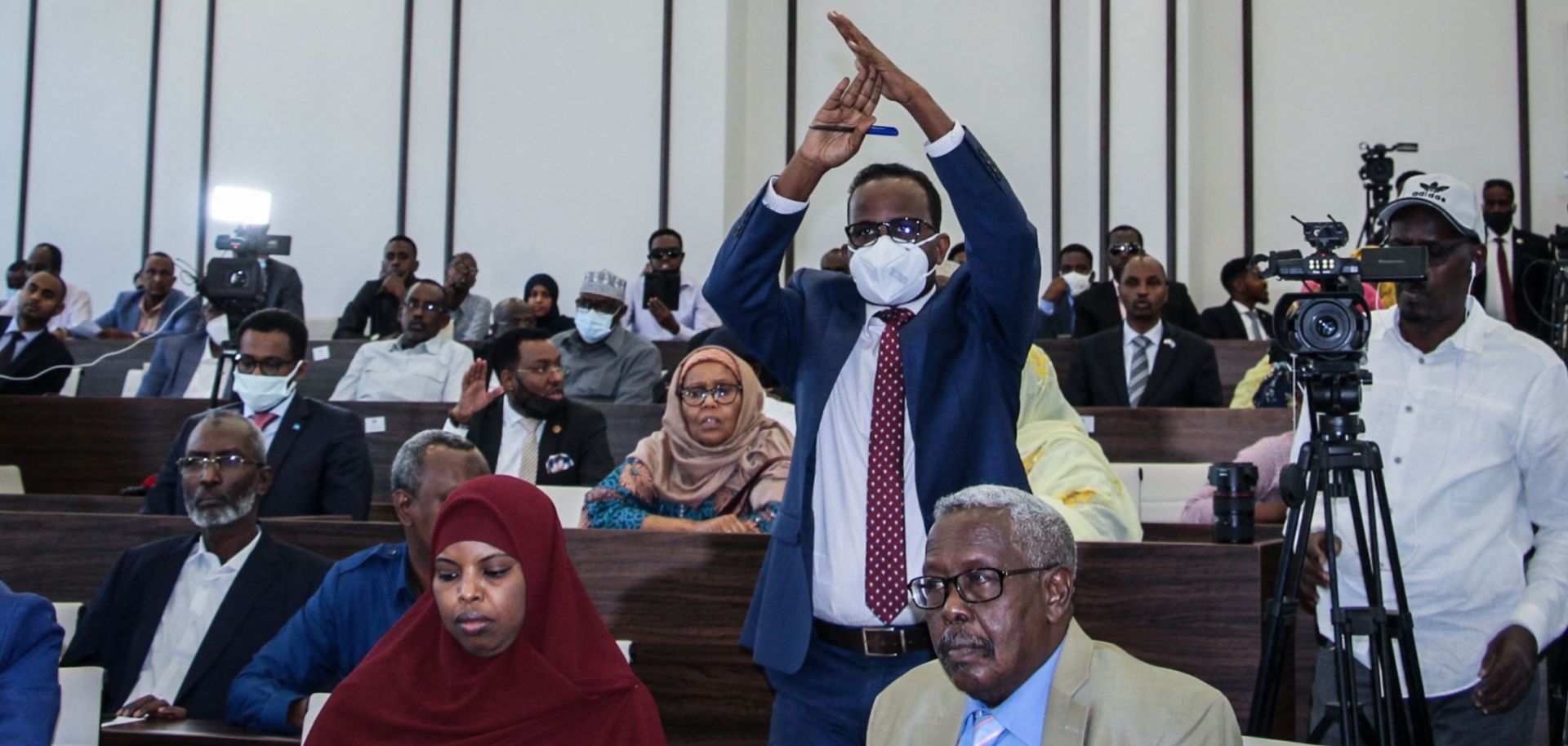
A member of parliament gestures in response to the president’s request to annul a law extending his term in Mogadishu, Somalia, on May 1, 2021.
A decision not to extend Somali President Mohamed Abdullahi Mohamed’s mandate will alleviate the immediate security crisis in Mogadishu, but continued political turmoil will disrupt the implementation of security and economic reforms needed to stabilize the country. On May 1, Mohamed and the lower house of parliament formally annulled a controversial law that would have extended his term by two years after clashes in Mogadishu sparked concern that Somalia could return violence along clan lines. The decision will restore an agreement that Somali leaders reached in September to hold the country’s delayed presidential election under an indirect system. Prime Minister Mohamed Hussein Roble has since invited the leaders of Somalia’s five federal member states to participate in another round of talks starting May 20 to organize the election, with the hopes of finally ending months of gridlock on how to move forward with the vote.
- Somalia’s political system, where the semi-autonomous federal member state presidents have significant domestic power, makes negotiations between them and the federal government a necessity to hold elections.
- On Sept. 17, Somalia’s federal government and the leaders of five member states reached an agreement on an indirect election model whereby clan-based electoral colleges would elect lower house representatives and state assemblies upper house members, who would then choose the president.
- Mohamed’s mandate ended on Feb. 8 but no election was held due to disagreements between Somali leaders on how to implement the indirect voting model, among other political disputes.
- On April 12, the lower house of parliament then passed the controversial law extending Mohamed’s term, which effectively made the Sept. 17 agreement irrelevant, gave the federal government two more years to organize an election.
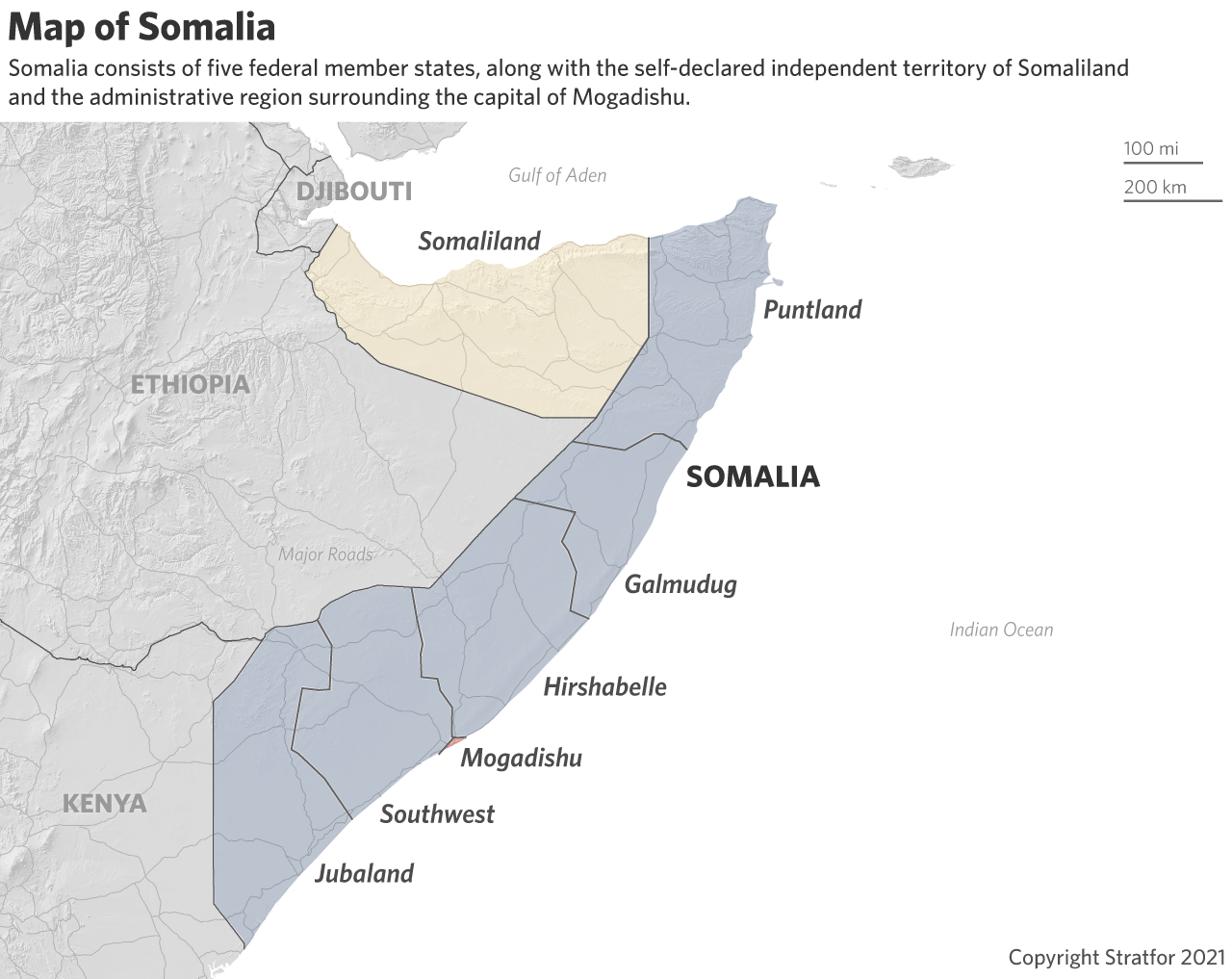
The two-year term extension triggered a surge of violence in Mogadishu and resulted in calls from international actors and Mohamed’s domestic allies to recant the decision. Fighting between Mohamed’s supporters and rivals erupted in Mogadishu on April 25. According to local media reports, while some members of the Somali Armed Forces and other security forces backed the federal government, others sided with the opposition. This sparked fears that Somalia’s security services could fracture along the country’s clan lines and undermine the broader fight against al Shabaab terrorists.
- The United States called for a reversal of the two-year extension and threatened to impose sanctions.
- On April 27, the presidents of the Somali federal states of Hirshabelle and Galmudug — who had both previously supported Mohamed — issued a joint statement opposing the term extension mandate.
The election talks will de-escalate the security crisis in Mogadishu in the short term, but many of the underlying issues that prevented the implementation of the Sept. 17 agreement remain unresolved. For opposition leaders, Mohamed’s attempted extension only reinforces their perception of him being a power-hungry leader who has little intention of stepping down. Mohamed’s critics had already accused him of stacking the deck in his favor ahead of the next presidential election by appointing allies to bureaucratic positions overseeing the electoral process. Jubaland State President Ahmed Madobe, one of Mohamed’s most outspoken critics, refused to back the election unless federal troops left Jubaland’s Gedo region, which Mohamed has refused to do. The concessions that Madobe will likely demand to back the new election negotiations may again prove too much for Mohamed’s hard-line nationalists to accept, given Madobe’s interest in maintaining the relatively large power Somali federal states currently hold over local matters. Without Madobe’s support, however, the elections cannot be held in Jubaland.
- In February, Madobe withdrew his recognition of Mohamed as Somalia’s president. Jubaland’s Information Minister recently said the state would not attend the new election talks until control over national security issues — and thus control over the Somali Armed Forces deployments to Gedo — is transferred from Mohamed to Prime Minister Roble.
- Kenya’s support of Madobe — whose control over neighboring Jubaland it views as essential to establishing a buffer zone between Kenya and al Shabaab militants — also emboldens his position in negotiations with Mogadishu.
Somalia’s lengthy political crisis will delay security reforms and hinder counterterrorism efforts aimed at ensuring the country’s broader stabilization. In 2017, Somali stakeholders reached an agreement with the international community to build a more unified and cohesive Somali National Army that could eventually replace the now 14-year old African Union Mission to Somalia (AMISOM) peacekeeping mission in the country. Mohamed’s government has since been pushing for reforms in the security sector to implement the plan, which includes merging some forces of Somalia’s semi-autonomous states with the national government. But while unifying Somali forces may paper over some regional and clan faultlines, the turmoil following the recent term extension mandate has already shown just how fragile that process can be, given that some federal armed forces reportedly intervened on behalf of opposition leaders. The current crisis has also highlighted the need for Somali political factions to maintain the allegiance of security forces in the event they are needed to settle the country’s political disputes.
The political crisis could also threaten Somalia’s long-term financial stability by undermining the government’s attempts to implement economic reforms and receive debt relief. After years of negotiations, the International Monetary Fund announced in March 2020 that Somalia had taken all of the steps necessary to start receiving debt relief under the Heavily Indebted Poor Countries (HIPC) initiative. The IMF also approved a three-year financing package to help support Somalia’s economic reform plans. But the completion of the HIPC process takes three years and the financing package requires the Somali government to implement more economic reforms to unlock further tranches, which the ongoing political crisis could disrupt. The Somali government is also in the process of opening the country’s oil and gas sector and had hoped to announce winning bids in its first licensing round in early 2021. The bidding process, however, appears to have slowed down amid the election-related unrest, as there have not been subsequent updates since February.
