
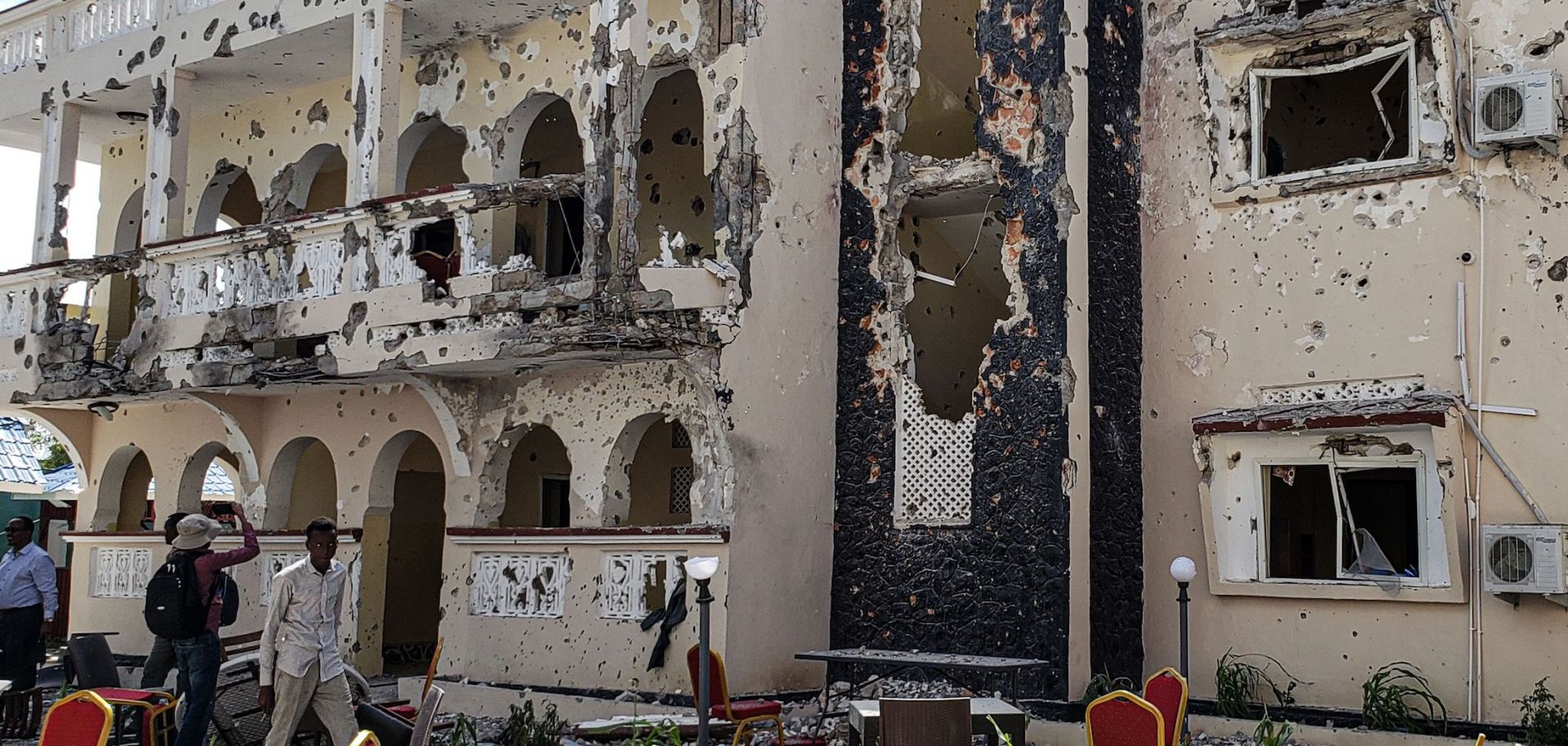
A hotel in the Somalian city of Kismayo on July 13, 2019, a day after at least 26 people, including several foreigners, were killed and 56 people were injured in a suicide bomb and gun attack claimed by al Shabaab militants.
Somalian President Mohamed Abdullahi Mohamed's decision to cut off diplomatic relations with Kenya will undermine his efforts to consolidate federal control of restive Somalian provinces, compounding his security woes amid the planned 2021 drawdown of U.S. security assistance. Nairobi's decision to host meetings with President Muse Bihi Abdi of Somaliland, a self-declared independent state in Somalia, prompted the Dec. 15 decision by Mohamed. Relations between the two countries have been deteriorating for some time over Kenyan involvement in the Somali province of Jubaland, with Nairobi's invitation apparently finally crossing the line for Somalia.
- Kenya has supported Jubaland President Ahmed Mohamed Islam, better known as Ahmed Madobe, since intervening in Somalia's civil war in 2011 as part of a broader initiative to shape a buffer zone between Kenya and al Shabaab.
- In Somalia, Kenya's armed forces are primarily active in Jubaland as part of the African Union Mission to Somaliland (AMISOM) peacekeeping mission against al Shabaab.
- Somalia expelled the Kenyan ambassador to Somalia on Nov. 30 and recalled its ambassador to Kenya, accusing Kenya of interfering in elections in Jubaland. Mogadishu has given other Kenyan diplomats seven days to leave Somalia.
- U.S. President Donald Trump on Nov. 30 signed an order for the withdrawal of nearly all U.S. troops stationed in Somalia by Jan. 15, 2021.
Tensions between Kenyan leaders and Madobe and Mohamed have been high since 2019 elections in Jubaland, as Mohamed has sought to rein in Madobe, who has attempted to extract concessions from Mogadishu in exchange for allowing federal elections in Jubaland in 2021. In September, Mohamed and Somalia's five state leaders agreed on a new model for presidential and parliamentary elections, but Madobe made his support conditional on Somali National Army forces withdrawing from the Gedo region of Jubaland. Mohamed has since argued that Madobe with the support of Kenya has effectively pulled out of that election agreement.
- Mogadishu has questioned the legitimacy of Madobe's 2019 victory, and in February 2020 deployed the national army to Gedo, ostensibly to control the triborder region between Somalia, Ethiopia and Kenya, but these actions have also undercut support for Madobe in the region.
- National army and Jubaland forces have clashed several times in Gedo during 2020.
- After intense mediations, Mogadishu begrudgingly accepted Madobe in June as an interim Jubaland president — but only with a two-year mandate instead of the normal four years, setting up further clashes over recognition in late 2021.
Kenya will continue to support the Jubaland government against Mogadishu, complicating Mohamed's consolidation objectives while likely preventing other possible successors from achieving the same goals. The Jubaland buffer zone is a strategic priority for Kenya, whose military involvement remains focused on limiting potential spillover of al Shabaab attacks into Kenya. While the strategy hasn't blunted the frequency of al Shabaab's targeting of Kenyan interests or its success in conducting high-profile attacks in Nairobi itself, a cooling of relations between the capitals is unlikely to result in a reduction in Kenyan support for operations in the region. This will ensure Jubaland's relative autonomy from Mogadishu. Moreover, Ethiopian support of Mogadishu's consolidation efforts — as well as its deployment in Gedo — will reinforce Nairobi's policies.
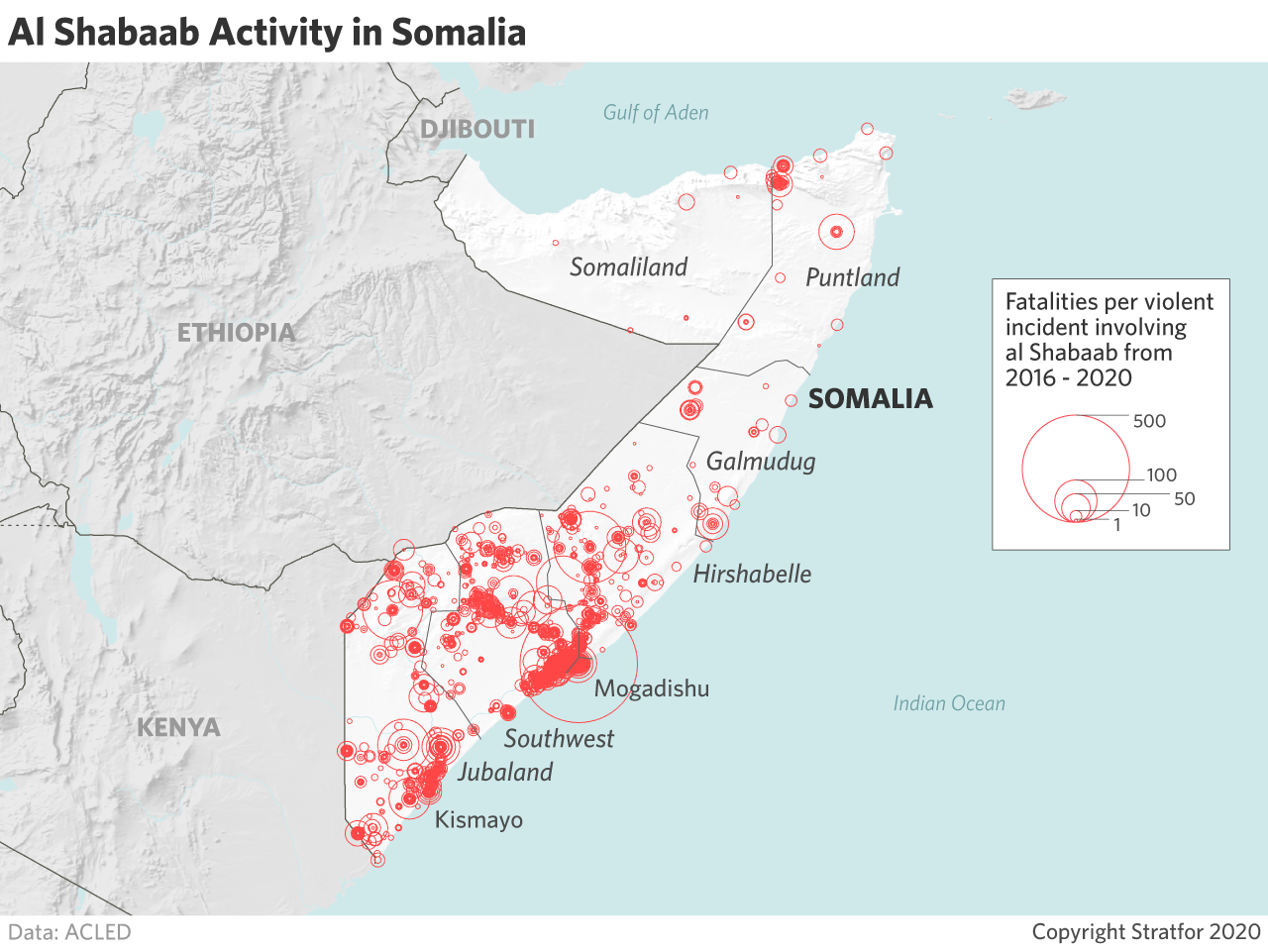
The breakdown in relations between Kenya and Somalia will complicate long-term strategy to neutralize al Shabaab and other militant groups without intervention in the form of intensive regional negotiations to restore normalized relations, but this could take months. The presence of Somali federal forces in Gedo plus probable disputes over the legitimacy of leaders in Jubaland will probably provoke confrontations between regional militias and the Somali National Army, undermining counterterrorism efforts and collaboration. Jubaland's desire for autonomy will continue to make significant security sector reforms difficult. Mogadishu remains focused on staffing and equipment shortfalls that hamper the effectiveness of the national army, along with aligning paramilitary and police forces under a unified security apparatus. Mohamed's policy statements and actions suggest that he views efforts to devolve power and to decentralize have failed, and perceives centralization is necessary to effectively manage the economy, overcome clan divisions and defeat al Shabaab. With AMISOM's mandate under continual review against the backdrop of peacekeeping fatigue, Mogadishu remains committed to a strategy of security sector reform designed to strengthen the federal armed forces as a long-term replacement for AMISOM, although at present it doesn't appear that Somalia will attempt to eject Kenyan forces operating under the auspices of AMISOM. The breakdown in relations between Kenya and Somalia also comes against the backdrop of the U.S. reduction in forces in Somalia, which will exacerbate the challenges that Somalia and Kenya face in their struggles against al Shabaab.
- Al Shabaab continues to attempt to exploit disagreements between national and subnational security forces, and remains a significant regional threat sustained by seizing funds from locals and its ability to form alliances locally.
