
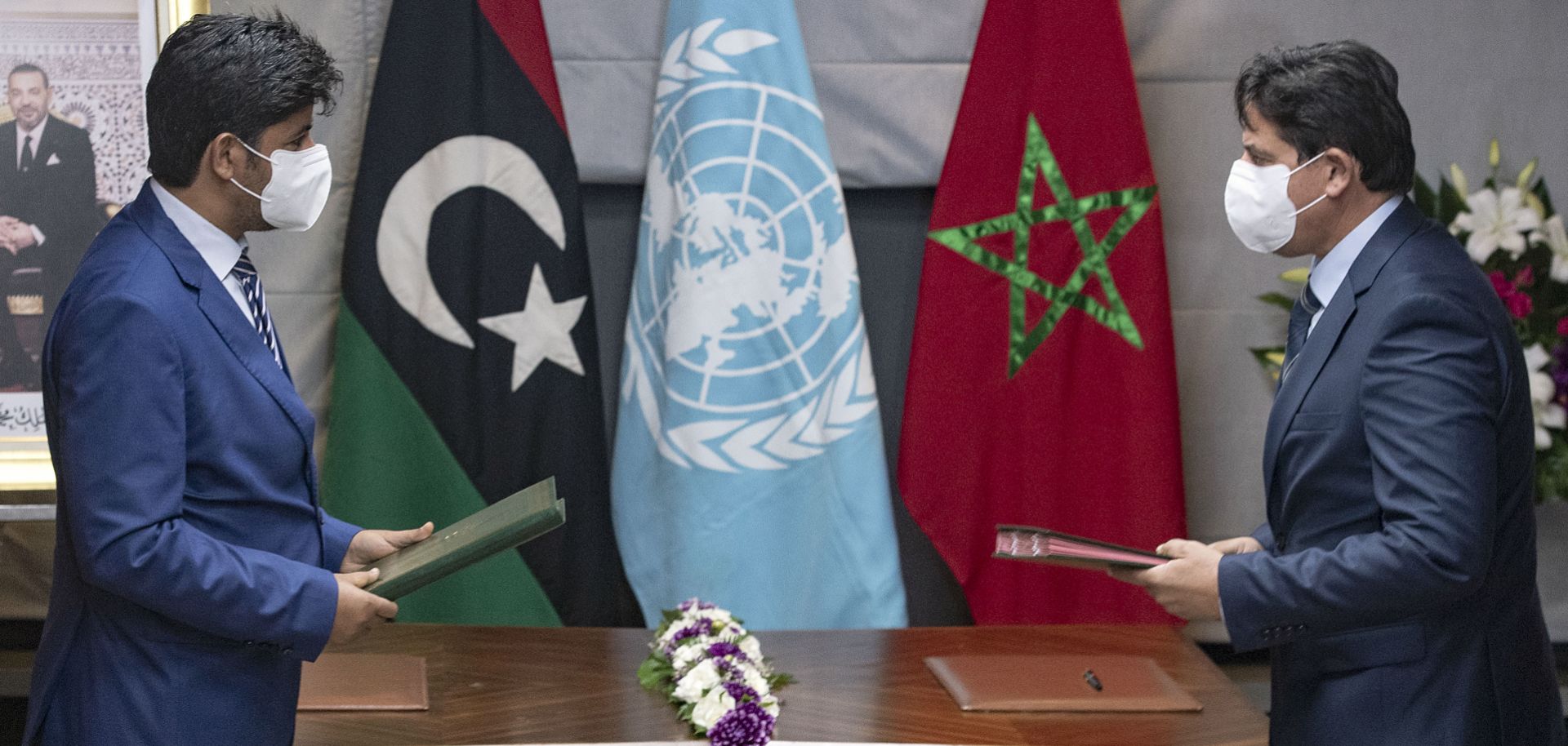
Representatives of Libya's rival administrations take part in a meeting in Temara, Morocco, on Oct. 6, 2020.
The launch of political negotiations under Libya’s new permanent cease-fire will create space to reduce hostilities between the country’s warring factions. But addressing the fractured political, economic and security dynamics of Libya’s ongoing civil war will remain significant obstacles to a comprehensive settlement and lasting peace. The longevity of the Oct. 23 cease-fire will largely depend on the progress and pace of those negotiations. Should they result in an outcome that goes against his political fortunes, Khalifa Hifter and his Libyan National Army (LNA) are likely to return to a coercive strategy in negotiations and may potentially disrupt them altogether.
The new cease-fire agreement enshrines entrenched dynamics that existed since June 2020, as fighting between Libyan rivals has largely stopped along front lines between Jufra and Sirte. Economic pressures have driven both the LNA and GNA to the negotiating table, as well as an inability to make further military progress due in part to the lack of Russian and Turkish support. Deep distrust will prevent either side from comprehensive demobilization around the highly strategic line extending between the Libyan towns of Sirte and Jufra, which both sides have been fortifying since May.
- Russia and Turkey are likely to oppose reducing their presence per the cease-fire conditions, including private military contractors such as Russia’s Wagner Group, which has been working with the LNA.
- GNA Defense Minister Salah al-Namroush already said that the cease-fire won’t affect Turkey’s defense agreements with the GNA.
Libyan factions are now expected to turn their attention to the broader peace process, which includes separate tracks of negotiations covering political and economic issues. But disagreements on finances and hydrocarbon resources, as well as the relationship between the GNA and LNA leader Hifter will limit progress. The cease-fire does not address reconciliation agreements between former rivals and only tangentially covers demobilization and integration of Libya’s militias into the formal state security apparatus. Ideological grievances over the role of the Muslim Brotherhood also remain unaddressed.
- The next step in the peace process is the opening up of the Libyan Political Dialogue Forum, which began virtually on Oct. 26 ahead of the Nov. 9 start of in-person talks in Tunis.
- The forum may result in the appointment of a new Libyan government, including a new prime minister, following GNA Prime Minister Fayez Serraj’s September announcement that he intended to resign. Serraj had initially planned to step down at the end of October, but has since said will stay in office until a new government is appointed.
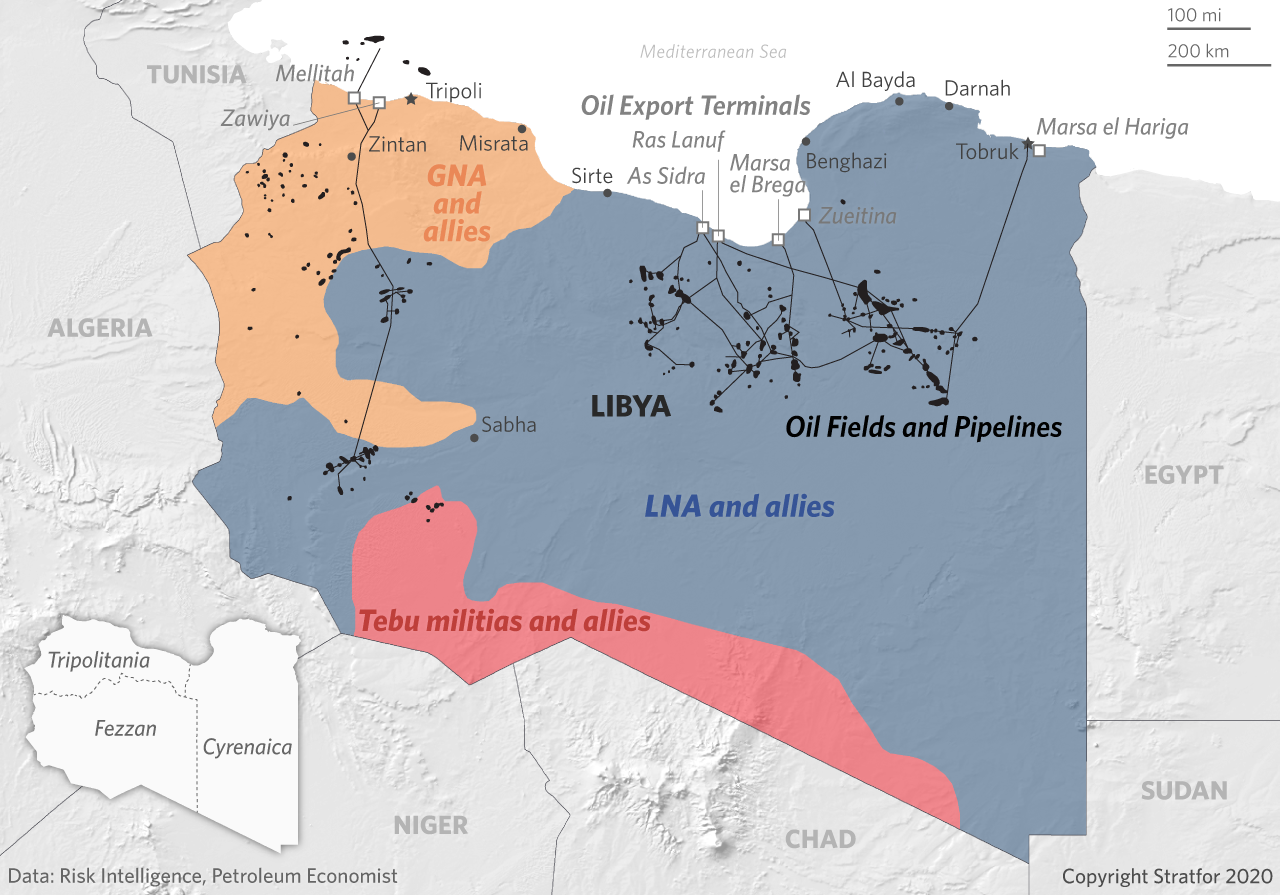
The Libyan Political Dialogue Forum will need to balance competing domestic and international pressures over the makeup of a new government, as both the LNA and GNA’s external allies will be unwilling to yield on policies that could jeopardize their longstanding proxy fights in Libya and elsewhere in the region. France, Turkey and the United Arab Emirates are all deeply involved in the Libyan conflict and have significant disagreements over the extent to which the Muslim Brotherhood, whose allies and members hold key positions in the GNA, should be involved in a unity government. As an ally of the United Arab Emirates, the LNA is likely to reject any agreement that includes significant Islamist representation as well. Any agreement that sees Hifter’s influence in the government increase would also alienate anti-LNA hardliners in the GNA who would view it as rewarding him for his failed offensive on Tripoli.
Internal tension between rival factions of the GNA is expected to intensify over the next few months as disagreements over negotiating priorities surface. This will weaken Tripoli’s collective negotiating position, as widespread opposition to Hifter will limit any concessions offered by even the most pragmatic factions. Over the last two years, the primary unifier between factions in Western Libya has been opposition to Hifter. The pragmatists in the GNA, including oil deal champion Deputy Prime Minister Ahmed Matiq, will be more open to making some concessions on certain issues compared with more pro-Turkey and anti-LNA hardliners. Rival factions will also contest the appointment of a new government (and thus new offices of power), which could result in military shows of force being used as a way to cement new political forces or maintain the status quo. Some factions have already rejected talks altogether, and others may follow suit.
Hifter will probably seek to extend talks in the hope of rebuilding his credibility, while also exploiting political divisions in Western Libya. Hifter’s decision to allow the resumption of oil exports in September was precipitated by intense pressure from Eastern Libyan constituencies to address a swelling economic and financial crisis. That pressure will probably continue to keep the LNA leader engaged in the talks as long as his base prioritizes economic rejuvenation over political leverage.
- Hifter’s failed Tripoli offensive exposed the LNA’s limitations when it came to pursuing military action and Western Libya amid Turkey’s significant support for the GNA and Russia’s unwillingness to prop up the offensive. Those constraints are likely to remain.
Hifter’s calculus, however, would probably be shifted if the negotiation’s outcomes do not continue to benefit him. There are several ways that this could manifest:
- An inability to agree on a transparent oil revenue distribution mechanism, and/or the appointment of a new central bank governor that is not politically aligned with Hifter or Eastern Libya, which would bring more tribal support to cutting off oil exports again.
- The appointment of Hifter’s rivals and pro-Turkey officials to defense and military-related positions in the government, and/or the appointment of pro-Muslim Brotherhood figures to prominent spots in the government, which would push both Hifter and his external backers, such as the United Arab Emirates, to take a more aggressive stance in political negotiations.
- Continued Turkish military support for the GNA could also push Hifter and his supporters to revert to coercive tactics in negotiations.
Given the tall order of resolving all the concerns voiced by Hifter and his opponents, the LNA’s eventual return to coercive practices during negotiations that could disrupt the broader peace process will thus remain a distinct possibility. Hifter has disrupted negotiations through aggressive moves on multiple occasions in the past. Due to the LNA’s current military constraints, disrupting oil exports may be the most likely way for Hifter to play spoiler if he decides to. A possible non-oil option would be through competition for influence and military operations in Southwestern Libya, but this would only have limited benefits given the LNA’s already significant influence in the region.
- In April 2019, the LNA launched his offensive on Tripoli just days before a major Libya Conference.
- In January, Hifter also blockaded the country’s oil exports shortly before a critical conference on Libya was set to begin in Berlin.
